

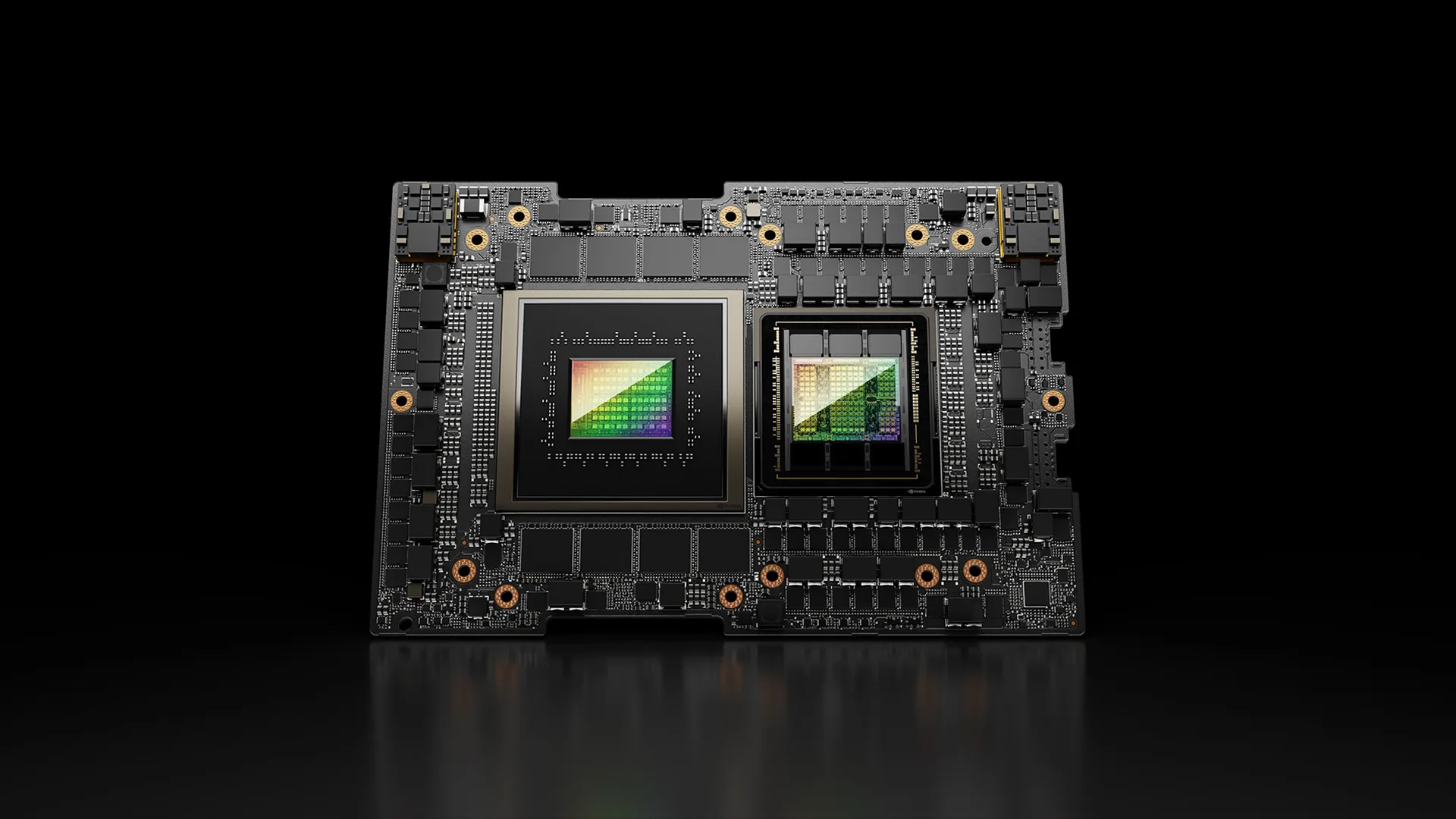
NVIDIA has announced that nine new supercomputers worldwide are using NVIDIA Grace Hopper Superchips to speed up scientific research and discovery. These systems, including EXA1-HE in France and Alps in Switzerland, deliver 200 exaflops of energy-efficient AI processing power. The French Alternative Energies and Atomic Energy Commission (CEA) and Eviden, an Atos Group company, have delivered the EXA1-HE supercomputer, which uses Eviden’s BullSequana XH3000 technology. Ian Buck, vice president of hyperscale and HPC at NVIDIA, highlighted the role of AI in accelerating research into climate change and drug discovery.
NVIDIA’s Grace Hopper Superchips Powering a New Generation of AI Supercomputers
NVIDIA, a prominent player in the high-performance computing industry, has announced a significant shift towards AI-powered systems. The company has revealed that nine new supercomputers across the globe are now utilizing NVIDIA’s Grace Hopper™ Superchips to expedite scientific research and discovery. These systems collectively provide 200 exaflops, equivalent to 200 quintillion calculations per second, of energy-efficient AI processing power.
The new Grace Hopper-based supercomputers include EXA1-HE in France, Helios in Poland, Alps in Switzerland, JUPITER in Germany, DeltaAI in the United States, and Miyabi in Japan. These supercomputers are expected to significantly accelerate research in various fields, including climate change and drug discovery, while also promoting better energy efficiency.
The Role of Grace Hopper Superchips in the EXA1-HE Supercomputer
The EXA1-HE supercomputer, a collaboration between CEA (the French Alternative Energies and Atomic Energy Commission) and Eviden (an Atos Group company), is one of the new systems powered by Grace Hopper. The supercomputer is based on Eviden’s BullSequana XH3000 technology, which features a patented warm-water cooling system. The EXA1-HE is equipped with 477 compute nodes based on Grace Hopper, which is expected to enhance its performance and efficiency.
The Emergence of Sovereign AI and the Global Impact of Grace Hopper Supercomputers
The global drive to build new, more efficient, AI-based supercomputers is gaining momentum as countries recognize the strategic and cultural significance of sovereign AI. This concept involves investing in domestically owned and hosted data, infrastructure, and workforces to stimulate innovation.
The NVIDIA Grace CPU and NVIDIA Hopper™ GPU architectures, connected via NVIDIA NVLink®-C2C interconnect technology, form the core of the GH200, which powers scientific supercomputing centers worldwide. Many of these centers are planning to transition from system installation to actual scientific research in a matter of months rather than years.
Isambard-AI: A Case Study of Grace Hopper Supercomputer
Isambard-AI, a project at the University of Bristol in the U.K., serves as a prime example of the capabilities of Grace Hopper-powered supercomputers. The first phase of Isambard-AI involves an HPE Cray EX2500 supercomputer equipped with 168 NVIDIA GH200 Superchips, making it one of the most efficient supercomputers ever built. The arrival of an additional 5,280 NVIDIA Grace Hopper Superchips this summer is expected to boost the system’s performance by approximately 32 times.
The Isambard-AI project is positioning the U.K. as a global leader in AI and is expected to stimulate open science innovation both domestically and internationally. The project was delivered in record time, and upon completion, it is anticipated to significantly enhance performance in data analytics, drug discovery, climate research, and many other areas.
External Link: Click Here For More


