

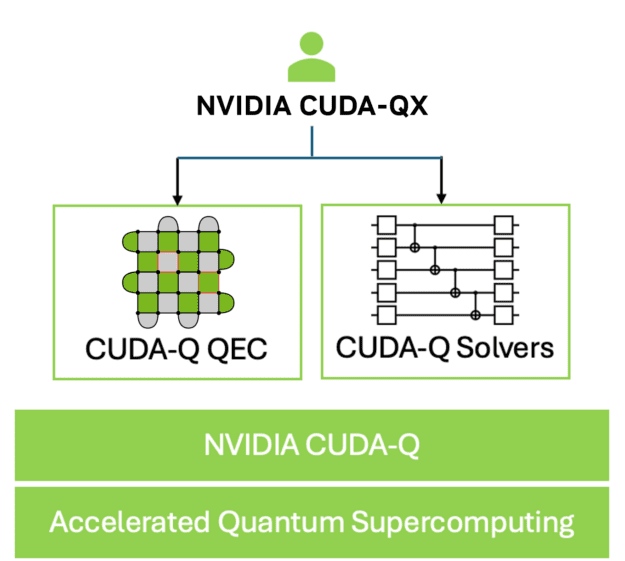
Researchers have made a breakthrough in simulating complex quantum systems, paving the way for faster and more efficient chemistry and materials science calculations. The innovation comes from NVIDIA’s CUDA-Q Solvers library, which accelerates applications like ADAPT-VQE, a method for finding molecules’ ground state energy.
This is crucial for understanding chemical reactions and designing new materials. By leveraging NVIDIA GPUs, scientists can perform these calculations up to 4.5 times faster. The ADAPT-VQE procedure iteratively builds an ansatz from an operator pool to converge on a ground state energy. With CUDA-Q Solvers, researchers can easily use and accelerate this method.
This technology can potentially revolutionize fields like quantum chemistry and materials science by enabling faster and more accurate simulations. NVIDIA’s CUDA-QX libraries, including CUDA-Q Solvers and CUDA-Q QEC, are at the forefront of this innovation, providing highly optimized tools for hybrid quantum-classical applications.
An Article by Nvidia highlights the flexibility of CUDA-Q Solvers in improving active space computations using different orbitals. Specifically, it focuses on the Adaptive Derivative-Assembled Pseudo-Trotter VQE (ADAPT-VQE) solver technique, which iteratively builds an ansatz from a predefined operator pool to efficiently converge to predict the ground state energy.
Nvidia illustrates the workflow of ADAPT-VQE, showing how the ansatz is built iteratively from an operator pool. The article provides a step-by-step guide on how to implement ADAPT-VQE using CUDA-Q Solvers, including extracting the number of electrons and qubits from a molecule, defining the operator pool, and preparing an initial Hartree-Fock state.
CUDA-Q Solvers accelerates the gradient computation in the 16-qubit nitrogen molecule simulation by 4.5x. This acceleration is achieved without substantial code modifications, demonstrating the power of CUDA-Q Solvers in emulating parallel computation across multiple QPUs.
The article also highlights the ease of use and flexibility of CUDA-Q Solvers, which can be used with different ansatzes, such as UCCSD and GSD. Additionally, it provides information on how to get started with CUDA-QX libraries, including installation instructions and documentation for CUDA-Q Solvers and CUDA-Q QEC.
External Link: Click Here For More


