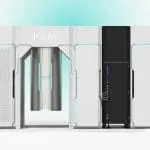
NVIDIA is accelerating quantum computing efforts at supercomputing centers in Germany, Japan, and Poland using its open-source NVIDIA CUDA-Q platform. Germany’s Jülich Supercomputing Centre is installing a Quantum Processing Unit (QPU) built by IQM Quantum Computers, while Japan’s National Institute of Advanced Industrial Science and Technology will add a QPU from QuEra to its supercomputer. Poland’s Poznan Supercomputing and Networking Center has installed two photonic QPUs built by ORCA Computing. The QPUs, the brains of quantum computers, have the potential to make certain types of calculations faster.
NVIDIA’s Quantum Computing Efforts: A Global Perspective
NVIDIA, a prominent player in the field of technology, has announced its plans to boost quantum computing research at national supercomputing centers worldwide. This initiative will be powered by the open-source NVIDIA CUDA-Q™ platform. Supercomputing sites in Germany, Japan, and Poland will utilize this platform to enhance the quantum processing units (QPUs) within their NVIDIA-accelerated high-performance computing systems.
QPUs, the core computational components of quantum computers, leverage the behavior of particles such as electrons or photons to perform calculations in a manner distinct from traditional processors. This unique approach holds the potential to expedite certain types of calculations.
Quantum Computing in Germany, Japan, and Poland
In Germany, the Jülich Supercomputing Centre (JSC) at Forschungszentrum Jülich is integrating a QPU developed by IQM Quantum Computers into its JUPITER supercomputer, which is powered by the NVIDIA GH200 Grace Hopper™ Superchip.
In Japan, the National Institute of Advanced Industrial Science and Technology (AIST) houses the ABCI-Q supercomputer, designed to propel the nation’s quantum computing initiative. This system, powered by the NVIDIA Hopper™ architecture, will incorporate a QPU from QuEra.
Meanwhile, in Poland, the Poznan Supercomputing and Networking Center (PSNC) has recently installed two photonic QPUs, constructed by ORCA Computing, into a new supercomputer partition accelerated by NVIDIA Hopper.
Quantum Computing Applications in AI, Energy, and Biology
The integration of QPUs into these supercomputers will enable researchers to explore a variety of applications. For instance, the QPU integrated with ABCI-Q will allow AIST researchers to investigate quantum applications in AI, energy, and biology. These applications will utilize Rubidium atoms, controlled by laser light as qubits, to perform calculations.
Similarly, PSNC’s QPUs will facilitate research into biology, chemistry, and machine learning with two PT-1 quantum photonics systems. These systems use single photons, or packets of light, at telecom frequencies as qubits, enabling a distributed, scalable, and modular quantum architecture using standard telecom components.
Quantum Computing and Supercomputing: A Powerful Combination
The integration of quantum computers with supercomputers, as facilitated by CUDA-Q, also enables quantum computing with AI to address challenges such as noisy qubits and the development of efficient algorithms.
CUDA-Q is an open-source and QPU-agnostic quantum-classical accelerated supercomputing platform. It is widely used by companies deploying QPUs and is known for delivering top-tier performance.
In conclusion, NVIDIA’s efforts to accelerate quantum computing research at supercomputing centers worldwide represent a significant step forward in the field of quantum computing. By integrating QPUs into high-performance computing systems, researchers can explore a wide range of applications and push the boundaries of scientific discovery.
External Link: Click Here For More