

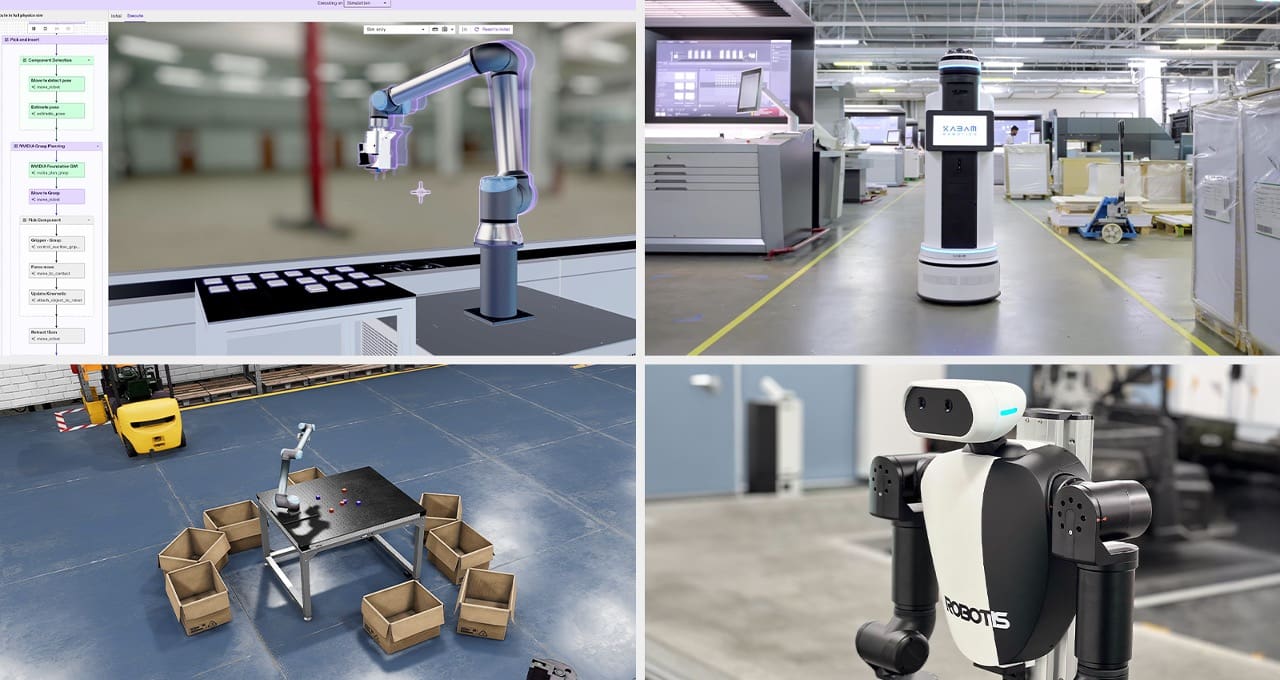
NVIDIA and the Open Source Robotics Alliance (OSRA) are pioneering GPU-aware ROS 2 for accelerated robotics development. Announced at this year’s ROSCon conference in Singapore, this collaboration advances open standards and aims to accelerate innovation in the rapidly evolving field of robotics. NVIDIA is contributing key abstractions directly to ROS 2, enabling efficient management of diverse processors and ensuring consistent, high-speed performance across the ROS ecosystem. This commitment, alongside the open-sourcing of Greenwave Monitor and new robotics software, underscores NVIDIA’s dedication to providing the open-source community with a robust platform for building the future of physical AI.
Advancing Robotics with GPU Acceleration and Open Standards
This year’s ROSCon conference in Singapore highlights advancements in robotics driven by GPU acceleration and open standards, with NVIDIA announcing key collaborations and software releases. The company is actively supporting the Open Source Robotics Alliance (OSRA), specifically its new Physical AI Special Interest Group, focused on real-time control and accelerated AI processing for robotics applications. These efforts aim to establish ROS 2 as the leading open, high-performance framework for building robots in real-world scenarios, according to the conference announcements.
NVIDIA is contributing GPU-aware abstractions directly to ROS 2, enabling the framework to efficiently manage diverse processors, from CPUs to integrated and discrete GPUs. This integration ensures consistent, high-speed performance and future-proofs the ROS ecosystem, allowing it to adapt to rapid hardware innovations. Building on this, NVIDIA has also open-sourced Greenwave Monitor, a tool designed to help developers quickly identify and resolve performance bottlenecks, accelerating the robot development process.
Furthermore, NVIDIA Isaac ROS 4.0,a collection of ROS-compatible, GPU-accelerated libraries and AI models, is now available on the NVIDIA Jetson Thor platform for deploying physical AI and robotics. AgileX Robotics is utilizing NVIDIA Jetson modules and Isaac Sim for AI autonomy, vision, and simulation, while Canonical is simplifying development with a fully open observability stack for ROS 2 devices on Ubuntu, available for the NVIDIA Jetson AGX Thor platform. Ekumen has also integrated NVIDIA Isaac Sim into its workflows, enabling high-fidelity simulations.
NVIDIA and ROS 2: Powering the Future of Robotics
NVIDIA is expanding the capabilities of ROS 2 with new tools designed to streamline robot development and improve performance. The company announced the open-sourcing of Greenwave Monitor, a tool enabling developers to quickly identify performance bottlenecks within their robotic systems. This allows for accelerated robot development cycles and more reliable deployments in real-world applications, according to the company. By pinpointing areas for optimization, developers can enhance efficiency and responsiveness across various robotic platforms.
Building on this, NVIDIA Isaac ROS 4.0 is now available on the NVIDIA Jetson Thor platform, providing a collection of ROS-compatible, GPU-accelerated libraries and AI models. Developers can leverage CUDA-accelerated libraries, AI models, and workflows specifically designed for robot manipulation and mobility tasks. This integration aims to simplify the deployment of physical AI and robotics solutions, allowing for more complex and sophisticated robotic behaviors. Canonical is also contributing by offering a demo of a fully open observability stack for ROS 2 devices on Ubuntu, further enhancing the developer experience on the NVIDIA Jetson AGX Thor platform.
AgileX Robotics is already utilizing NVIDIA Jetson modules to power the AI autonomy and vision systems in its mobile robots. Furthermore, the company is employing NVIDIA Isaac Sim, an open-source robotic simulation framework built on NVIDIA Omniverse, for robust simulation testing. Ekumen has integrated NVIDIA Isaac Sim into its robotics development workflows, enabling high-fidelity simulations for improved accuracy and reliability. These collaborations demonstrate the growing ecosystem around NVIDIA’s ROS 2 integrations and the potential for accelerated innovation in the field of robotics.
By integrating GPU-aware abstractions directly into ROS 2, NVIDIA and the Open Source Robotics Alliance are fostering a more adaptable and high-performance robotics framework. This development could enable developers to rapidly deploy advanced AI capabilities on diverse hardware, accelerating innovation across applications. For industries relying on robotic systems, this represents a significant step toward more efficient, reliable, and intelligent automation solutions. Moreover, tools like Greenwave Monitor will empower developers to optimize performance, building increasingly sophisticated robotic platforms with greater ease and speed.


