Researchers from Princeton University, University of California Santa Barbara, University of Basel, and ETH Zurich have discovered new applications for nitrogen vacancy (NV) centre quantum sensors in condensed matter physics. These sensors, which offer nanoscale resolution across a wide range of temperatures, have been used to measure static magnetic fields in condensed matter systems.
NV centres can probe beyond average magnetic fields, enabling high precision noise sensing in diverse systems. They offer several advantages over other nanoscale probes, including the ability to probe both static and dynamic properties in a momentum and frequency-resolved way.
What are the New Opportunities in Condensed Matter Physics for Nanoscale Quantum Sensors?
Condensed matter physics is a field that studies the physical properties of condensed phases of matter, such as solids and liquids. Recently, researchers from Princeton University, University of California Santa Barbara, University of Basel, and ETH Zurich have discovered new opportunities in this field for nanoscale quantum sensors, specifically nitrogen vacancy (NV) centre quantum sensors. These sensors offer unique advantages in studying condensed matter systems due to their quantitative, noninvasive, physically robust nature, and their ability to offer nanoscale resolution across a wide range of temperatures.
NV centre quantum sensors have been used in recent years to obtain nanoscale resolution measurements of static magnetic fields arising from spin order and current flow in condensed matter systems. Compared to other nanoscale magnetic field sensors, NV centres have the unique advantage of being able to probe quantities that go beyond average magnetic fields. By leveraging techniques from magnetic resonance, NV centres can perform high precision noise sensing and have given access to diverse systems such as fluctuating electrical currents in simple metals and graphene, as well as magnetic dynamics in yttrium iron garnet.
How do NV Centre Quantum Sensors Work?
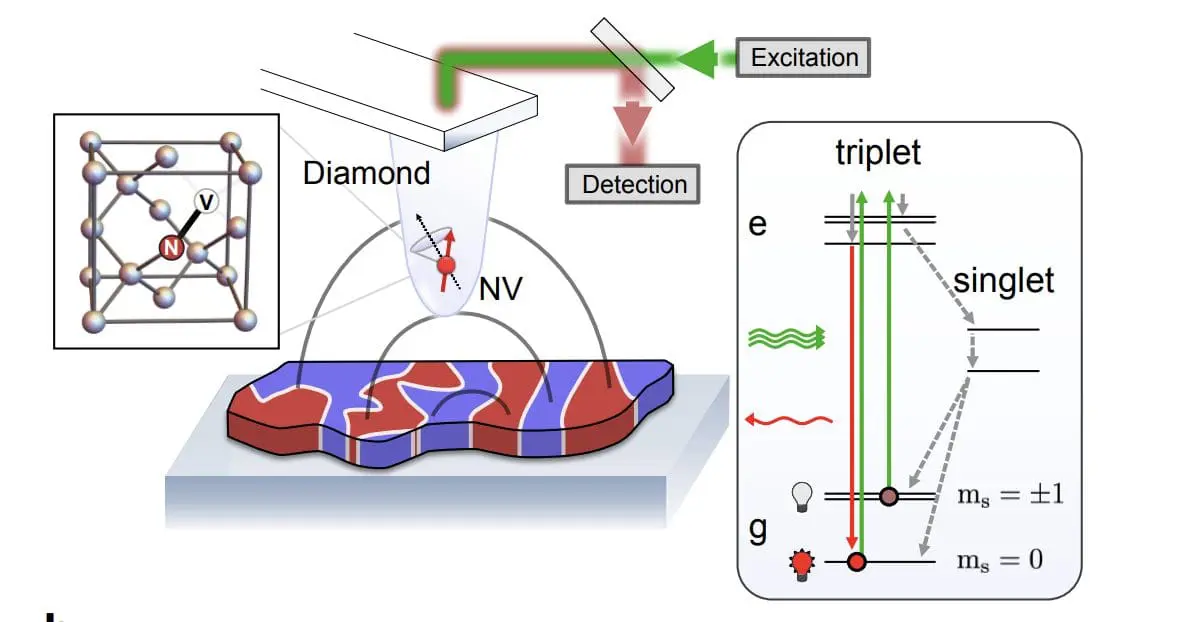
An NV centre is an optically addressable qubit that can sense its environment with extremely high spatial resolution. The spatial resolution is determined by the offset between the NV centre and the material of interest, typically ranging from 5 to 100 nm, and is ultimately limited by the extent of the electronic wave function, which is around 1 nm. Because the NV centre offers both local resolution and the entire suite of qubit manipulation techniques developed in the context of nuclear magnetic resonance, it enables a host of new local sensing technologies.
For example, static magnetic fields shift the qubit splitting, the noise spectral density at the qubit transition frequency can change the qubit’s T1-time, and dynamic structure like the spatiotemporal correlations of the noise in an underlying sample can be detected in a coherent T2-limited measurement of multiple NV centres. The momentum resolution of an NV centre comes from changing its distance from the sample or using an ensemble of NV centres at different distances.
What are the Advantages of NV Centre Quantum Sensors?
NV centre quantum sensors have several advantages over other nanoscale probes. For instance, scanning-tunneling microscopy measures the local electronic density of states, scanning SQUID microscopy measures local magnetic fields, and microwave impedance microscopy measures local conductivity and permittivity. While these probes have led to immense advances in our understanding of materials’ electronic structure and correlated phases, their modes of operation can restrict the available parameter space for the material under investigation, for example, to low temperatures. It is also difficult to gain access to local magnetic field textures and dynamics with these probes.
In contrast, NV centres in diamond have emerged as a new class of nanoscale sensor that complements these technologies in their temperature range and in their ability to probe both static and dynamic properties in a momentum and frequency-resolved way. Furthermore, while neutron scattering averages over the bulk of the material, NV centres enable real-space probing with nanoscale resolution, giving access to spatially inhomogeneous momentum information.
What are the Potential Applications of NV Centre Quantum Sensors?
The current noise that an NV centre detects can also be sensitive to transverse current fluctuations and can therefore pick up the response of the electron fluid to being sheared. This shear response is a key diagnostic of Wigner crystallization, as well as a natural probe of viscous hydrodynamic behavior. Thus, NV centres offer a new suite of tools for condensed matter experiment, including many tools that are only just being developed.
NV centres have been employed to measure the momentum-dependent density response, from which one can extract the behavior of longitudinal currents, but not transverse ones. The ability to measure transverse current fluctuations could open up new avenues for research and applications in condensed matter physics.
Conclusion
In conclusion, NV centre quantum sensors provide unique opportunities in studying condensed matter systems. They are quantitative, noninvasive, physically robust, offer nanoscale resolution, and may be used across a wide range of temperatures. These properties have been exploited in recent years to obtain nanoscale resolution measurements of static magnetic fields arising from spin order and current flow in condensed matter systems. With their unique advantages and potential applications, NV centre quantum sensors are poised to revolutionize the field of condensed matter physics.
sensors”
Publication Date: 2024-03-20
Authors: Jared Rovny, Sarang Gopalakrishnan, Ania Jayich, Patrick Maletinsky, et al.
Source: arXiv (Cornell University)
DOI: https://doi.org/10.48550/arxiv.2403.13710