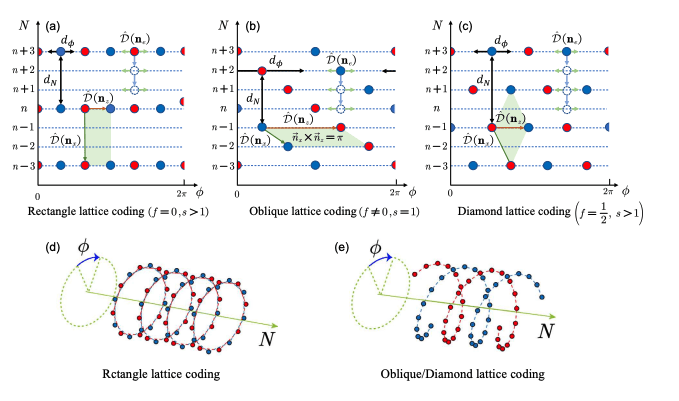
Bosonic systems represent a promising avenue for quantum information processing, offering a substantial advantage through the large computational space inherent in a single bosonic mode. Dong-Long Hu, alongside colleagues at the University of Science and Technology of China, now presents a unified framework for encoding quantum information that exploits the combined symmetries of both number and phase variables within a bosonic mode. This research moves beyond previous limitations by creating lattice-based codes, rectangular, oblique, and diamond-shaped, within the number-phase space, and importantly, demonstrates that oblique and diamond codes exhibit a unique “number-phase vortex effect”. This effect allows for efficient error detection via phase measurements, resulting in codes that significantly outperform conventional approaches against dephasing noise, and ultimately paving the way for more robust fault-tolerant computation and extended communication ranges in bosonic quantum systems.
Bosonic systems offer unique advantages for quantum error correction, as a single bosonic mode provides a large space to redundantly encode quantum information. This work introduces a unified framework for encoding a qubit, utilizing the symmetries present in the phase space of number and phase variables of a bosonic mode. The resulting logical codewords form lattice structures in the number-phase space, giving rise to rectangular, oblique, and diamond-shaped lattice codes. Notably, oblique and diamond codes exhibit a number-phase vortex effect, where shifts in the number of photons induce discrete rotations in the phase, which can be cleverly used as indicators of errors, allowing for efficient error detection through phase measurements.
Number-Phase Encoding with Bosonic Codes
Researchers have developed a novel approach to encoding quantum information using the properties of light, specifically leveraging the number and phase of photons within a single mode of light, a bosonic system. This method utilizes the full number-phase space to create more robust codes, moving beyond techniques that focus solely on the quadrature phase. The core innovation lies in constructing logical codewords that form distinct lattice structures, rectangular, oblique, and diamond-shaped, within this number-phase space, offering a wider range of possibilities for error correction. A particularly significant aspect of this work is the discovery of a “number-phase vortex effect” exhibited by the oblique and diamond-shaped codes, where shifts in the number of photons induce discrete rotations in the phase, enabling efficient error detection through phase measurements.
This represents a departure from conventional error correction schemes, offering a new pathway for identifying and correcting errors in quantum systems. To implement this approach, researchers devised a method to interface these generalized number-phase codes with rotation-symmetric codes, effectively preparing the system for error readout. This interface capitalizes on the unique properties of the number-phase vortex effect, enabling the identification of errors characterized by phase rotations. The team then proposed a standard procedure for removing errors, utilizing the vortex effect to translate number shifts into detectable phase rotations, thereby enabling quantum error correction. Furthermore, the researchers demonstrated a practical implementation of this error correction process, showcasing how it can be integrated into a quantum circuit, leveraging the number-phase vortex effect to correct errors in oblique codes, even when traditional number-parity measurements are ineffective. This advancement opens up possibilities for extending the range and reliability of quantum communication and computation by providing a more resilient framework for encoding and protecting quantum information.
D-NP Code Performance and Bosonic Correction
This research investigates the performance of a specific type of bosonic code, known as the D-NP code, and explores ways to improve its resilience to noise in realistic experimental settings. The team goes beyond theoretical analysis to consider the impact of actual hardware limitations, explicitly modeling the effects of transmon dissipation and photon loss. They also account for imperfections in the quantum gates used to implement the error correction. The research aims to achieve performance beyond the break-even point, where the error correction actually reduces the error rate, using metrics like average infidelity to quantify the performance of the scheme and comparing different types of phase measurements. To mitigate errors, the researchers suggest encoding the transmon in a higher excited state and emphasize the need for developing fault-tolerant quantum error correction schemes. This work moves beyond purely theoretical research by addressing the practical challenges of implementing these codes in real-world experiments, contributing to the growing field of bosonic quantum error correction, which offers advantages over qubit-based approaches in certain scenarios, and highlighting the importance of designing schemes tailored to the specific characteristics of the hardware being used.
Number-Phase Codes Enable Robust Bosonic Qubits
This research introduces a new framework for encoding quantum information using bosonic systems, leveraging symmetries within the number and phase variables of a single mode. By structuring logical codewords into lattice formations within the number-phase space, they can create codes, rectangular, oblique, and diamond-shaped, with improved performance against dephasing noise. Notably, the oblique and diamond codes exhibit a unique “number-phase vortex effect”, where shifts in the number of bosons induce predictable phase rotations, offering a novel method for error detection through phase measurements. These generalized number-phase codes represent a significant step towards more robust quantum communication and computation with bosonic systems, outperforming conventional methods in resisting dephasing noise. While the current work focuses on theoretical development and demonstration of the framework, the authors acknowledge that practical implementation requires further experimental validation, with future research directions including exploring hybrid encoding strategies and applying these codes to complex quantum networks.
👉 More information
🗞 Generalized Number-Phase Lattice Encoding of a Bosonic Mode for Quantum Error Correction
🧠 ArXiv: https://arxiv.org/abs/2508.12354