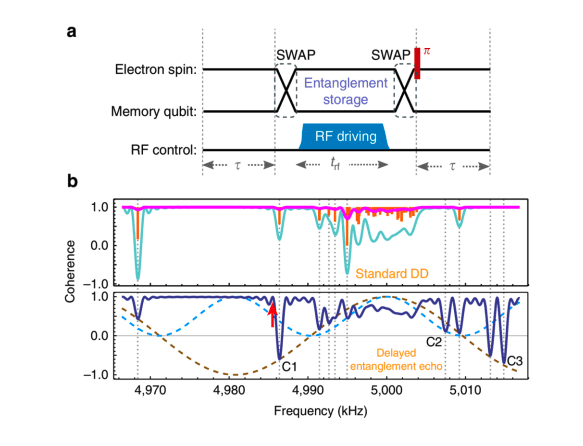
Nitrogen-vacancy (NV) centres in diamond represent a promising technology for increasingly sensitive quantum sensors, with applications ranging from medical imaging to materials science. Jonathan Kenny, Feifei Zhou, and Ruihua He, all from Nanyang Technological University, alongside colleagues including Fedor Jelezko from Ulm University and Weibo Gao, now demonstrate a significant step forward in harnessing these sensors by utilising a ‘nuclear spin register’. This innovative approach protects the delicate quantum state of the NV centre from environmental noise, effectively extending its coherence and boosting sensitivity, a crucial factor limiting current performance. By leveraging the naturally occurring pairing of electron and nuclear spins, the team achieves enhanced coherence times, paving the way for more precise measurements and unlocking the full potential of NV centre-based quantum sensing
Diamond and hBN for nanoscale quantum sensing
This document details research into utilizing defects in diamond (Nitrogen-Vacancy or NV centers) and, increasingly, hexagonal boron nitride (hBN) as quantum sensors, with a focus on enhancing sensitivity and expanding applications. The research explores how these materials can be harnessed for increasingly precise measurements at the nanoscale. NV centers exhibit exceptional sensitivity to magnetic fields, electric fields, temperature, and strain at the nanoscale, making them ideal for diverse sensing applications. Researchers have achieved remarkable control over the electron and nuclear spins associated with NV centers, enabling precise manipulation and readout of quantum states. This control stems from the unique electronic structure of the NV center, where a nitrogen atom replaces a carbon atom adjacent to a vacancy in the diamond lattice, creating a spin-1 defect with a zero-field splitting that allows for optical initialization and readout of its spin state.
A major focus involves leveraging nuclear spins to enhance sensing capabilities, including utilizing them as quantum memories to extend coherence times and improve measurement precision, driving them with dynamic nuclear polarization to enhance signal strength and sensitivity, creating registers for quantum information processing and sensing, and utilizing interactions between multiple spins to improve sensitivity and spatial resolution. The principle behind using nuclear spins as quantum memories relies on their relatively long coherence times compared to electron spins, effectively shielding the quantum information from environmental noise. Dynamic nuclear polarization, achieved through microwave irradiation, aligns the nuclear spins, increasing the signal-to-noise ratio in sensing measurements. Potential applications include high-resolution magnetic field mapping, crucial for materials science and biomedical imaging, detecting electric fields with applications in neuroscience and microelectronics, precise temperature measurement for nanoscale thermometry, developing solid-state gyroscopes for navigation, utilizing NV centers as qubits for quantum information processing, detecting and analyzing radio frequency signals with a quantum RF spectrum analyzer, and exploring biological systems at the nanoscale, offering unprecedented insights into cellular processes.
hBN is gaining traction as an alternative to diamond, offering unique advantages like a wider range of potential defects and different symmetry properties. Unlike diamond, hBN is a layered material, allowing for the creation of point defects and edge defects with varying properties. These defects, similar to NV centers, can exhibit spin-dependent optical transitions, making them suitable for quantum sensing. The different symmetry of hBN also influences the interaction between the defects and their environment, potentially leading to enhanced sensitivity to specific stimuli. Research focuses on achieving coherent control and utilizing nuclear spins for sensing within hBN defects, mirroring the advancements made with NV centers in diamond. The exploration of hBN expands the possibilities for tailoring quantum sensors to specific applications, leveraging its unique material properties.
A major challenge is extending the coherence times of nuclear spins, crucial for high-precision sensing. Environmental noise, including fluctuations in electromagnetic fields and mechanical vibrations, causes decoherence, limiting the duration of quantum information storage. Researchers are exploring techniques to mitigate decoherence, including applying pulse sequences with dynamic decoupling to suppress noise and implementing error correction protocols to protect quantum information. Dynamic decoupling employs a series of precisely timed pulses to refocus the nuclear spins, effectively cancelling out the effects of low-frequency noise. Error correction protocols, inspired by classical coding theory, introduce redundancy to protect quantum information from errors. Developing methods to address and control large numbers of nuclear spins is essential to create more complex and powerful sensors, requiring sophisticated control electronics and algorithms. Remote sensing, detecting and controlling spins at a distance from the NV center, expands the sensing range, enabling the investigation of larger volumes. Achieving atomic-scale resolution in imaging nuclear spin clusters is a key goal, demanding advanced microscopy techniques. Utilizing quantum entanglement and other quantum phenomena aims to surpass classical limits in sensing precision, potentially unlocking entirely new sensing modalities. Hyperpolarization techniques enhance the polarization of nuclear spins, boosting signal strength and improving sensitivity.
Developing methods to create NV centers and hBN defects at specific locations with high precision is also a priority. Current fabrication techniques often rely on statistical processes, resulting in a low density of defects at desired locations. Focused ion beam implantation, electron beam lithography, and advanced growth techniques are being explored to achieve deterministic defect creation. Precise control over defect placement is crucial for creating complex sensor arrays and integrating quantum sensors with other nanoscale devices. This requires a multidisciplinary approach, combining materials science, nanofabrication, and quantum control expertise.
Solid-state gyroscopes based on NV centers could revolutionize navigation systems, offering improved accuracy, stability, and resistance to jamming. Traditional gyroscopes rely on mechanical components, making them susceptible to vibrations and electromagnetic interference. NV-center-based gyroscopes utilize the sensitivity of NV centers to magnetic fields to measure rotation, offering a more robust and precise solution. Quantum sensors could be used for secure communication protocols, leveraging the principles of quantum key distribution to encrypt and transmit information with unparalleled security. Quantum RF spectrum analyzers could provide enhanced capabilities for detecting and analyzing radio frequency signals, enabling the identification of weak signals and the detection of interference. These analyzers could be used for applications ranging from wireless communication to radar systems. Quantum sensors could also be used for non-destructive characterization of materials at the nanoscale, providing insights into their structure, composition, and properties without damaging them.
In conclusion, this research demonstrates the immense potential of NV centers in diamond and emerging platforms like hBN as powerful quantum sensors. Ongoing advancements in spin control, coherence enhancement, and scaling up sensing capabilities are paving the way for a new generation of sensors with unprecedented sensitivity and resolution, with significant implications for a wide range of scientific, technological, and military applications. The continued development of these technologies promises to unlock new possibilities in fields ranging from materials science and biomedicine to navigation and secure communication, establishing quantum sensing as a cornerstone of future technological innovation.
👉 More information
🗞 Quantum Sensing Enhancement through a Nuclear Spin Register in Nitrogen-Vacancy Centers in Diamond
🧠 DOI: https://doi.org/10.48550/arXiv.2507.14563