

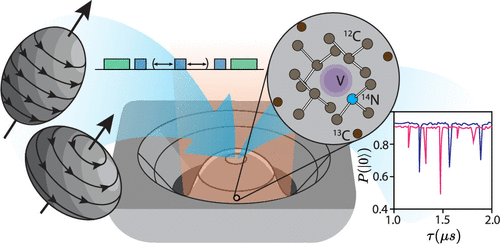
Nuclear Quadrupole Resonance (NQR) spectroscopy has long been a valuable tool for studying chemical bonding patterns in materials and molecules. However, its limitations have hindered researchers from exploring individual nuclei and molecule-to-molecule variations. The advent of quantum sensors based on optically active defects in semiconductors has revolutionized this field, enabling the detection and control of individual nuclei at room temperature.
This breakthrough has opened up new possibilities for studying molecular structures, thermometry, pharmaceutical analysis, and security applications, with significant implications for our understanding of molecular structures and chemical bonding patterns.
What is Nuclear Quadrupole Resonance (NQR) Spectroscopy?
Nuclear Quadrupole Resonance (NQR) spectroscopy is a technique used to study the chemical bonding patterns in materials and molecules. It reveals the unique coupling between nuclear spins and local fields, which provides valuable information about the molecular structure. However, traditional NQR techniques require macroscopic ensembles of nuclei to yield a detectable signal, making it difficult to study individual molecules and obscuring molecule-to-molecule variations due to local perturbations or deformations.
The technique relies on the interaction between nuclear electric quadrupole moments and local electric field gradients. This interaction is sensitive to the chemical bonds and molecular structure, allowing researchers to identify and characterize molecules and bulk materials. NQR spectroscopy has been widely applied in various fields, including security for explosive and drug detection, pharmaceutical analysis of powders, and thermometry.
Despite its potential, traditional NQR techniques have limitations. The small magnetic signal generated by each nucleus makes it challenging to detect individual nuclei, limiting the study to macroscopic samples containing large nuclear ensembles. However, with the advent of quantum sensors based on optically active defects in semiconductors, researchers can now explore new possibilities for NQR spectroscopy.
What are Quantum Sensors and How Do They Work?
Quantum sensors are devices that utilize the unique properties of quantum systems to detect and manipulate individual nuclei. One such sensor is the nitrogen-vacancy (NV) center in diamond, which is an optically active electronic spin qubit. The NV center can facilitate the detection and control of individual nuclei through their local magnetic couplings.
The NV center works by exploiting the interaction
The NV center works by exploiting the interaction between the nuclear spins of the associated nitrogen-14 (14N) nuclei and the local magnetic fields generated by the NV center itself. This interaction allows researchers to perform NQR spectroscopy on individual 14N nuclei at room temperature, which is a significant advancement over traditional NQR techniques.
The use of quantum sensors like the NV center opens up new possibilities for studying molecule-to-molecule variations and dynamical changes due to local fields and structural changes. Researchers can now explore the properties of individual molecules and bulk materials with unprecedented precision, shedding light on complex phenomena such as protein folding and drug-target interactions.
How Does NQR Spectroscopy Work?
NQR spectroscopy relies on the interaction between nuclear electric quadrupole moments and local electric field gradients. This interaction is sensitive to the chemical bonds and molecular structure, allowing researchers to identify and characterize molecules and bulk materials.
The technique involves mapping the nuclear quadrupolar Hamiltonian, which describes the energy levels of the 14N nuclei in the presence of external magnetic fields. By resolving minute variations between individual nuclei, researchers can gain insights into the molecular structure and chemical bonding patterns.
In addition to studying individual nuclei, NQR spectroscopy also reveals correlations between the parameters in the NV centers’ electronic spin Hamiltonian and the 14N quadrupolar Hamiltonian. This correlation is a previously unreported phenomenon that highlights the complex interplay between nuclear spins and local magnetic fields.
What are the Implications of NQR Spectroscopy?
The implications of NQR spectroscopy are far-reaching, with potential applications in various fields. The ability to study individual molecules and bulk materials with unprecedented precision can lead to breakthroughs in understanding complex phenomena such as protein folding and drug-target interactions.
NQR spectroscopy also has the potential to revolutionize the field of security by enabling the detection of explosives and drugs at the molecular level. Furthermore, the technique can be used to analyze pharmaceutical powders and thermometry, providing valuable insights into material properties.
The use of quantum sensors like the NV
The use of quantum sensors like the NV center in diamond also opens up new possibilities for studying molecule-to-molecule variations and dynamical changes due to local fields and structural changes. This can lead to a deeper understanding of complex phenomena such as protein folding and drug-target interactions.
What are the Key Challenges and Limitations?
Despite its potential, NQR spectroscopy faces several challenges and limitations. The small magnetic signal generated by each nucleus makes it challenging to detect individual nuclei, limiting the study to macroscopic samples containing large nuclear ensembles.
Furthermore, the technique requires highly sensitive detection methods, which can be difficult to achieve with current technology. Additionally, the use of quantum sensors like the NV center in diamond is still in its early stages, and further research is needed to fully exploit its potential.
What are the Future Directions?
The future directions for NQR spectroscopy are exciting and promising. With the advent of new quantum sensors and detection methods, researchers can now explore new possibilities for studying molecule-to-molecule variations and dynamical changes due to local fields and structural changes.
Furthermore, the technique has the potential to revolutionize various fields, including security, pharmaceutical analysis, and thermometry. As research continues to advance, we can expect to see significant breakthroughs in understanding complex phenomena such as protein folding and drug-target interactions.
NQR spectroscopy also opens up new possibilities for studying individual molecules and bulk materials with unprecedented precision. This can lead to a deeper understanding of material properties and behavior, which is essential for developing new technologies and materials.
Publication Date: 2024-12-12
Authors: S. Alex Breitweiser, Mathieu Ouellet, Tzu-Yung Huang, T. H. Taminiau, et al.
Source: Nano Letters
DOI: https://doi.org/10.1021/acs.nanolett.4c04112


