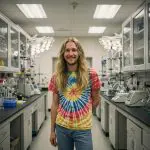

Nu Quantum has today, February 10th, 2026, opened the UK’s – and Europe’s – first dedicated industrial R&D facility for distributed quantum computing with trapped ions in Cambridge, effectively doubling the company’s research capacity. This state-of-the-art laboratory will focus on scaling quantum computing by interconnecting individual processors into a modular network, utilizing Nu Quantum’s world-leading Qubit-Photon Interface (QPI) technology. “The opening of our new laboratory is a huge milestone as it constitutes the first dedicated industrial R&D facility for trapped-ion distributed quantum computing in the UK and Europe,” said Dr. Carmen Palacios-Berraquero, Founder and CEO of Nu Quantum. The expansion, following a recent $60 million Series A funding round, signals a new period of growth and aims to push the performance of remote entanglement links beyond current limitations.
Nu Quantum Opens UK’s First Trapped-Ion R&D Facility
Located in Cambridge, the new laboratory will effectively double the company’s research capacity, accelerating development of scalable quantum systems. This expansion isn’t simply about more space; it’s about addressing a fundamental challenge in quantum computing – how to connect individual processors into a powerful, unified network. Nu Quantum’s approach centers on its Qubit-Photon Interface (QPI) technology, designed to interconnect quantum processors via a photonic network.
These interfaces, built with optical microcavity technology and custom ion traps, aim to establish high-performance entanglement links between qubits across different nodes. “After years of R&D achieving unprecedented cavity performance for fast, efficient quantum networking, we are now preparing to test one of our core technologies in-house with trapped-ion qubits,” said Dr. Claire Le Gall, VP Technology at Nu Quantum. The facility will house a multi-node networking testbed to prove the QPI’s capabilities with trapped-ions, but the architecture is adaptable to other quantum modalities, demonstrated by prior work with neutral atom qubits in 2024.
The laboratory will also benefit from collaborations with the UK’s National Quantum Computing Centre, the University of Sussex, the University of Cambridge, Cisco, and Infineon Technologies. This state-of-the-art laboratory will accelerate our roadmap to enabling interconnected quantum computing architectures,” said Dr. Professor Matthias Keller at University of Sussex added, “The opening of Nu Quantum’s Networking Testbed Lab in Cambridge is yet another sign that Nu Quantum is pushing the frontier of quantum networking.”
Qubit-Photon Interface Technology Enables Distributed Quantum Computing
Currently, scaling quantum computing power relies heavily on increasing the number of qubits within a single processor, a path rapidly approaching physical limitations. Nu Quantum is pioneering an alternative approach: distributed quantum computing, where individual quantum processors are linked together to function as a unified, more powerful system. This requires overcoming the significant challenge of maintaining quantum coherence across extended distances, and their solution lies in a novel Qubit-Photon Interface (QPI) technology. The company’s new £60 million Series A funded laboratory in Cambridge, UK, will house a multi-node networking testbed dedicated to proving this technology with trapped-ions. This isn’t limited to trapped-ion systems either; Nu Quantum demonstrated adaptability by announcing a Qubit-Photon Interface for neutral atom qubits in 2024, a project undertaken with Infleqtion.
$60 Million Series A Funding Fuels Expansion & Collaboration
Nu Quantum is establishing a new industrial research and development facility dedicated to distributed quantum computing using trapped ions, a first for the UK and Europe. Beyond trapped ions, Nu Quantum’s adaptable technology demonstrated in 2024 with neutral atom qubits, highlights its potential across diverse quantum modalities. “The quantum interconnection challenge remains a bottleneck from communications to distributing computing, and Nu Quantum’s new Testbed Lab will push the limits of networked quantum systems at industrially relevant scales,” noted Professor Mete Atatüre, Head of the Cavendish Laboratory at the University of Cambridge and Founding Advisor at Nu Quantum. The company is actively recruiting specialists in AMO (atomic, molecular, and optical) physics and engineering to staff the new facility.
Quantum is an important science and technology area for the UK, and industry-led R&D is critical for us to stay at the forefront. The quantum interconnection challenge remains a bottleneck from communications to distributing computing, and Nu Quantum’s new Testbed Lab will push the limits of networked quantum systems at industrially relevant scales.
Professor Mete Atatüre, Head of the Cavendish Laboratory at the University of Cambridge and Founding Advisor at Nu Quantum