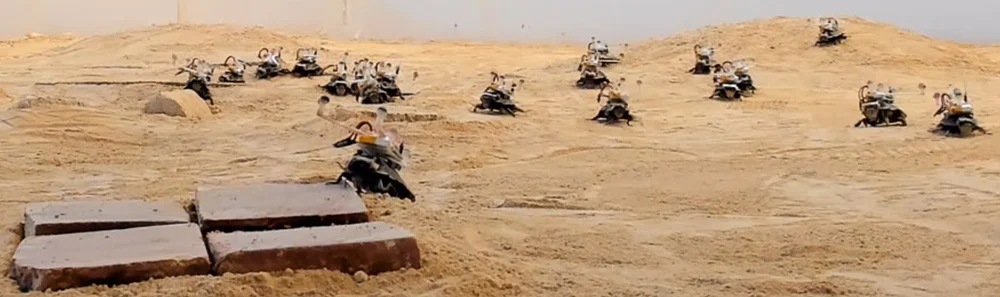
Scientists from NTU Singapore, Osaka University, and Hiroshima University have made a crucial advancement in swarm navigation technology for cyborg insects. This innovation, published in Nature Communications, has the potential to revolutionize disaster relief, search-and-rescue missions, and infrastructure inspection.
Cyborg insects, equipped with tiny electronic devices featuring optical and infrared cameras, batteries, and communication antennas, can be remotely controlled for specific tasks. Professor Hirotaka Sato from NTU Singapore’s School of Mechanical and Aerospace Engineering first demonstrated control of a single cyborg insect in 2008.
The latest development, led by co-corresponding authors Professor Masaki Ogura from Hiroshima University and Professor Wakamiya Naoki from Osaka University, utilizes a leader-follower dynamic where one cyborg insect guides a group of nineteen others. This swarm system enables the insects to move more freely, reducing the risk of getting stuck in obstacles and allowing nearby cyborgs to assist those in distress. The technology holds promise for complex operations such as search-and-rescue missions, where timely location of survivors is critical.
Introduction to Cyborg Insect Swarms
Developing advanced technologies for controlling cyborg insect swarms has been a subject of interest in recent years. Scientists from NTU Singapore, Osaka University, and Hiroshima University have made significant progress in this field by creating an advanced swarm navigation algorithm. This algorithm is designed to prevent cyborg insects from becoming stuck while navigating challenging terrain, which is a crucial aspect of their potential applications in disaster relief, search-and-rescue missions, and infrastructure inspection. The concept of cyborg insects involves equipping real insects with tiny electronic devices that allow for remote control of their movements. These devices typically consist of various sensors, such as optical and infrared cameras, a battery, and an antenna for communication.
Professor Hirotaka Sato from NTU Singapore’s School of Mechanical and Aerospace Engineering first demonstrated the control of a single cyborg insect in 2008. However, the use of a single insect is limited in its applications, particularly in scenarios where multiple insects are required to cover a wider area or perform complex tasks. For instance, search-and-rescue missions often involve locating survivors over a large area, and there is an optimal 72-hour window for doing so. In such cases, a swarm of cyborg insects would be more effective than a single insect. The latest research on the new swarm system utilizes a leader-follower dynamic, where one cyborg insect acts as a group leader guiding other insects.
The development of the swarm control algorithm and computer programs was led by co-corresponding authors Professor Masaki Ogura from Hiroshima University and Professor Wakamiya Naoki from Osaka University. Meanwhile, NTU Professor Hirotaka Sato and his team prepared the cyborg insect swarm, implemented the algorithm on the insects’ electronic backpacks, and conducted physical experiments in Singapore. The collaboration between these researchers has resulted in a significant advancement in swarm robotics, with potential implications for various fields. By allowing cyborg insects to move more freely and reducing the risk of them getting stuck in obstacles, the new algorithm improves the overall efficiency and effectiveness of the swarm.
The benefits of the new swarm algorithm were evident during lab experiments, where nearby cyborgs could help free those that were stuck or flipped over. This cooperative behavior among the insects is a key aspect of the leader-follower dynamic, which enables the swarm to navigate challenging terrain more effectively. The use of multiple cyborg insects also increases the chances of successful task completion, as the failure of one insect does not necessarily compromise the entire mission. With further development and refinement, this technology could pave the way for innovative applications in disaster relief, search-and-rescue missions, and infrastructure inspection.
Swarm Navigation Algorithm
The swarm navigation algorithm developed by the researchers is a critical component of the cyborg insect swarm system. This algorithm enables the insects to move in a coordinated manner, avoiding obstacles and reducing the risk of getting stuck. The leader-follower dynamic used in this system allows one cyborg insect to act as a group leader, guiding 19 other insects. The algorithm takes into account the position and movement of each insect, ensuring that they maintain a safe distance from each other and avoid collisions. By doing so, the swarm can navigate complex environments more effectively, which is essential for applications such as search-and-rescue missions.
The development of the swarm navigation algorithm involved significant computational modeling and simulation. The researchers used computer programs to test and refine the algorithm, ensuring that it could handle various scenarios and terrain types. The algorithm’s performance was evaluated based on its ability to prevent insects from getting stuck, as well as its overall efficiency in navigating challenging environments. The results of these simulations were then validated through physical experiments, where the cyborg insect swarm was tested in a controlled laboratory setting.
One of the key challenges in developing the swarm navigation algorithm was ensuring that the insects could adapt to changing environments and unexpected obstacles. To address this challenge, the researchers incorporated machine learning techniques into the algorithm, allowing it to learn from experience and improve its performance over time. This adaptive capability is essential for real-world applications, where the environment may be unpredictable and dynamic. By enabling the cyborg insect swarm to adapt to changing conditions, the algorithm increases the chances of successful task completion.
The swarm navigation algorithm also takes into account the physical limitations of the cyborg insects, such as their size, weight, and power consumption. These factors are critical in determining the overall performance and endurance of the swarm, particularly in applications where the insects may need to operate for extended periods. By optimizing the algorithm to account for these physical constraints, the researchers can ensure that the cyborg insect swarm operates within its design parameters, minimizing the risk of failure or malfunction.
Applications of Cyborg Insect Swarms
The potential applications of cyborg insect swarms are diverse and far-reaching, with implications for various fields such as disaster relief, search-and-rescue missions, and infrastructure inspection. One of the primary advantages of using cyborg insects is their ability to navigate complex environments, such as rubble or debris-filled areas, which may be inaccessible to traditional rescue vehicles. By deploying a swarm of cyborg insects, rescuers can quickly locate survivors and assess the situation, allowing for more effective response strategies.
Another potential application of cyborg insect swarms is in infrastructure inspection, where they can be used to monitor and maintain critical infrastructure such as bridges, tunnels, or pipelines. The insects can be equipped with sensors and cameras to detect signs of damage or deterioration, allowing for early intervention and repair. This can help prevent catastrophic failures, reducing the risk of accidents and minimizing downtime. Additionally, cyborg insect swarms can be used to inspect areas that are difficult or dangerous for humans to access, such as confined spaces or hazardous environments.
The use of cyborg insect swarms also has implications for environmental monitoring, where they can be used to track changes in ecosystems or detect signs of pollution. By deploying a swarm of insects equipped with sensors and cameras, researchers can gather detailed data on environmental conditions, allowing for more effective conservation strategies. This technology can also be used to monitor wildlife populations, tracking their movements and behavior to better understand their habitats and needs.
In addition to these applications, cyborg insect swarms may also have potential uses in fields such as agriculture, where they can be used to monitor crop health or detect signs of disease. By deploying a swarm of insects equipped with sensors and cameras, farmers can quickly identify areas that require attention, allowing for more targeted and effective interventions. This can help reduce the use of pesticides and other chemicals, minimizing the environmental impact of farming practices.
Challenges and Limitations
Despite the potential benefits of cyborg insect swarms, there are several challenges and limitations that must be addressed. One of the primary concerns is the development of more advanced algorithms and control systems, which can enable the insects to navigate complex environments and perform tasks autonomously. This requires significant advances in machine learning, computer vision, and robotics, as well as the development of more sophisticated sensors and actuators.
Another challenge is ensuring the reliability and durability of the cyborg insects, particularly in harsh or unpredictable environments. The insects must be designed to withstand various types of stress and damage, such as extreme temperatures, humidity, or physical impact. This requires the development of more robust and resilient materials, as well as advanced manufacturing techniques that can produce high-quality components at scale.
The use of cyborg insect swarms also raises ethical concerns, particularly with regards to privacy and surveillance. The deployment of insects equipped with cameras and sensors may be perceived as an invasion of privacy, particularly in areas where people expect a certain level of anonymity. To address these concerns, researchers must develop clear guidelines and regulations for the use of cyborg insect swarms, ensuring that they are used responsibly and with minimal impact on human rights.
Finally, there is the challenge of scaling up the production of cyborg insects, which requires significant advances in manufacturing technology and supply chain management. The development of more efficient and cost-effective production methods is essential for making this technology widely available, particularly for applications where large numbers of insects are required. By addressing these challenges and limitations, researchers can unlock the full potential of cyborg insect swarms, enabling innovative applications that transform various fields and industries.
External Link: Click Here For More