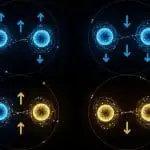
Physicists from NTT Research, ETH Zurich, and Stanford University have developed a method for creating electrically defined quantum dots, marking a significant advancement in quantum photonics. Quantum dots are nanoscale semiconductor structures with potential applications in quantum computing, display technology, and more. The new method allows for the creation and control of quantum dots using patterned electrodes and electric fields, improving scalability and precision. The research, led by Prof. Puneet Murthy of ETH Zurich and Dr. Thibault Chervy of PHI Lab, could pave the way for scalable photonic quantum computing architectures.
Quantum Dots: A New Approach to Electrical Control
A recent study led by physicists from NTT Research, ETH Zurich, and Stanford University has revealed a novel method for creating electrically defined quantum dots. This research, published in Science Advances, represents a significant advancement in the field of quantum photonics, potentially paving the way for new developments in light-based quantum information processing and beyond.
Quantum dots are nanoscale semiconductor structures with unique properties that have been recognized for their potential in various applications, including quantum computing, display technology, photovoltaics, and microscopy. However, the traditional methods for creating quantum dots, which rely on chemical synthesis or epitaxial growth of materials, have limitations in terms of scalability and precision. The new method introduced by the research team overcomes these limitations by defining optically active quantum dots entirely electrically, using precisely patterned electrodes and strong electric fields.
The Versatility and Scalability of Electrically Defined Quantum Dots
The researchers have demonstrated that quantum dots can be created by placing electrodes with the right shape close to a semiconductor material. This method not only allows for the precise location of the quantum dot but also enables the tuning of the wavelength of light emitted from it by adjusting the voltage applied on the electrodes. The structure of the quantum emitters can be altered simply by modifying the structure of the electrodes, for instance, from a quantum dot to a ring or a one-dimensional wire.
The scalability of this method is another significant achievement. The researchers used the electrode design to define not only single dots or rings but arrays of them. They demonstrated that by applying the right voltages on each electrode in the array, they can bring multiple quantum dots to the same energy, a feature that could be beneficial for future applications.
Implications for Photonic Quantum Computing
The ability to electrically control quantum dots is crucial for developing technologies such as photonic quantum computing. For these technologies to advance, an architecture that can scale up to thousands of identical quantum dots, which act as sources of single photons, is needed. The researchers’ architecture, which is similar to a transistor, allows for the control of voltages on a large scale. This feature is already used in many devices through CMOS technology.
Exploring Fundamental Physics and Future Applications
The researchers believe that their work opens up several new directions for future technological applications and exploring fundamental physics. The versatility of their technique in defining quantum dots and rings electrically provides an unprecedented level of control over the properties of the semiconductor at the nanoscale. The next step will be to investigate the nature of light emitted from these structures further and find ways of integrating such structures into cutting-edge photonics architectures.
External Link: Click Here For More