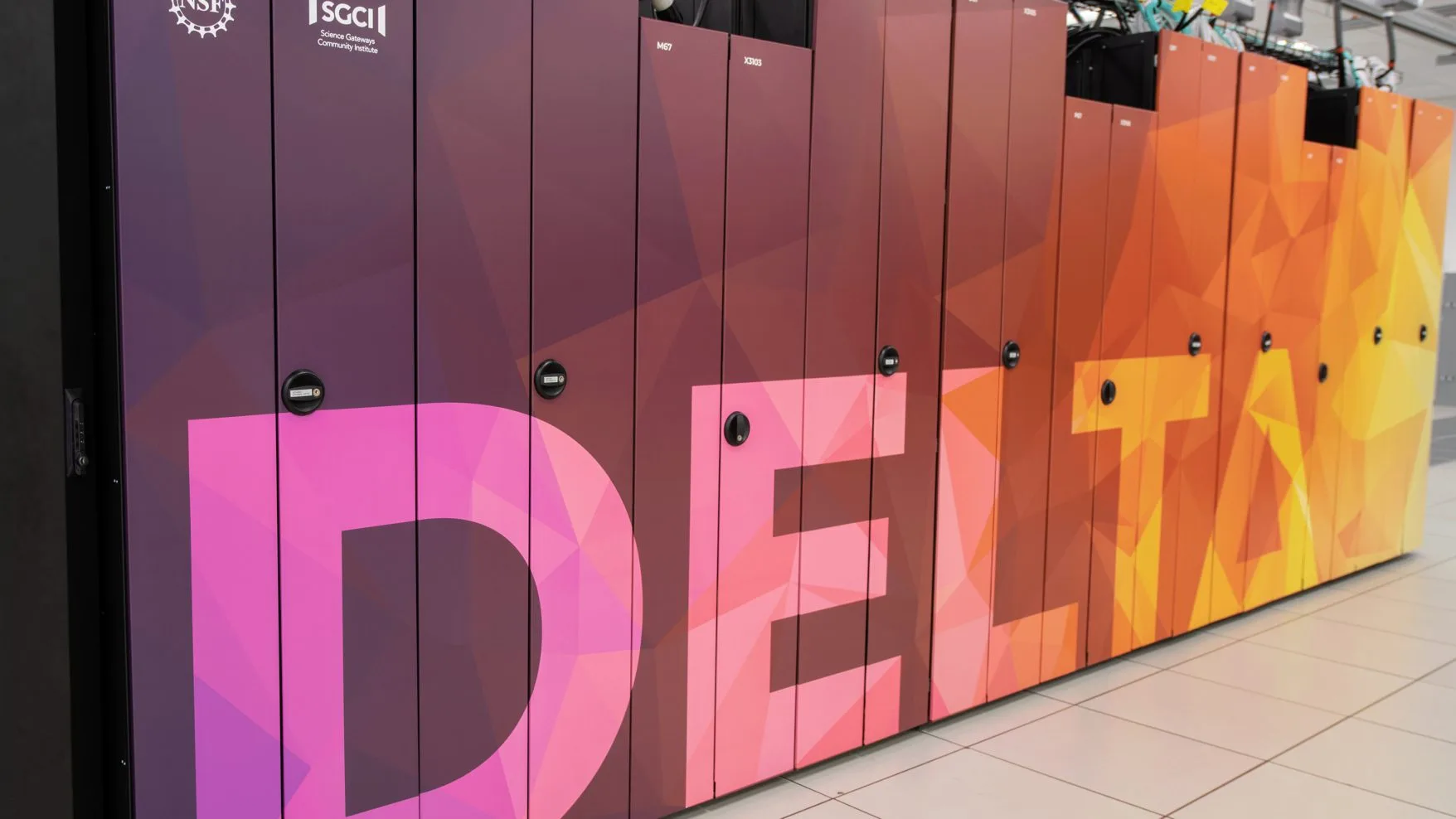
The National Center for Supercomputing Applications (NCSA) has received an additional $9.8 million from the U.S. National Science Foundation (NSF) for Delta and DeltaAI, expanding the potential capabilities of the soon-to-launch system by nearly 50 percent. DeltaAI will triple NCSA’s AI-focused computing capacity and greatly expand the capacity available within the NSF-funded advanced computing ecosystem. NCSA Director Bill Gropp emphasized the project’s aim to democratize high-performance computing. NCSA has partnered with NVIDIA to power DeltaAI with the NVIDIA GH200 Grace Hopper Superchip. The NSF also awarded Northeastern University $9 million for the National Deep Inference Fabric (NDIF), which will utilize DeltaAI.
NSF Grants Additional Funding for Delta and DeltaAI Supercomputers
The National Center for Supercomputing Applications (NCSA) has recently been granted an additional $4.9 million each for Delta and DeltaAI by the U.S. National Science Foundation (NSF). This funding aims to enhance the capabilities of the soon-to-be-launched system by nearly 50 percent.
Originally, the NCSA received close to $25 million from the NSF in 2023 to deploy and operate DeltaAI, a high-end computing and data resource designed to complement Delta. The introduction of DeltaAI is expected to triple the AI-focused computing capacity of the NCSA and significantly increase the capacity within the NSF-funded advanced computing ecosystem.
DeltaAI: A Powerful Tool for AI Research
DeltaAI is designed to offer robust capabilities for simulation and data science, with a particular focus on supporting AI, a field experiencing increasing demand across various scientific and engineering disciplines. The project aims to broaden the use of AI methods in research by providing easier access, training offerings, and other support to encourage a wider demographic of researchers.
The additional funding from the NSF underscores its commitment to ensuring that Delta and DeltaAI serve as top-tier machine learning and artificial intelligence computing resources for researchers nationwide. The NCSA anticipates launching DeltaAI later this year, where it will assist researchers in their innovative and groundbreaking work.
Delta and DeltaAI: Key Resources for National AI Research
A significant portion of the first round of the recently announced National Artificial Intelligence Research Resource (NAIRR) Pilot projects will utilize allocations on Delta. The additional funding for Delta will provide more large GPU memory nodes for research with AI models requiring over a terabyte of GPU memory.
The NCSA and the Delta team are eager to support the innovative AI projects researchers are undertaking through the NAIRR Pilot. The future of artificial intelligence is one of the biggest unknowns facing the academic and research computing communities. NCSA is proud to partner with NAIRR, NSF, and the DOE in attempting to find answers to these complex questions and empower AI research in a safe, responsible, and equitable manner.
DeltaAI: A Game-Changer for AI Research
The new capabilities that DeltaAI will bring are expected to be highly appreciated in the AI community to support the development and training of novel models for science and engineering. The system will allow researchers to routinely work with models with hundreds of billions of parameters, a capability that is currently not available to most academic AI researchers. This addition will have a profound impact on the AI research community.
NCSA has partnered with NVIDIA to power DeltaAI with the NVIDIA GH200 Grace Hopper Superchip. This partnership will play a crucial role in establishing the National Deep Inference Fabric (NDIF), a collective research platform that will investigate how large language models (LLM) and generative AI operate.
Delta is a powerful computing and data analysis resource created by combining next-generation processor architectures and NVIDIA graphics processors with forward-looking user interfaces and file systems. The project is part of the national cyberinfrastructure ecosystem through ACCESS and partners with the Science Gateways Community Institute to empower broad communities of researchers to easily access Delta. Delta is funded through NSF OAC 2005572.
External Link: Click Here For More