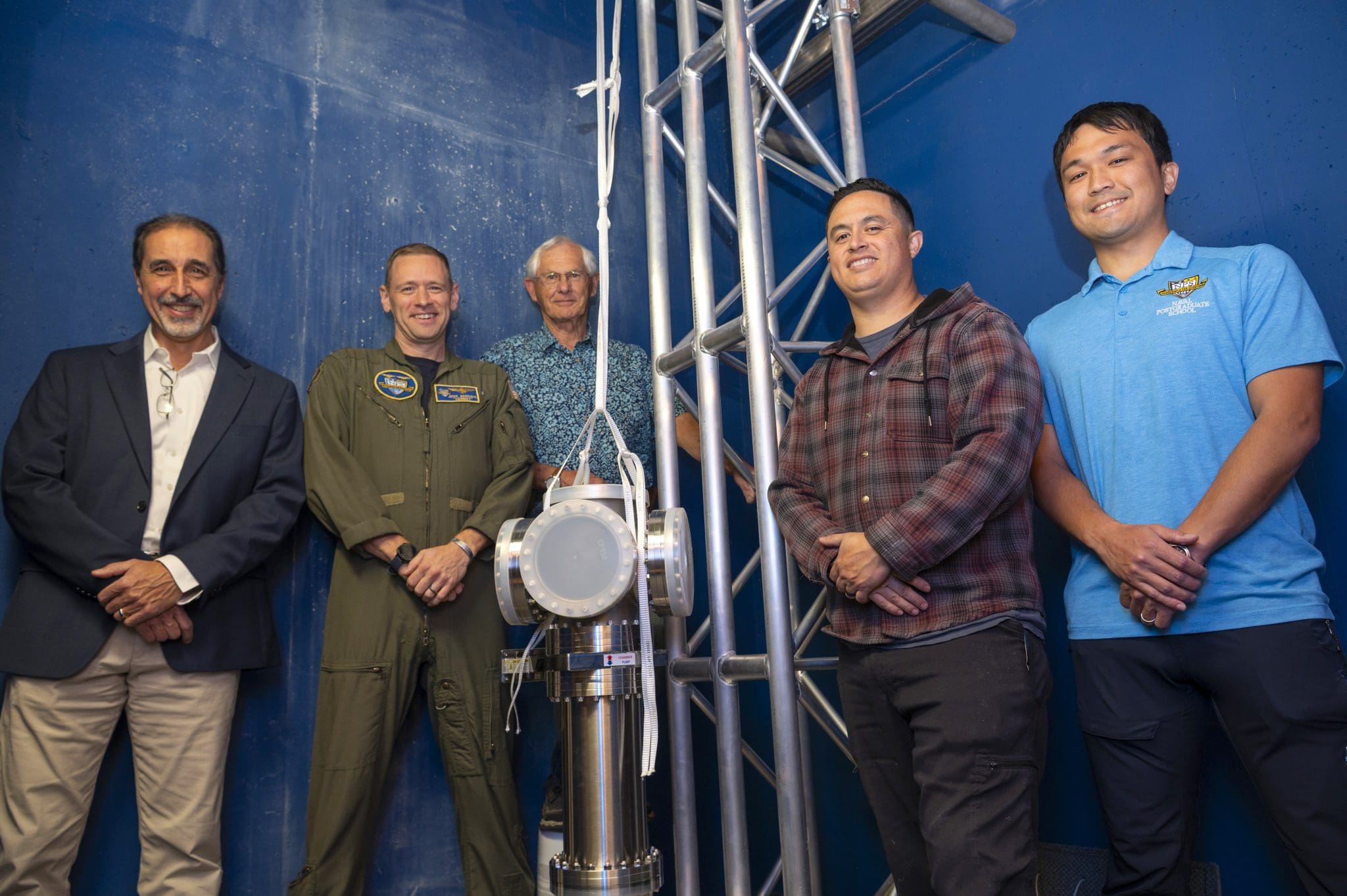
U.S. Navy Cmdr. Jens Berdahl, a doctoral student at the Naval Postgraduate School (NPS), and principal investigator Dr. Frank Narducci have achieved recognition for pioneering research in quantum sensing utilizing a unique atomic fountain. Berdahl received the Margaret Burbidge Award for Best Experimental Research from the American Physical Society at their 2025 annual meeting for this work conducted within NPS’ Department of Physics, alongside visiting scientist Takaho Tsubakiyama from Japan’s Ministry of Defense. This research focuses on detecting minuscule changes in mass from afar, with potential applications including submarine tracking and precision navigation, directly aligning with critical national security technology areas.
NPS Doctoral Student Receives Award for Quantum Research
U.S. Navy Cmdr. Jens Berdahl, a doctoral student at the Naval Postgraduate School (NPS), received the Margaret Burbidge Award for Best Experimental Research by a Graduate Student. The American Physical Society presented the award at their annual meeting on October 10-12, 2025, recognizing his pioneering research in quantum sensing. This achievement highlights NPS’s ability to compete with leading institutions and validates the quality of work conducted by its students and visiting scholars, according to Dr. Frank Narducci, principal investigator on the project.
Berdahl’s research centers on an Atomic Fountain constructed in Spanagel Hall, designed to detect minuscule changes in gravity—and therefore mass—from a distance. The current “baby tower” reaches 24 feet (8 meters) tall, with the final version planned to reach 100 feet (30 meters). This allows for increased sensitivity, aiming for precision to nine decimal places, enabling the detection of gravity differences caused by objects or hidden structures like tunnels.
The Atomic Fountain utilizes a Magneto-Optical Trap (MOT) and an interferometer to capture and manipulate atoms. By launching atoms into superposition—existing in multiple locations simultaneously—the system measures how gravity affects each state. This yields information about surrounding masses. Construction requires extreme precision, including components with tolerances of less than 0.001 inches, and one coil requires 1,214 windings.
Development of the Atomic Fountain at NPS
The Naval Postgraduate School (NPS) is developing an Atomic Fountain for advanced quantum sensing research within an unused elevator shaft in Spanagel Hall. An initial “baby tower” currently measures 24 feet (8 meters) in height, but the final version will reach approximately 100 feet (30 meters) tall. This increased height is crucial, as maximizing the time atoms spend in superposition directly improves sensor sensitivity, enabling the detection of minuscule gravity fluctuations with nine decimal places of precision.
The Atomic Fountain utilizes a Magneto-Optical Trap (MOT) to capture and cool atoms in an ultra-high vacuum, leveraging their wave-like properties and superposition. Atoms are launched vertically into an interferometer, where they are forced into superposition and then recombined. Differences in gravity experienced by the separated states provide information about surrounding masses. The team faces challenges accounting for interfering “noises” like Earth’s magnetic field and rotation while striving for components with tolerances of less than 0.001 inches.
This research aims to measure gravity and detect subtle changes caused by mass – or its absence – from a distance. Potential applications include submarine tracking, precision navigation in GPS-denied environments, and identifying hidden tunnels. The project involves complex engineering, including winding 1,214 turns onto copper coils, and aligns with six Critical Technology Areas identified as vital to U.S. national security. Cmdr. Jens Berdahl received the Margaret Burbidge Award for his work on this project.
Quantum Sensing Technology and Its Applications
NPS doctoral student Cmdr. Jens Berdahl received the Margaret Burbidge Award for his research on an atomic fountain used for quantum sensing. This technology aims to detect minuscule changes in mass, or its absence, from a distance. Potential applications include tracking submarines, enabling precision navigation in GPS-denied environments, and identifying hidden tunnel networks. The project aligns with six Critical Technology Areas identified by the Office of the Under Secretary of War for Research and Engineering, highlighting its national security relevance.
The NPS Atomic Fountain utilizes a Magneto-Optical Trap (MOT) and interferometer to measure gravity with extreme precision – reaching nine decimal places. The system captures and cools atoms in an ultra-high vacuum, leveraging their wave-like properties and superposition. By launching atoms vertically and then recombining them, the interferometer detects infinitesimal fluctuations in gravity caused by surrounding masses. Maximizing the time atoms spend in superposition – achieved by building a tall fountain – is crucial for sensor performance.
Currently, an initial “baby tower” measures 24 feet (8 meters) tall, with the final version planned to reach 100 feet (30 meters). This height is essential to maximize the time atoms are in superposition, enhancing sensor sensitivity. The project presents significant engineering challenges, requiring extreme precision – components must adhere to tolerances of less than 0.001 inches. For example, each copper coil requires 1,214 windings to generate a strong magnetic field.
Cmdr. Berdahl winning this award demonstrates to the world that NPS – and specifically NPS students and visiting scholars – can compete with the best that’s out there!
Dr. Frank Narducci
Teamwork and Engineering Challenges of the Project
The NPS project centers around constructing an Atomic Fountain within an elevator shaft in Spanagel Hall, initially reaching 24 feet (8 meters) and ultimately aiming for 100 feet (30 meters) in height. This vertical construction is crucial for maximizing the time atoms spend in superposition—a key factor in achieving better sensor performance. The team, led by Dr. Frank Narducci and including Cmdr. Jens Berdahl, faces significant engineering challenges in building such a structure, blending theoretical quantum science with practical construction within the existing building infrastructure.
The Atomic Fountain utilizes a Magneto-Optical Trap (MOT) and an interferometer to measure gravity with extreme precision – up to nine decimal places. The MOT captures and cools atoms in a vacuum, enabling their superposition. By measuring interference patterns as these atoms recombine, the system detects minute fluctuations in gravity caused by nearby masses. This sensitivity is vital for applications like submarine tracking, precision navigation, and identifying hidden tunnels, aligning with critical national security needs.
Successful completion of the project requires precision machining and custom fabrication. Machinists Daniel Moreno and George Jaksha are essential, creating components with tolerances of less than 0.001 inches. For example, each copper coil demands 1,214 windings to generate the necessary magnetic field gradient without overheating. This highlights the collaborative nature of the project and the blend of theoretical work with hands-on craftsmanship.