

On April 26, 2025, Roman Ya. Kezerashvili, Anastasia Spiridonova, and Klaus Ziegler published Electric field tunable magnetoexcitons in Xenes-hBN-TMDC, Xenes-hBN-BP, and Xenes-hBN-TMTC heterostructures, detailing how external electric fields and structural design can control excitonic properties in novel quantum materials.
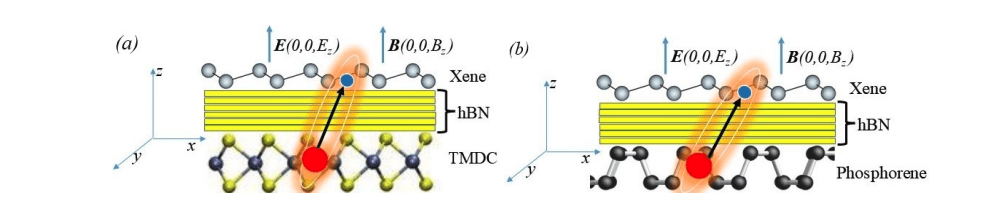
The study introduces novel van der Waals heterostructures combining Xenes, TMDCs, phosphorene, and TMTCs with insulating hBN layers. It investigates Rydberg indirect excitons in these systems under electric and magnetic fields, demonstrating tunable excitonic properties through field strength and heterostructure design. Key findings include increased exciton reduced mass and binding energy with stronger electric fields, while enhanced dielectric screening from additional hBN layers reduces binding energy. Anisotropic effects yield distinct excitonic responses, including variations in diamagnetic behavior. The research also explores Floquet band-structure engineering using time-periodic electric fields, offering insights for advanced optoelectronic devices.
Quantum materials represent a cutting-edge area of research that explores the unique properties of materials at the quantum level. These materials exhibit phenomena not observable in conventional substances, offering potential advancements in technology and our understanding of matter. One such phenomenon involves excitons—bound pairs of electrons and holes—in monolayer semiconductors like WS₂ and MoS₂. These transition metal dichalcogenides (TMDs) have attracted significant attention due to their two-dimensional structure and intriguing electronic properties.
Research into excitons in TMDs has yielded fascinating insights, particularly under high magnetic fields. Techniques such as magnetophotoluminescence are used to observe how these materials emit light when subjected to magnetic influence, providing a window into the quantum world. Key findings include the diamagnetic shift, where energy levels of excitons change with applied magnetic fields, and the valley Zeeman effect, which involves energy level splitting due to spin-orbit interactions. These effects are crucial for understanding the electronic structure and potential applications in optoelectronics.
Beyond static conditions, scientists are exploring time-periodic driving methods, such as oscillating magnetic fields, to induce new quantum phases. This approach, known as Floquet engineering, aims to create topological states that could revolutionize material science by enabling novel electronic properties. For instance, Floquet topological insulators demonstrate how periodic driving can transform materials into states with unique conductive properties. This opens avenues for developing advanced electronic devices and quantum computing components.
The implications of this research are profound. By understanding and controlling exciton behavior and inducing new quantum phases, scientists pave the way for innovations in optoelectronics, quantum computing, and other technologies that rely on precise control of material properties. As we continue to explore these quantum materials, the potential for transformative applications grows, promising a future where technology is not just improved but fundamentally reshaped by our understanding of the quantum world.
👉 More information
🗞 Electric field tunable magnetoexcitons in Xenes-hBN-TMDC, Xenes-hBN-BP, and Xenes-hBN-TMTC heterostructures
🧠 DOI: https://doi.org/10.48550/arXiv.2504.19063


