

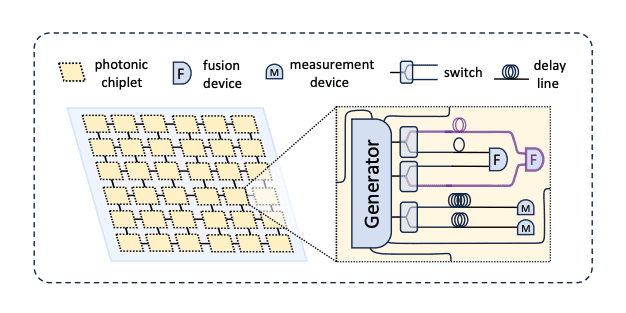
On April 23, 2025, Hezi Zhang and co-authors published OneAdapt: Adaptive Compilation for Resource-Constrained Photonic One-Way Quantum Computing, introducing a novel framework that enhances photonic quantum computing by adaptively optimizing resource usage to minimize hardware requirements and execution time while integrating error correction mechanisms.
The study introduces a novel intermediate representation (IR) with optimization passes for measurement-based quantum computing (MBQC), enabling a resource-adaptive compiler that minimizes hardware size and execution time while controlling fusion device requirements. This approach addresses limitations of previous compilers in photonic platforms, improving efficiency by reducing resource constraints. Additionally, the method integrates with quantum error correction (QEC), enhancing the performance of photonic fault-tolerant quantum computing (FTQC).
Photonic quantum computing has emerged as a promising approach to building practical quantum computers. By leveraging photons—particles of light—researchers aim to overcome some of the limitations faced by traditional quantum systems. This article explores recent advancements in this field, focusing on key innovations such as cluster states, percolation thresholds, error correction mechanisms, and architectural requirements.
Cluster states are a critical resource for one-way quantum computation, enabling complex quantum operations through entanglement. Recent research has highlighted the importance of these states in photonic systems, where photons are used to create highly entangled networks. These networks form the backbone of photonic quantum computers, allowing them to perform tasks that classical computers struggle with.
Percolation thresholds play a pivotal role in determining the efficiency and scalability of photonic quantum computing systems. This concept refers to the point at which a system transitions from being inefficient to becoming viable for practical applications. By studying percolation, researchers can optimize network designs, ensuring that resources are used effectively and computations remain feasible as systems grow larger.
Error correction is fundamental to maintaining the integrity of quantum computations. In photonic systems, errors can arise due to photon loss or decoherence. Advanced error correction codes have been developed to address these issues, ensuring that computations remain accurate even in noise. These mechanisms are crucial for building reliable and robust quantum computers.
The design of photonic quantum computing architectures is another critical area of research. Efficient architectures must balance scalability with practicality, ensuring that systems can be built using current technology while maintaining computational power. This involves optimizing components such as photon sources, detectors, and optical circuits to work seamlessly together.
Recent advancements in photonic quantum computing have brought us closer to realizing practical quantum computers. Innovations in cluster states, percolation thresholds, error correction, and architectural design pave the way for more efficient and reliable systems. As research continues, these breakthroughs could lead to significant applications in cryptography, optimization, and drug discovery, revolutionizing how we approach complex computational challenges.
👉 More information
🗞 OneAdapt: Adaptive Compilation for Resource-Constrained Photonic One-Way Quantum Computing
🧠 DOI: https://doi.org/10.48550/arXiv.2504.17116


