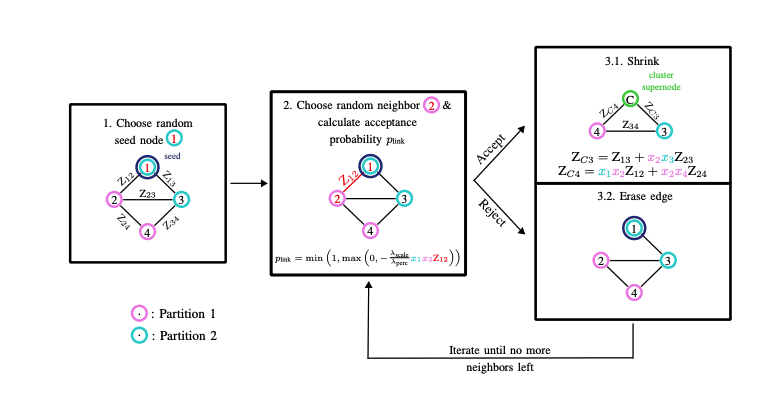
Combinatorial optimization problems, such as finding the most efficient routes for logistics or designing optimal machine learning models, often present formidable challenges for even the most powerful computers. Peter J. Eder from TUM and Siemens AG, Aron Kerschbaumer from the Institute of Science and Technology Austria (ISTA), and their colleagues demonstrate a new approach to tackling these problems by combining the principles of quantum mechanics with established cluster algorithms. The team’s method uses precomputed correlations between variables to guide the formation of clusters, effectively allowing the algorithm to explore a wider range of potential solutions and avoid becoming trapped in suboptimal configurations. This innovative technique, which leverages information about the problem’s underlying energy landscape, significantly improves the algorithm’s efficiency and enables faster exploration of the solution space, potentially unlocking breakthroughs in fields reliant on complex optimization tasks.
Cluster Algorithm Escapes Local Optima Effectively
Researchers have developed a new algorithm for solving complex optimization problems, inspired by the challenges of finding the lowest energy state in disordered magnetic materials known as spin glasses. These problems, often framed as finding the best combination from a vast number of possibilities, are notoriously difficult for conventional computers. The team’s approach centers on a novel cluster algorithm, which, unlike methods that change one variable at a time, flips groups of variables simultaneously, allowing for more coordinated adjustments and effective escape from suboptimal configurations. Previous cluster algorithms struggled with spin glasses due to sprawling, interconnected clusters hindering efficient exploration.
To overcome this, the researchers incorporated information about the relationships between variables, pre-computing a “correlation matrix” that guides cluster formation and focuses on coordinated changes. The team demonstrated a significant performance improvement when compared to standard algorithms, particularly on highly complex, frustrated problems where satisfying all constraints is impossible. Furthermore, incorporating information from quantum optimization algorithms accelerated the process, allowing for even more rapid exploration and lower energy states. This suggests a promising synergy between classical and quantum approaches, potentially unlocking new capabilities in fields ranging from logistics and manufacturing to materials science and financial modeling. The algorithm’s ability to efficiently navigate complex landscapes represents a significant step forward in tackling challenging computational problems.
Correlation-guided clustering boosts Max-Cut optimisation
This work introduces a novel cluster algorithm designed to improve the optimization of challenging combinatorial problems, specifically the MaxCut problem encountered in disordered systems like spin glasses. The algorithm addresses limitations of traditional methods by forming clusters of spins based on pre-computed two-point correlations, enabling larger, more effective transitions in the system’s configuration space and helping it escape local minima. Results demonstrate that correlations derived from the Approximate Optimization Algorithm, and particularly those generated with increased circuit depth, significantly enhance the algorithm’s acceptance rates. The research highlights the importance of correlation quality, showing that while coupling constants provide guidance in systems with low frustration, more informative correlations become crucial in highly frustrated systems. The authors analytically demonstrate a close relationship between correlations at a specific quantum algorithm depth and those derived from coupling constants, providing insight into the structural properties influencing performance. Future research directions include aligning the cluster-building procedure with Markov chain Monte Carlo methods to ensure ergodicity, and benchmarking the algorithm against correlations obtained from alternative quantum methods.
Quantum MaxCut via Variational Quantum Algorithms
The paper addresses the challenge of solving NP-hard combinatorial optimization problems, focusing on the Maximum Cut (MaxCut) problem as a representative example. The authors explore the potential of leveraging quantum computation, not necessarily through full-scale quantum computers, but through hybrid quantum-classical algorithms and quantum-inspired techniques. The core approach combines the strengths of both quantum and classical computation, utilizing algorithms like the Quantum Approximate Optimization Algorithm (QAOA) and extending beyond simple implementations. The research also explores ways to mimic quantum behavior using classical computation, crucial for developing algorithms that can run on current hardware.
Cluster Monte Carlo methods, a class of Markov Chain Monte Carlo (MCMC) methods, are employed for their effectiveness in exploring complex energy landscapes. The paper focuses on improving these methods using quantum-derived information, recognizing that frustration significantly impacts the difficulty of finding good solutions. The authors emphasize the importance of capturing correlations between variables in the optimization problem, exploring how quantum information can guide the search process. They introduce a novel approach that combines recursive optimization techniques with information derived from quantum computations or quantum-inspired models, allowing for efficient exploration of the solution space and high-quality solutions.
Extensive benchmarking results demonstrate significant improvements. They demonstrate how to enhance Cluster Monte Carlo methods by using quantum-derived correlation functions to guide the cluster updates, leading to faster convergence and better performance, especially in frustrated problems. The paper provides a detailed analysis of how frustration affects the performance of different optimization algorithms, helping to identify key challenges and develop strategies for overcoming them. The authors investigate quantum-like probability distributions and entanglement-like measures to improve classical optimization algorithms.
👉 More information
🗞 Quantum-Guided Cluster Algorithms for Combinatorial Optimization
🧠 ArXiv: https://arxiv.org/abs/2508.10656