

Nonreciprocal interactions, where one system’s influence on another differs from the reverse, appear across diverse fields from living organisms to social networks and open physical systems. Giulia Garcia Lorenzana, David Martin, and Yael Avni, working with colleagues at institutions including the École normale supérieure and the University of Chicago, now establish clear criteria for determining when these interactions fundamentally alter the behaviour of systems undergoing phase transitions. The team’s work demonstrates that nonreciprocity can shift a system into a new universality class, meaning its properties change dramatically near the transition point, and provides a framework, reminiscent of established principles for disordered systems, to predict these shifts. This achievement offers crucial guidelines for understanding how dynamical phase transitions respond to various perturbations, extending beyond nonreciprocity to provide a broader understanding of complex system behaviour.
Nonreciprocal interactions, where the influence between two components of a system is not mutual, are widespread in nature, appearing in biological, social, and quantum systems. Despite their prevalence, the impact of nonreciprocity on phase transitions, the points where a system’s properties dramatically change, remains incompletely understood. This work establishes criteria to determine whether non-reciprocal coupling alters the fundamental characteristics of phase transitions, specifically the universality class that governs the system’s behaviour, offering a framework for predicting how these asymmetric interactions affect critical exponents and scaling functions, providing insights into complex systems far from equilibrium.
Non-Reciprocal Interactions in Three-Dimensional Ising Models
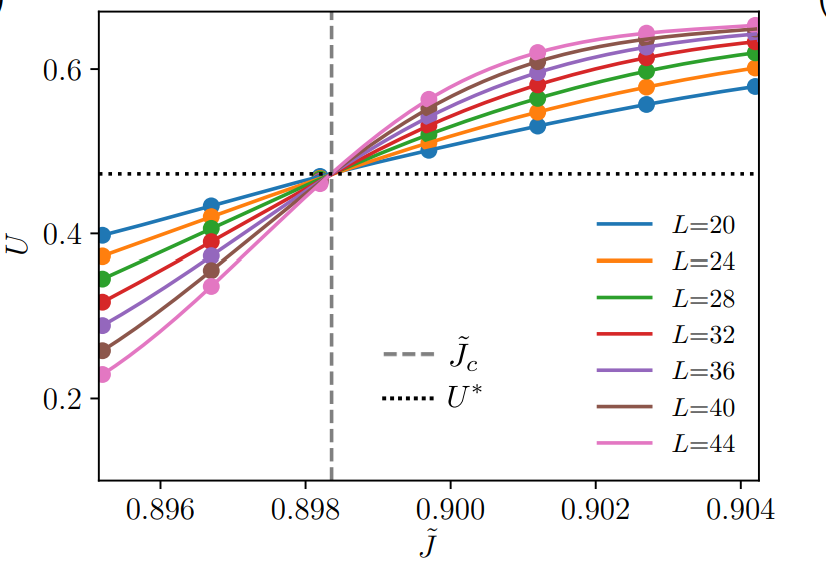
Researchers investigated how non-reciprocal interactions affect the critical behaviour of the three-dimensional Ising model, a fundamental system in statistical physics. This study introduces a scenario where interactions are asymmetrical, with one component exerting a stronger or one-sided influence. The team discovered that under certain conditions, specifically when the system possesses inversion symmetry, the non-reciprocal Ising model still falls into the same universality class as the standard model, meaning the critical exponents remain unchanged. Numerical calculations of these exponents, and analysis of the Binder cumulant, support this finding, which relies heavily on the presence of inversion symmetry. The research extends beyond the Ising model, drawing connections to the Lotka-Volterra system, a model from ecology describing predator-prey interactions, demonstrating the broad applicability of non-reciprocal interactions. Investigations into Directed Percolation revealed that breaking the inversion symmetry present in the Ising model leads to asymmetric behaviour, with one component transitioning to a stable state before the other, highlighting that lost symmetry can change the universality class and system behaviour.
Nonreciprocity Alters Phase Transition Universality Classes
This work builds upon the well-known Harris criterion to establish criteria for determining how non-reciprocal interactions influence phase transitions in coupled systems. Researchers derived conditions to predict whether non-reciprocal coupling alters the universality class of systems undergoing a phase transition, focusing on perturbations to asymmetrically coupled fields. Results demonstrate that a non-reciprocal perturbation is irrelevant if its strength exceeds a certain threshold for uncoupled identical fields, but marginal for a two-dimensional Ising model, and remains irrelevant for uncoupled nonidentical and reciprocally coupled fields. Crucially, the study reveals that a weak non-reciprocal perturbation shifts the critical exponents of a phase transition away from the standard Ising universality class when there is no reciprocal coupling. Numerical simulations of the three-dimensional Nonreciprocal Ising model, measuring critical exponents and comparing them to the standard three-dimensional Ising and XY models, confirm that the transition remains within the Ising universality class when a finite reciprocal coupling is present. The research establishes a framework for understanding how non-reciprocal interactions impact phase transitions, providing insights applicable to diverse physical systems.
Nonreciprocity Alters Critical Exponent Behaviour
This research establishes clear criteria for determining how asymmetric interactions, specifically nonreciprocity, influence phase transitions in coupled systems. Scientists demonstrated that the relevance of a non-reciprocal perturbation depends on the critical exponent governing the susceptibility of the system; if this exponent is greater than zero, a non-reciprocal interaction can fundamentally change the transition, a result supported by numerical simulations and renormalization group studies. This finding extends the well-known Harris criterion to encompass the effects of non-reciprocal coupling. The team further investigated scenarios involving coupled fields with differing critical points and those with symmetric reciprocal coupling. They showed that coupling to a field already in a disordered state represents an irrelevant perturbation, having no impact on the transition, while reciprocal coupling does not alter the universality class of the transition. These findings provide a comprehensive understanding of how asymmetric interactions affect the behaviour of coupled systems undergoing phase transitions, offering insights applicable to a range of physical phenomena.


