

Hidden crystal symmetries and the emergence of unusual magnetic states often remain elusive, challenging our understanding of complex materials, but a team led by Subin Mali, Yufei Zhao, and Yu Wang are now demonstrating a new way to reveal these subtle features. They present a method using nonlinear transport measurements to detect previously hidden distortions in the crystal structure of calcium ruthenate, a strongly correlated material. Their work reveals a lower-symmetry structure below 48 Kelvin, associated with a reorientation of magnetic moments, and provides direct evidence for a transformation towards a unique magnetic state known as an altermagnet. This sensitivity, capable of detecting distortions of only 0. 1 picometres, significantly extends the capabilities of traditional techniques like X-ray diffraction and opens new avenues for exploring complex materials with hidden symmetries.
Diffraction techniques are fundamental tools for determining crystal structures, but their resolution limits can sometimes lead to misinterpretations, especially in materials with subtle distortions or competing phases. Here, scientists demonstrate the use of nonlinear transport as a complementary approach to uncover hidden crystal symmetries, focusing on the strongly correlated material Ca₃Ru₂O₇. Below 48 Kelvin, where the magnetic moments reorient, leading to a gap in the electronic structure, measurements reveal a previously overlooked lower-symmetry phase. This manifests as the emergence of longitudinal nonlinear resistance along a specific crystallographic direction.
Nonlinear Hall Effect Reveals Hidden Altermagnetism
This research details the discovery and characterization of a novel nonlinear transport phenomenon in the polar metal Ca₃Ru₂O₇, revealing evidence of a hidden Weyl altermagnet state. The team investigated Ca₃Ru₂O₇, a correlated electron material known for its complex magnetic and electronic properties, and its unique interplay between charge, spin, and orbital degrees of freedom. They observed a significant nonlinear Hall effect, which isn’t typical and isn’t explained by conventional mechanisms. This effect is attributed to a previously unrecognized Weyl altermagnet state, where spins are ordered but don’t break time-reversal symmetry, leading to a unique band structure with split bands.
The presence of Weyl nodes in the electronic band structure contributes to the unusual transport properties. This is a crucial finding because it demonstrates a new way to realize altermagnetism and a novel mechanism for generating nonlinear transport. First-principles calculations support the existence of Weyl nodes and the altermagnetic band splitting in Ca₃Ru₂O₇. Symmetry analysis confirms that the observed symmetry of the material is consistent with the proposed altermagnetic state. The magnitude and sign of the nonlinear Hall effect are explained by the altermagnetic band structure and the presence of Weyl nodes.
This research identifies a new type of altermagnetism, expanding our understanding of magnetic order and its relationship to electronic properties. The discovery of a nonlinear transport mechanism driven by altermagnetism and Weyl nodes opens up possibilities for new electronic devices and functionalities. The unique spin-polarized transport properties of this material could be exploited in spintronic applications, and the findings link altermagnetism to the broader field of topological materials, suggesting that these two concepts may be intertwined.
Hidden Symmetry Revealed by Nonlinear Transport
Scientists have demonstrated a novel method for uncovering hidden crystal symmetries using nonlinear transport, complementing traditional X-ray and neutron diffraction. Their work focuses on Ca₃Ru₂O₇, a strongly correlated material, and reveals a previously overlooked lower-symmetry phase below 48 Kelvin, where the magnetic moments reorient. Measurements show a subtle lattice distortion of approximately 0. 1 picometers, too small to be detected by conventional diffraction methods, associated with this magnetic transition. This distortion breaks a specific symmetry, transforming the material from a conventional antiferromagnet into an altermagnet.
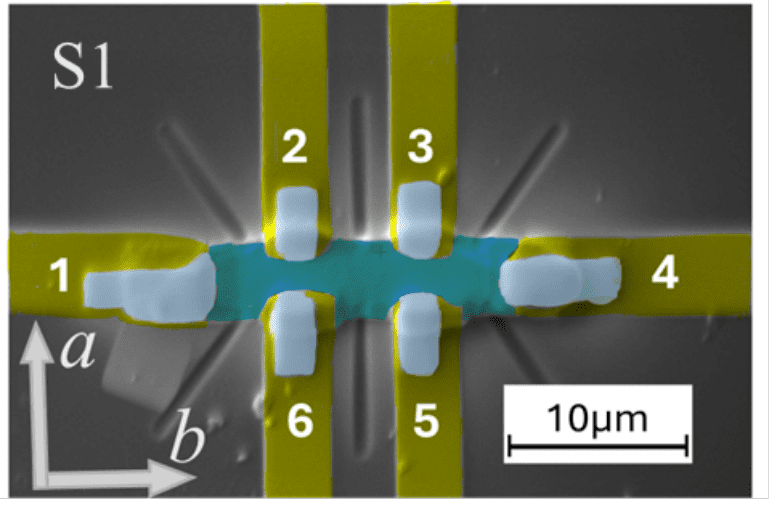
The team measured a significant longitudinal nonlinear resistance along a specific crystallographic direction below this transition temperature, providing direct evidence of the combined breaking of translational and time-reversal symmetry. This nonlinear resistance, accompanied by a nonlinear Hall effect, is enhanced by a large quantum metric associated with Weyl chains near the Fermi surface. Calculations reveal that the Weyl bands are tilted in the lower-symmetry phase due to the broken symmetry, leading to a significant net quantum metric and a substantial nonlinear response. Detailed analysis shows that the carrier densities, determined by Hall measurement, are consistent with the calculated electronic structure. The researchers established that the observed nonlinear Hall effect arises from Berry curvature dipole, while both the nonlinear Hall effect and longitudinal nonlinear resistance are driven by the quantum metric dipole, which is several orders of magnitude larger than other contributions. The detection of this longitudinal nonlinear resistance serves as a clear signature of the symmetry-breaking altermagnetic state, offering a new pathway for identifying elusive topological and altermagnetic phases in emerging quantum materials.
Nonlinear Transport Reveals Hidden Symmetry Breaking
This research demonstrates the power of nonlinear transport measurements to reveal subtle symmetry breaking in complex materials, complementing traditional structural characterization techniques like X-ray and neutron diffraction. Scientists have uncovered a previously undetected lower symmetry state in the compound Ca₃Ru₂O₇, emerging below 48 Kelvin as the magnetic moments reorient. This subtle distortion, approximately 0. 1 picometers, is below the detection limit of conventional diffraction methods, yet is clearly revealed by the emergence of a nonlinear resistance along a specific crystallographic direction.
The findings establish that this symmetry breaking is linked to a transformation towards an altermagnetic state, a unique magnetic order where time-reversal symmetry is broken. Measurements of both longitudinal nonlinear resistance and a nonlinear Hall effect confirm this conclusion, and align with theoretical predictions for the material’s crystal structure in this phase. While quantitative comparisons between experimental and theoretical nonlinear conductivities show some discrepancies, the observed trends are consistent, and the researchers attribute differences to factors like contact misalignment and crystal imperfections. Future work could focus on refining theoretical models to better capture the observed nonlinear responses, and on exploring similar phenomena in other materials with complex magnetic orders. This research provides a new pathway for probing hidden symmetries and magnetic states in materials, opening opportunities for discovering novel quantum phenomena and functionalities.
👉 More information
🗞 Probing Hidden Symmetry and Altermagnetism with Sub-Picometer Sensitivity via Nonlinear Transport
🧠 ArXiv: https://arxiv.org/abs/2510.18144


