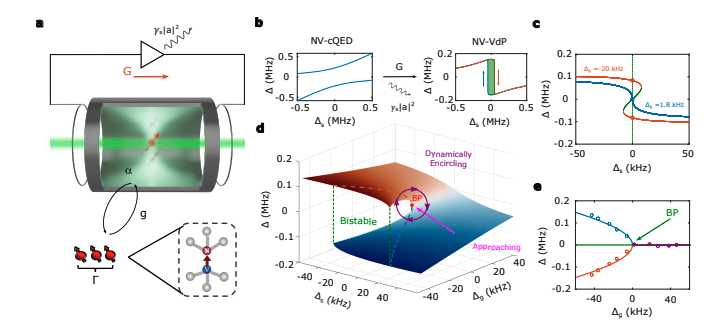
Phase transitions hold immense potential for enhancing sensor performance, and researchers are now demonstrating a significant leap forward in sensitivity by harnessing the power of nonlinearity. Hanfeng Wang from MIT, alongside Kurt Jacobs from the DEVCOM Army Research Laboratory and University of Massachusetts Boston, and their colleagues, report a hybrid quantum system that achieves exceptional sensitivity near a critical switching point. The team coupled a diamond-based sensor to a nonlinear oscillator, creating a self-oscillating system that exhibits both stable and bistable states, and crucially, overcomes the usual noise limitations associated with these transitions. This innovative approach delivers a seventeen-fold improvement in signal-to-noise ratio, reaching a record sensitivity of 170 femtotesla per root Hertz, and surpasses the theoretical limits of conventional magnetometers, resolving a long-standing challenge in the field.
Nonlinear Systems Boost Quantum Sensor Sensitivity
The pursuit of increasingly sensitive sensors drives innovation across diverse fields, from medical diagnostics to fundamental physics research. Nitrogen-vacancy (NV) centers in diamond have emerged as promising quantum sensors, capable of detecting incredibly weak magnetic fields.
Recent research, led by Hanfeng Wang, Kurt Jacobs, and Donald Fahey, addresses the challenge of maximizing signal detection while minimizing noise by leveraging the unique properties of nonlinear systems to dramatically enhance sensor sensitivity. Conventional approaches to boosting sensor response often rely on reaching “exceptional points”, which can amplify both signal and noise.
This research team overcame this limitation by integrating an NV center with a nonlinear oscillator, specifically a Van der Pol (VdP) oscillator, exhibiting two distinct operating phases: a standard state and a bistable state. The crucial innovation lies in operating near a bistable transition point, where the noise characteristics of the nonlinear oscillator are modified, preventing the usual noise amplification.
This allows for a significant enhancement in signal-to-noise ratio, with the NV-VdP system exhibiting unique behaviors, including self-oscillation and state switching, absent in traditional linear systems. Experiments demonstrate a remarkable 17-fold increase in signal-to-noise ratio, achieving a record sensitivity of 170 femtotesla per root Hertz.
This surpasses the theoretical limit of conventional, thermally-limited magnetometers and establishes a new benchmark for NV-based quantum sensing, promising to unlock new capabilities in a wide range of applications.
NV Center Sensing via PT Symmetry
This research details a significant advancement in nanoscale magnetic field sensing using a hybrid system combining a Nitrogen-Vacancy (NV) center in diamond with a superconducting microwave resonator. The team achieved exceptional sensitivity by engineering a special phase transition in the system, utilizing a principle called Parity-Time (PT) symmetry.
The researchers carefully designed the system to operate near a PT-symmetric phase transition, a point where the system’s properties change dramatically, leading to enhanced sensitivity. This is achieved through a carefully controlled nonlinearity in the system, preventing uncontrollable noise amplification.
They achieved a magnetic field sensitivity of 170 fT/√Hz, a state-of-the-art result surpassing previous NV-based sensors and approaching theoretical limits. The sensor performance broke the sensitivity bound for a general thermally-limited device by a factor of 10 at equal oscillating power, demonstrating a new approach to enhancing sensitivity with broader implications for quantum sensing and metrology.
The results surpass the sensitivity limit of an ideal, thermally-limited electron magnetometer and resolve a long-standing debate regarding exotic physics in advanced quantum sensing.
Bistability Boosts Magnetometer Sensitivity Dramatically
The research team demonstrates a significant advance in magnetic field sensing by successfully coupling a diamond sensor with a nonlinear oscillator, creating a hybrid system that overcomes limitations found in conventional sensors. This innovative approach leverages the principles of bistability and phase transitions to achieve a substantial enhancement in signal-to-noise ratio, ultimately resulting in a record sensitivity of 170 fT/√Hz.
This performance surpasses the theoretical limit of traditional, thermally-limited magnetometers, resolving a long-standing debate regarding the application of physics to advanced sensing technologies. The system’s ability to operate near a bistable transition point enhances sensitivity without the noise amplification typically associated with linear systems.
While the current model effectively describes the system’s behavior using a semiclassical approach, the authors acknowledge that it does not fully account for quantum noise. Future research will focus on exploring the system’s quantum mechanical properties and investigating operation in regimes that could further enhance sensitivity, potentially by several orders of magnitude.
The team envisions that this technology, and devices harnessing similar principles, could become standard tools in high-precision magnetometry and provide valuable platforms for studying nonlinear phenomena and phase transitions.
👉 More information
🗞 Exceptional sensitivity near the bistable transition point of a hybrid quantum system
🧠 DOI: https://doi.org/10.48550/arXiv.2507.09691