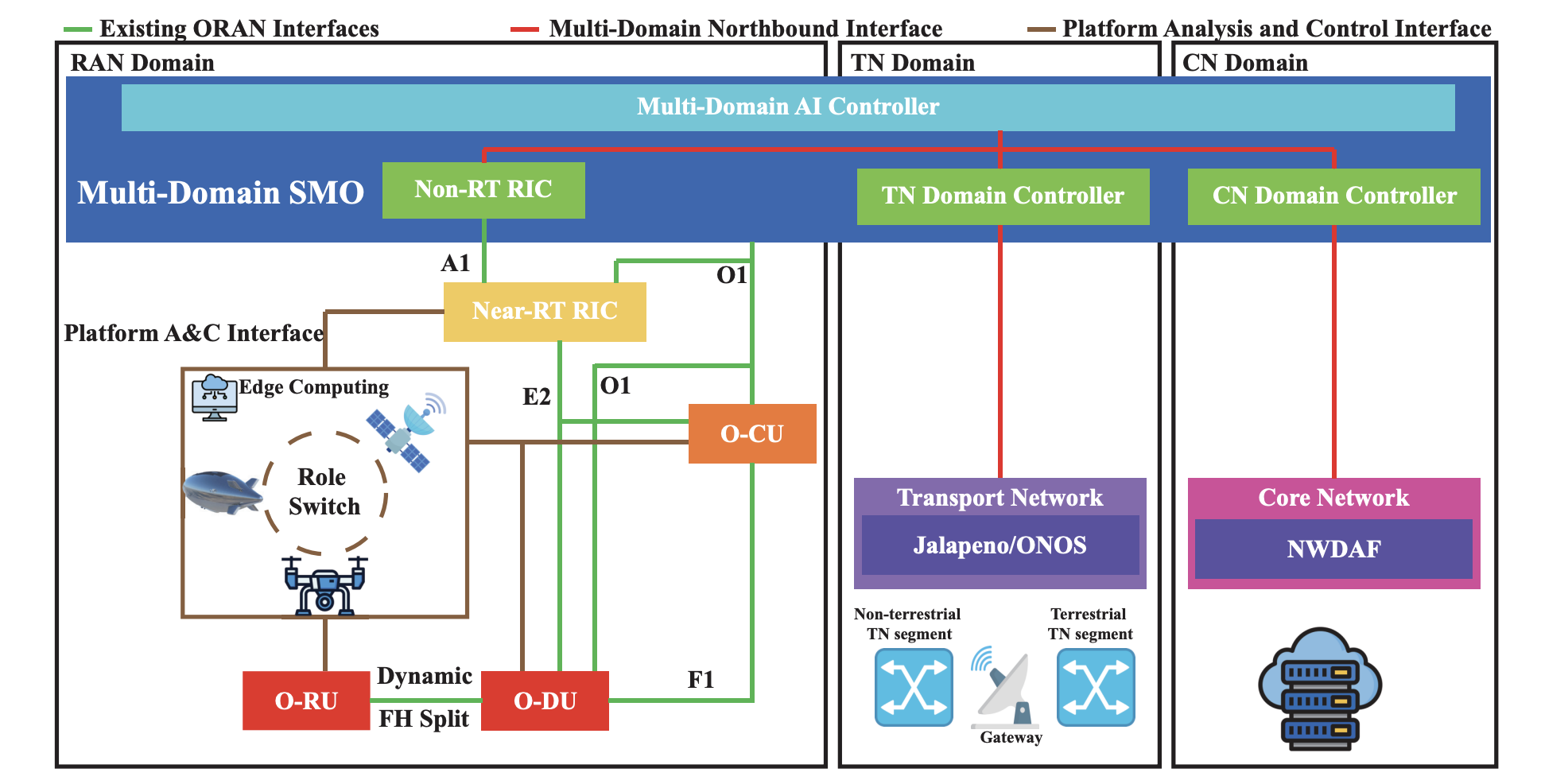
The increasing demand for ubiquitous connectivity drives innovation in network architectures, particularly for challenging environments beyond traditional terrestrial networks. Jikang Deng from King Abdullah University of Science and Technology, Fizza Hassan from King Fahd University of Petroleum and Minerals, and Hui Zhou from Coventry University, along with their colleagues, investigate how to combine the benefits of non-terrestrial networks (NTNs) and open radio access networks (ORAN) to create more scalable and intelligent wireless systems. Their work addresses a critical gap in current research, which often overlooks the practical challenges of managing highly mobile and high-altitude NTNs, and proposes a holistic framework integrating artificial intelligence throughout the entire network lifecycle. By leveraging the disaggregated, virtualised and intelligent nature of ORAN, this research paves the way for more resilient, efficient and adaptable networks capable of supporting future 6G applications in diverse and demanding environments.
Integrating Terrestrial and Non-Terrestrial Wireless Networks
As wireless networks evolve towards Sixth Generation (6G) and beyond, a key challenge is providing ubiquitous connectivity alongside increasing demands for data rates and network capacity. Researchers are exploring novel network architectures by integrating terrestrial networks with non-terrestrial networks (NTNs), utilizing platforms like satellites and high-altitude platforms to extend coverage, even in remote areas and during emergencies. Deploying and managing these NTNs presents hurdles, including limitations in size, weight, and power, as well as maintaining reliable connections with fast-moving platforms. Current network management approaches struggle with the unique demands of NTNs, hindering their ability to scale efficiently and adapt to changing conditions.
To address these challenges, researchers are turning to the principles of Open Radio Access Network (ORAN) architecture, which promotes disaggregation, virtualization, and intelligence within the radio access network, allowing for greater flexibility, innovation, and automation. By applying ORAN principles to NTNs, network operators can unlock new capabilities and overcome the limitations of traditional approaches. This research focuses on developing a holistic framework for integrating ORAN and NTNs throughout the entire network lifecycle, from development and deployment to ongoing operations. The team proposes a novel ORAN-based NTN framework that leverages virtualization to dynamically adjust network configurations, optimize resource allocation, and enhance scalability.
This framework incorporates intelligent controllers that utilize artificial intelligence to learn from network data and proactively address potential issues, creating a more efficient, resilient, and adaptable wireless network. The proposed framework emphasizes end-to-end orchestration, enabling seamless management and optimization across multiple network domains. This approach allows for intelligent control of network resources, improved service delivery, and enhanced user experience. Future research will explore the integration of this framework with other enabling technologies and investigate potential use cases, paving the way for a new generation of wireless networks that seamlessly blend terrestrial and non-terrestrial connectivity.
Integrating ORAN with Non-Terrestrial Networks
Researchers are developing a new network framework by integrating open radio access networks (ORAN) with non-terrestrial networks (NTNs), such as satellites and high-altitude platforms, to address the challenges of future 6G networks. This approach aims to create more efficient, scalable, and flexible wireless communication systems capable of supporting a growing number of devices and demanding applications. Traditional network architectures struggle with the unique constraints of NTNs, including limited power, weight, and the complexities of maintaining reliable connections with moving platforms, necessitating a new approach. The core of this innovation lies in leveraging the disaggregated and virtualized nature of ORAN to overcome the difficulties inherent in NTN deployment and operation.
ORAN allows for a more adaptable network, enabling dynamic adjustments to how data is processed and transmitted, which is crucial for the variable conditions of NTN links. Researchers are focusing on flexible “fronthaul splits” to optimize performance based on the specific NTN environment, a key departure from traditional, more rigid network designs. A central component of this framework is the enhancement of RAN Intelligent Controllers (RICs), designed to utilize artificial intelligence for network optimization. The team is developing RICs capable of distributed learning, allowing them to analyze data and make decisions closer to the network edge, reducing latency and improving responsiveness.
This distributed intelligence is particularly important for NTNs, where long distances and variable conditions require rapid, localized adjustments. Furthermore, the framework incorporates an end-to-end orchestration layer, using AI to manage and optimize the entire network across multiple domains, ensuring seamless integration and efficient resource allocation. The proposed architecture prioritizes scalability through flexible component configuration and optimized RIC placement. By virtualizing network functions, the system can dynamically allocate resources and adapt to changing demands, essential for supporting the growing number of connected devices and applications. Researchers are also addressing the unique challenges of NTN DevOps, including limitations on size, weight, and power, as well as the need for robust connectivity and on-orbit testing and upgrades, by integrating AI-driven solutions throughout the network lifecycle. This holistic approach promises to unlock the full potential of NTNs and pave the way for a more connected and intelligent future.
NTN and ORAN Convergence for Resilience
The convergence of non-terrestrial networks (NTNs) and open radio access networks (ORAN) promises a new era in wireless connectivity, extending coverage and improving network resilience. NTNs utilize various platforms, satellites at different altitudes, high-altitude platforms, and unmanned aerial vehicles, to deliver service, each with unique characteristics regarding coverage area, propagation delay, and mobility. These platforms employ either transparent or regenerative payload architectures, offering greater flexibility and potential performance gains. Recent research focuses on integrating the principles of ORAN into NTN designs, leveraging ORAN’s disaggregation, openness, and intelligence to address the challenges of managing these complex networks.
ORAN allows for a more flexible and scalable approach to network management, particularly important given the high altitudes and constant motion inherent in NTN platforms. Several studies have explored optimal placements for key ORAN components, such as the RAN intelligent controller (RIC), within NTN architectures, and how to best configure the network’s functional split to maximize performance. While existing work demonstrates the potential of this integration, a holistic view of how to effectively combine ORAN and NTN throughout the entire network lifecycle is still developing. Current research often focuses on specific platforms, like satellites or drones, without fully considering the broader implications for a multi-platform NTN. A comprehensive approach is needed to fully realize the benefits of ORAN in NTNs, enabling intelligent, scalable, and adaptable wireless networks for the future.
ORAN Principles Extend Networks to New Frontiers
This work investigates the integration of open radio access network (ORAN) principles into non-terrestrial networks (NTNs) to address the challenges of building scalable and intelligent wireless networks for future 6G systems. The authors highlight that NTNs, while offering extended coverage and resilience, present unique difficulties in network management due to their high altitude and mobility. By combining the flexibility and intelligence of ORAN with the broad reach of NTNs, the research proposes a framework for dynamic network configuration and end-to-end orchestration. The proposed ORAN-based NTN framework aims to facilitate flexible network deployments and integrate intelligence directly into the network architecture.
This approach enables tailored services for diverse applications, such as enhanced vehicle-to-everything (V2X) communication, and supports heterogeneous demands across both terrestrial and non-terrestrial domains. The study emphasizes the importance of open standards and multi-vendor frameworks in achieving ubiquitous connectivity and resilient communication systems. This work contributes to the ongoing development of intelligent and scalable wireless networks for future communication systems.
🗞 Native-AI Empowered Scalable Architectures and Solutions for Future Non-Terrestrial Networks: An Overview
🧠 DOI: https://doi.org/10.48550/arXiv.2507.11935