Reconfigurable intelligent surfaces offer exciting possibilities for controlling wireless signals, and researchers are now exploring how to push these surfaces beyond conventional limitations. Ziang Liu and Bruno Clerckx, along with their colleagues, investigate a new type of surface, termed a beyond-diagonal reconfigurable intelligent surface, that breaks the usual rules of signal transmission and reception. Their work introduces a wireless circulator, a device enabling full-duplex communication, built using this advanced surface, and demonstrates a significant step towards secure wireless networks. By enforcing one-way communication and suppressing unwanted signals, this technology effectively prevents eavesdropping and enhances data transmission rates, consistently outperforming traditional approaches, particularly in complex communication scenarios with multiple devices. This innovation promises to improve the performance and security of future wireless systems, offering a pathway to more reliable and private communication.
The output wave at one port depends on waves impinging on neighboring ports, allowing non-local control of both phase and magnitude. Non-reciprocal (NR) technology, combined with reconfigurable intelligent surfaces (RIS), further enhances this capability by breaking the typical symmetry in wireless channels, benefiting communication among devices that aren’t directly aligned. Researchers have introduced a new application of NR-RIS in full-duplex (FD) wireless systems, where multiple devices communicate via the surface, improving security by enforcing one-way communication and suppressing signals from unintended recipients.
Beyond-Diagonal RIS for Full-Duplex Communication
This research explores the use of non-reciprocal, beyond-diagonal reconfigurable intelligent surfaces (RIS) for full-duplex communication. Beyond-diagonal RIS offer more complex control than conventional RIS, manipulating both amplitude and polarization, and creating non-reciprocal behavior where signals travel differently depending on direction. This allows for simultaneous transmission and reception on the same frequency, enabling full-duplex communication, which is challenging due to self-interference.
The team developed a new RIS architecture that enables non-reciprocal behavior and precise control of electromagnetic waves. A key contribution is a realistic, physics-based model of the RIS, accounting for the physical limitations of its components and their interactions, allowing for accurate performance evaluation and optimization. Researchers used multiport network theory to analyze signal flow and developed novel optimization algorithms to maximize data transmission rates, breaking down the complexity of the problem into smaller, manageable parts.
The research also addresses channel estimation, crucial for effective beamforming and interference mitigation. The proposed RIS design and optimization algorithms minimize self-interference, enabling reliable full-duplex communication. Scalability analysis investigates performance as the number of RIS elements and network size increase, promising increased spectral efficiency, enhanced network performance, reduced interference, and improved energy efficiency, with potential applications in 6G and future wireless systems, including high-capacity cellular networks, IoT, virtual reality, industrial automation, and smart cities.
Non-Reciprocal RIS Enables Secure Full-Duplex Communication
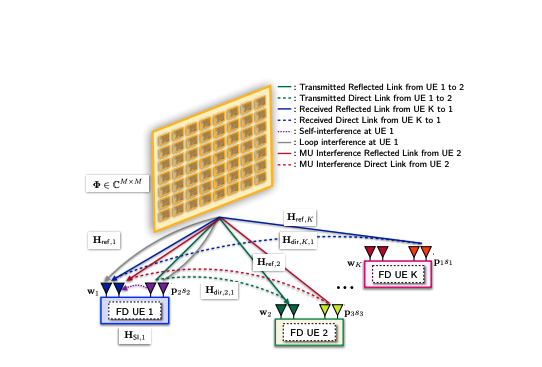
Researchers have developed a new wireless communication system utilizing a reconfigurable intelligent surface (RIS) with unique non-reciprocal (NR) capability, significantly enhancing both performance and security. This NR-RIS acts as a wireless circulator, enabling full-duplex communication where devices can simultaneously transmit and receive data. The system supports multiple users, allowing each to transmit and receive data without interference, and prevents eavesdropping by unauthorized parties.
The core innovation lies in the NR-RIS’s ability to control both the strength and direction of wireless signals with unprecedented precision. Unlike conventional RIS, this NR-RIS can manage signals arriving from and reflecting to multiple devices, creating a one-way communication pathway. This is achieved by manipulating the signals at the surface, suppressing unwanted interference and ensuring secure data transmission. The system model incorporates realistic effects like structural scattering, further improving performance. The team formulated a mathematical problem to maximize data transmission rate and developed an iterative optimization algorithm to find the best RIS configuration, adjusting its settings to optimize signal strength and direction. Simulation results demonstrate that the NR-RIS consistently outperforms conventional and reciprocal RIS designs, particularly as the number of users and antennas increases.
Non-Reciprocal Surfaces Enhance Secure Wireless Transmission
This research introduces a novel application of beyond-diagonal reconfigurable intelligent surfaces (BD-RIS) in full-duplex wireless communication, demonstrating their potential to enhance secure transmission. Researchers demonstrate that a non-reciprocal BD-RIS (NR-BD-RIS) outperforms conventional and reciprocal counterparts by enabling one-way communication between devices and suppressing unwanted signals, preventing eavesdropping. This improved performance stems from the NR-BD-RIS’s ability to control both the phase and magnitude of signals, supporting multiple beam directions simultaneously.
The study validates these advantages through numerical evaluations, showing consistently higher sum-rate performance with the NR-BD-RIS, particularly when supporting multiple communication directions. Analysis of signal power and beam patterns further confirms the ability of the NR-BD-RIS to achieve secure transmission through effective interference management. Investigations into different configurations, including varying group sizes and antenna numbers, reveal that performance increases with greater connectivity and more elements within the BD-RIS. The authors acknowledge that the specific configuration influences performance and that the benefits are most pronounced when direct links between devices are blocked.
🗞 A Secure Full-Duplex Wireless Circulator enabled by Non-Reciprocal Beyond-Diagonal RIS
🧠 ArXiv: https://arxiv.org/abs/2507.23381