Controlling quantum systems presents a significant challenge because even slight disturbances from the environment cause fragile quantum states to degrade, a process known as decoherence. Lixiang Ding from Tongji University, Jingtao Fan from Shanxi University, and Xingze Qiu, also from Tongji University, and their colleagues demonstrate a new method for maintaining quantum control regardless of the specific type of environmental noise. Their research introduces a framework that actively modifies how the quantum system interacts with its surroundings, effectively shielding it from disturbances without needing detailed knowledge of the noise itself. This approach achieves remarkably high fidelity in quantum operations, suppressing errors by orders of magnitude compared to existing methods, and represents a crucial step towards building practical and reliable quantum technologies applicable to diverse hardware platforms.
Quantum Control, Open Systems and Sensing Resources
This document represents a comprehensive compilation of research related to quantum control, open quantum systems, and related topics, covering fundamental theory and practical applications in areas like quantum computing, sensing, and materials science, specifically defects in diamond. It functions as a detailed bibliography and reference list for those working on controlling quantum systems and mitigating the effects of noise. The document explores key themes, beginning with open quantum systems and how they interact with their environment, leading to decoherence and energy loss. It details the mathematical tools used to describe these interactions and covers the principles of quantum control, including optimal control theory and techniques for designing robust control pulses.
Finally, it highlights the use of quantum systems for precise measurements, with a focus on nitrogen-vacancy and silicon-vacancy centers in diamond as sensors. This compilation is useful as a starting point for literature reviews, a source of references for research papers and grant proposals, and a basis for graduate-level course material. It also provides experimentalists with a guide to the theoretical tools used to analyze and control quantum systems, and fosters cross-disciplinary research.
Dynamic Control Shields Quantum Systems From Noise
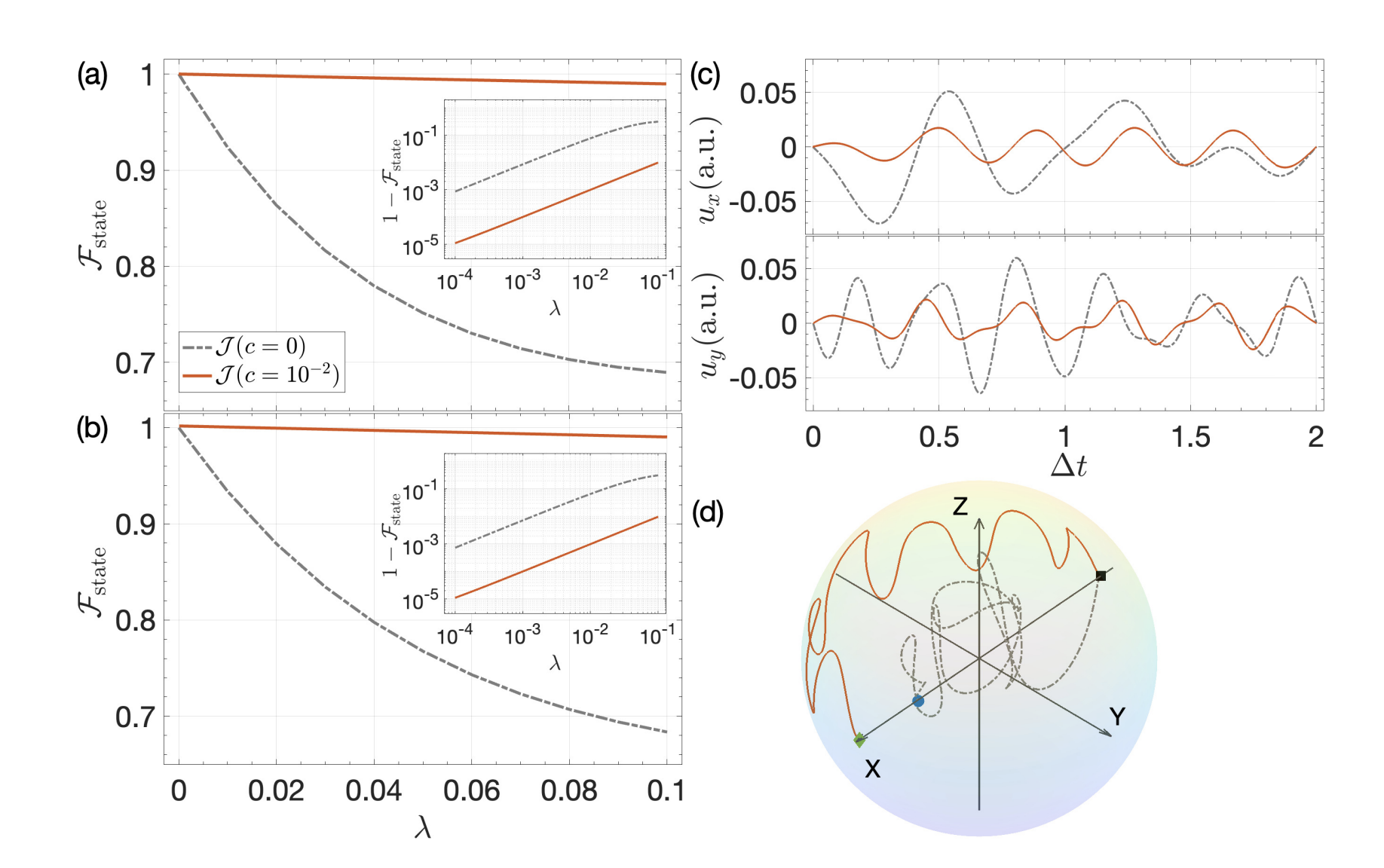
Researchers have developed a new framework for controlling quantum systems that is robust to environmental noise, a major obstacle in developing quantum technologies. The team demonstrates a method for achieving high-fidelity quantum operations without needing detailed prior knowledge of the noise affecting the system. This is achieved by dynamically modifying how the quantum system interacts with its environment through precisely applied control drives, effectively shielding it from disturbances. Validation through simulations of quantum state transfer and gate operations shows this approach significantly suppresses errors, achieving near-perfect performance across a range of noise conditions.
The significance of this work lies in its potential to simplify the development of practical quantum devices. Current methods for mitigating noise often require extensive characterization of the environment, which is challenging and platform-specific. This new framework offers a hardware-agnostic solution applicable to various quantum computing platforms, including circuits, trapped ions, and solid-state systems, and also extends to high-precision quantum sensing. While the demonstrated success is currently for a two-qubit gate, the authors acknowledge that the computational resources needed to optimize this control scheme will increase with system size. Future work will focus on developing more efficient numerical techniques or leveraging machine learning to scale this approach to larger, more complex quantum processors.
Active Noise Suppression via System Control
Researchers have developed a new framework for controlling quantum systems that significantly reduces the impact of environmental noise, a major obstacle to building practical quantum technologies. This approach achieves high-fidelity operations without needing detailed prior knowledge of the specific noise affecting the system, representing a substantial advancement over existing methods. The core innovation lies in actively modifying how the quantum system interacts with its environment through carefully designed control signals. The team’s method focuses on suppressing noise at its source by manipulating the system’s response, rather than attempting to shield it from external disturbances.
This is achieved by constructing control strategies that minimize a newly defined “noise sensitivity” metric, effectively making the system less vulnerable to environmental fluctuations. Remarkably, the framework is universally applicable, working across diverse quantum hardware platforms including superconducting circuits, trapped ions, and solid-state systems. Testing through simulations of quantum state transfer and gate operations demonstrates near-perfect performance, achieving fidelities approaching unity, a significant improvement over standard control techniques. The researchers developed a mathematical tool to quantify noise sensitivity, allowing them to optimize control strategies for maximum robustness. By minimizing this metric, they effectively reduce the system’s susceptibility to environmental disturbances, leading to more reliable and accurate quantum operations. This advancement paves the way for building more stable and scalable quantum technologies, bringing practical quantum computing and communication closer to reality.
🗞 Universally Robust Control of Open Quantum Systems
🧠 ArXiv: https://arxiv.org/abs/2508.07379