


The Royal Swedish Academy of Sciences has awarded the Nobel Prize in Physics 2024 to John J. Hopfield and Geoffrey E. Hinton for their foundational discoveries and inventions that enable machine learning with artificial neural networks. These pioneers used tools from physics to develop methods that are the foundation of today’s powerful machine learning.
Hopfield created an associative memory that can store and reconstruct images and other patterns in data, while Hinton invented a method that can autonomously find properties in data, such as identifying specific elements in pictures. Their work, which dates back to the 1980s, has already had a significant impact on various fields, including physics, where artificial neural networks are used to develop new materials with specific properties.
Foundational Discoveries in Machine Learning with Artificial Neural Networks
The Royal Swedish Academy of Sciences has awarded the Nobel Prize in Physics 2024 to John J. Hopfield and Geoffrey E. Hinton for their foundational discoveries and inventions that enable machine learning with artificial neural networks. Their work, which dates back to the 1980s, has been instrumental in developing methods that are the foundation of today’s powerful machine learning.
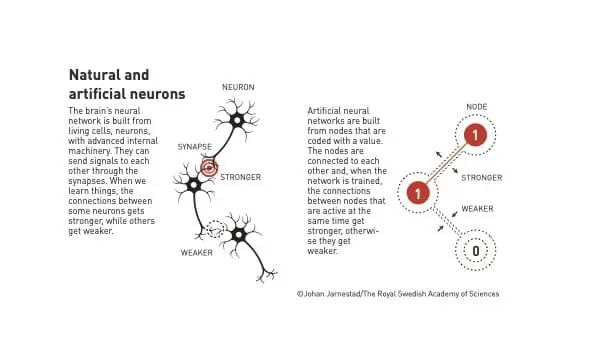
Artificial neural networks were originally inspired by the structure of the brain, where neurons are represented by nodes that have different values and influence each other through connections that can be likened to synapses. The network is trained by developing stronger connections between nodes with simultaneously high values. Hopfield and Hinton’s work has focused on using tools from physics to develop methods for training these networks.
Associative Memory and Pattern Recognition
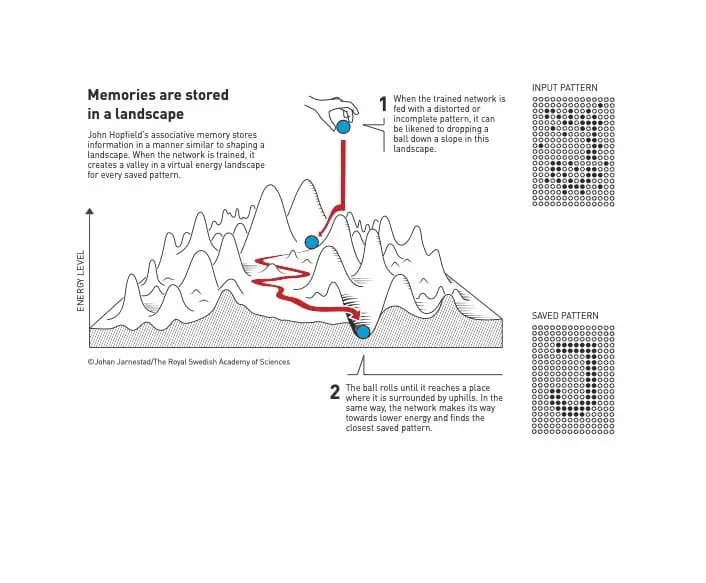
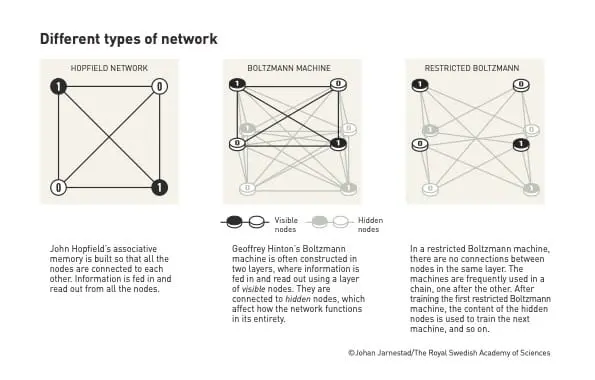
John Hopfield invented a network that uses a method for saving and recreating patterns, known as an associative memory. This network utilizes physics that describes a material’s characteristics due to its atomic spin – a property that makes each atom a tiny magnet. The network as a whole is described in a manner equivalent to the energy in the spin system found in physics, and is trained by finding values for the connections between the nodes so that the saved images have low energy.
When the Hopfield network is fed a distorted or incomplete image, it methodically works through the nodes and updates their values so the network’s energy falls. The network thus works stepwise to find the saved image that is most like the imperfect one it was fed with. This invention has far-reaching implications for pattern recognition and machine learning.
Boltzmann Machines and Statistical Physics
Geoffrey Hinton used the Hopfield network as the foundation for a new network that uses a different method: the Boltzmann machine. This can learn to recognize characteristic elements in a given type of data by using tools from statistical physics, the science of systems built from many similar components. The machine is trained by feeding it examples that are very likely to arise when the machine is run.
The Boltzmann machine can be used to classify images or create new examples of the type of pattern on which it was trained. Hinton has built upon this work, helping initiate the current explosive development of machine learning. His contributions have been instrumental in developing methods for training artificial neural networks that are capable of recognizing patterns and making predictions.
Applications of Artificial Neural Networks
The laureates’ work has already been of the greatest benefit, with applications in a wide range of areas, including physics, where artificial neural networks are used to develop new materials with specific properties. According to Ellen Moons, Chair of the Nobel Committee for Physics, “In physics, we use artificial neural networks in a wide range of areas, such as developing new materials with specific properties.”
Artificial neural networks have also been used in image recognition, natural language processing, and other areas where pattern recognition is essential. The development of these networks has enabled machines to learn from data and make predictions or take actions based on that data.
Impact and Future Directions
Hopfield and Hinton’s work has paved the way for further research into machine learning and artificial neural networks. Their inventions have enabled the development of powerful pattern recognition and prediction tools, which have applications in a wide range of fields.
As machine learning continues to evolve, we will likely see even more sophisticated applications of artificial neural networks in areas such as healthcare, finance, and transportation. The future directions of this research are vast and exciting, with the potential to revolutionize many aspects of our lives.
External Link: Click Here For More


