

The quest for new materials for future spintronic devices focuses increasingly on two-dimensional van der Waals magnets, and recent research into iron-germanium-telluride has revealed intriguing magnetic properties. Bindua May from Oak Ridge National Laboratory, alongside Angela Wittmann and Mathias Kläui from Johannes Gutenberg University Mainz, and their colleagues, now present a detailed investigation into the magnetic domain structures of this material under ambient conditions. They utilise a novel microscope based on nitrogen-vacancy centres to directly image magnetism at the sub-micron scale, revealing a surprising independence of magnetic behaviour from sample thickness down to 15 nanometres. This finding challenges existing assumptions about magnetic anisotropy in these materials and, crucially, offers new insights for designing advanced magnetic memories and logic based on two-dimensional van der Waals magnets.
Nanoscale Magnetometry with Diamond NV Centers
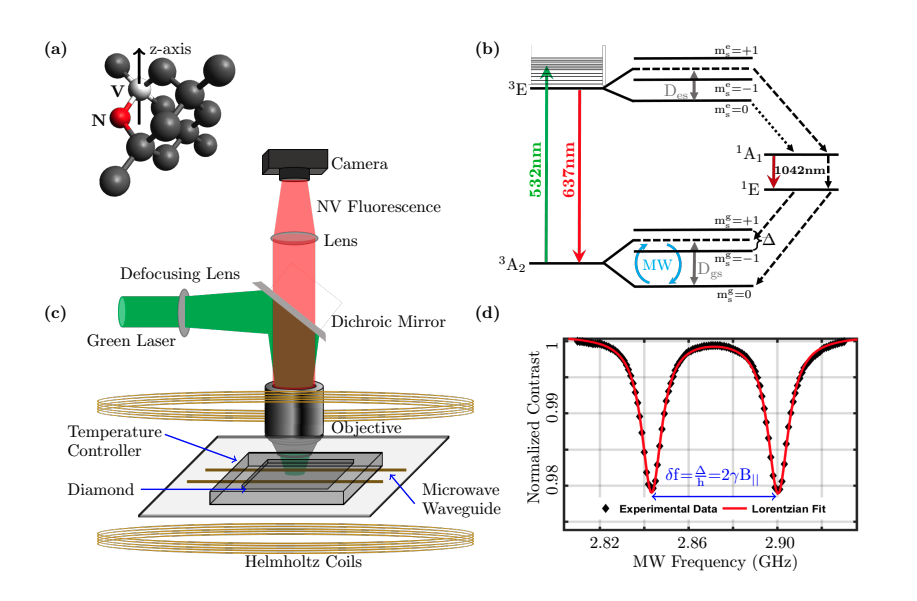
This research centers on a powerful technique for imaging magnetism at the nanoscale using nitrogen-vacancy (NV) centers in diamond. These defects within the diamond structure possess unique quantum properties, making them exceptionally sensitive to magnetic fields. Researchers utilize optically detected magnetic resonance (ODMR) to measure these fields, allowing them to map magnetic structures with unprecedented resolution. This method enables the investigation of materials exhibiting complex magnetic behavior, providing insights into their fundamental properties and potential applications. The team applies this technique to study a range of materials, with a particular focus on two-dimensional materials and van der Waals magnets.
These layered materials offer exciting possibilities for future spintronic devices, and understanding their magnetic properties is crucial for realizing their potential. Researchers investigate magnetic domains and explore how these domains change with temperature and external fields. They also examine magnetic phase transitions and metamagnetic behavior. The results demonstrate the ability to create detailed maps of magnetic fields within these materials, revealing nanoscale magnetic structures and how properties vary with temperature and between layers. Researchers also explore methods for controlling magnetism, such as through doping or applying external fields.
By measuring magnetic susceptibility and reconstructing magnetization distributions, they gain a comprehensive understanding of the magnetic behavior of these materials. This work has significant implications for spintronics, a field aiming to develop electronic devices utilizing electron spin. It advances our understanding of magnetism at the nanoscale, crucial for developing new magnetic materials and devices. This research provides a powerful tool for characterizing the magnetic properties of 2D materials and van der Waals magnets, and demonstrates the potential of NV centers as a versatile quantum sensor for a wide range of applications. Ultimately, this work paves the way for developing novel magnetic storage devices, sensors, and other technologies.
Magnetic Patterns and Transitions in Iron-Germanium-Telluride
Recent advances in two-dimensional materials have focused attention on materials exhibiting magnetism, offering potential for novel devices. Researchers have been investigating Iron-Germanium-Telluride, a material with promising magnetic properties, to understand how its magnetism behaves in ultra-thin flakes. This study utilizes nitrogen-vacancy center magnetic microscopy to directly image the magnetic patterns within these materials at a sub-micron scale, observing how these patterns change with temperature, magnetic field, and flake thickness. The investigation reveals a surprisingly wide spread in the temperature at which the material transitions into a magnetic state, with no clear correlation to the thickness of the flakes.
This suggests that the material’s magnetic behavior is less dependent on its size than previously expected. Importantly, the research demonstrates that magnetic anisotropy appears to have a limited impact on the magnetic behavior of this particular compound. Furthermore, the team discovered previously unknown stripe-like patterns within the material, revealed through both optical and magnetic imaging. These patterns are believed to originate from subtle variations in the material’s composition during its creation and subsequent exposure to air. These findings highlight the importance of interfacial effects in determining the overall magnetic properties of these two-dimensional materials, crucial for designing future spintronic devices, magnetic memories, and logic circuits.
FGT Magnetism Imaged at Nanoscale Resolution
This research successfully demonstrates a high-resolution method for probing the magnetic properties of two-dimensional van der Waals materials, specifically Iron-Germanium-Telluride (FGT). Through nitrogen-vacancy center-based magnetic microscopy, researchers directly imaged the magnetization of FGT flakes down to 15 nanometers, confirming room-temperature ferromagnetism and identifying a Curie temperature ranging from 285 to 315 Kelvin, with no significant dependence on flake thickness. The study also revealed previously unknown stripe features, attributed to variations in the concentration of iron, oxygen, and germanium during crystal growth and subsequent oxidation. Importantly, the findings suggest that magnetic anisotropy does not significantly influence the magnetic behavior of FGT.
The identification of these micron-scale stripe features, and their correlation with compositional variations, highlights the importance of growth conditions in determining the magnetic properties of these materials. Future work using this microscopy technique could investigate current-induced domain-wall motion and further explore the potential of FGT for spintronic devices, magnetic memories, and logic applications. This research provides valuable insights into the magnetic properties of FGT and paves the way for developing innovative technologies based on this promising material.
🗞 Quantum Imaging of Ferromagnetic van der Waals Magnetic Domain Structures at Ambient Conditions
🧠 ArXiv: https://arxiv.org/abs/2507.20245


