The nitrogen-vacancy centre in diamond, a key component in emerging technologies such as quantum sensing and computation, continues to reveal subtle complexities in its behaviour. Kristine Ung, Connor Roncaioli, and Ronald Walsworth from the University of Maryland, along with Sean Blakley at the DEVCOM Army Research Laboratory, have now significantly refined our understanding of this crucial defect. Their research focuses on precisely measuring the energy required to remove an electron from the nitrogen-vacancy centre, a value known as the ionization energy. By carefully observing how light interacts with the centre at different temperatures and wavelengths, the team achieves a two-fold reduction in uncertainty regarding this fundamental property, paving the way for more accurate modelling and improved performance in future quantum devices.
NV− Ionization Energy Limits Quantum Sensing Performance
The nitrogen-vacancy (NV) center in diamond is a powerful tool for quantum sensing, offering exceptional sensitivity for measuring magnetic fields, temperature, and other physical quantities. Realizing its full potential, however, requires a detailed understanding of its energy levels.
Accurately determining the ionization energy of the 1E singlet state within the negatively charged NV center (NV−) is crucial for optimizing its performance in quantum sensing applications. Previous measurements, while providing an initial range of 2.25 to 2.33 electron volts (eV), lacked the resolution needed to refine techniques like spin-to-charge conversion and photoelectric detection of magnetic resonance.
Researchers at the University of Maryland and the US Army Research Laboratory have now significantly refined the measurement of the 1E ionization energy, achieving a two-fold reduction in uncertainty. By meticulously measuring the energy levels as a function of both laser wavelength and diamond temperature, the team has narrowed the range to between 2.29 and 2.33 eV.
This was accomplished through a sophisticated method involving magnetically mediated spin-selective photoluminescence (PL) quenching, where the disappearance of light emission signals when certain wavelengths are used reveals the point at which the 1E state loses an electron. This improved precision directly impacts the development of more sensitive and reliable quantum sensors.
By precisely controlling the energy levels within the NV center, researchers can enhance signal strength and reduce noise, leading to more accurate measurements of a wide range of physical phenomena. This advancement paves the way for breakthroughs in diverse fields, including materials science, biomedical imaging, and fundamental physics research, solidifying the NV center’s position as a cornerstone of future quantum technologies.
Magnetic Field Enhances Triplet State Mixing
A method was developed involving the application of a bias magnetic field of at least 100 mT along the diamond axis, which equally mixes the spin states in the 3E triplet excited state for NV-centres along all four diamond crystallographic axes. This field magnitude and direction increase the population of the 1E state via its interaction with the 3E state, resulting in a measurable increase in NV⁰ photoluminescence (PL) due to 1E photoionization.
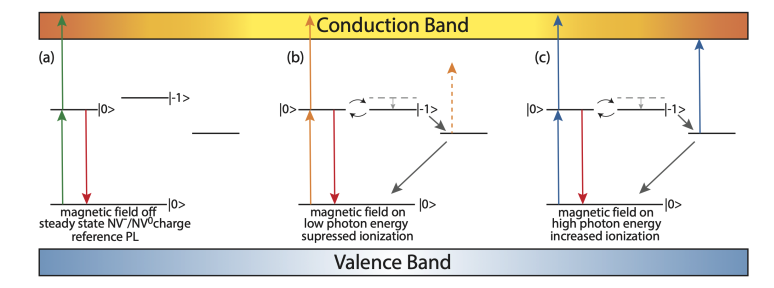
The measurement procedure builds upon a previously used method and proceeds in two steps. First, a reference PL spectrum from the NV− centers is recorded with no bias magnetic field and with illumination from a candidate ionization wavelength. This PL spectrum defines the reference measurement, establishing a steady-state charge configuration ratio between NV− and NV⁰ at the applied ionization wavelength for a system with negligible 1E population.
Without significant 1E population, the only photoionization pathways available are either direct single photon ionization from the ground state or two-photon Auger ionization proceeding through the 3E triplet state. The second step involves recording a PL spectrum with a bias magnetic field of 100 mT for the same ionization wavelength.
The application of the bias magnetic field populates the 1E state via spin-state mixing, opening an additional two-photon ionization pathway. This involves absorption of a photon transitioning from the ground state to the 3E triplet state, followed by decay to 1E.
Once in 1E, an NV− can either ionize via absorption of a second photon of sufficient energy, or remain in 1E if the second photon energy is too small to trigger ionization. If the photon energy is insufficient for NV− ionization from the 1E state, 1E occupancy protects the NV− from two-photon Auger ionization by reducing the population in the 3E state, a process referred to as “1E shelving”.
This shelving mechanism shifts the charge configuration ratio in favor of NV−, reducing the contribution of NV⁰ to the measured PL spectrum. If the photon energy is sufficient to ionize the 1E state, ionization occurs.
NV Centre Ionization Energy Precisely Determined
By measuring the ratio between nitrogen-vacancy (NV) photoluminescence (PL) spectra obtained with and without a 100 mT bias magnetic field, and across a range of temperatures (50 to 150 K), laser excitation wavelengths (450 to 470 nm and 540 to 566 nm), and laser powers (0.1 and 1 mW), researchers determine the 1E ionization energy to be between 2.29 and 2.33 eV. This represents a two-fold reduction in the uncertainty surrounding this quantity, significantly refining previous measurements.
The result further clarifies the range of energies required for direct spin-to-charge conversion from the 1E singlet, a crucial aspect for enhancing the performance of quantum sensors that utilise optically detected magnetic resonance or persistent dark magnetic resonance measurement techniques.
🗞 High Resolution Temperature-Resolved Spectroscopy of the Nitrogen Vacancy Singlet State Ionization Energy
🧠 DOI: https://doi.org/10.48550/arXiv.2507.10291