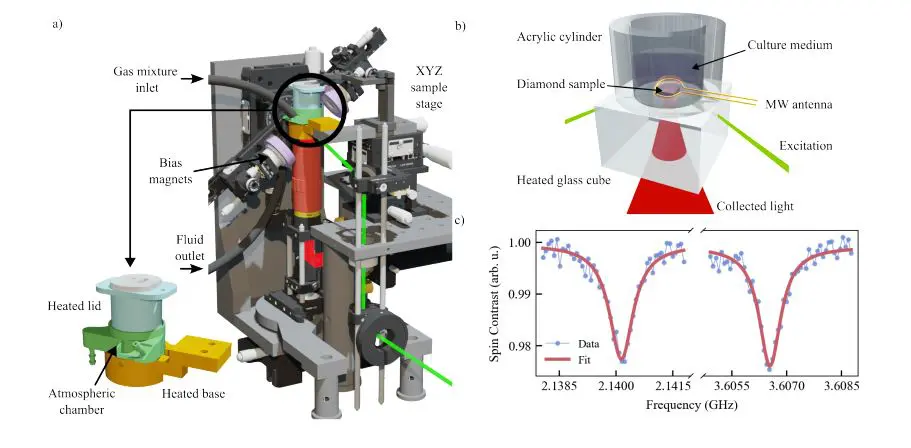
Nitrogen-vacancy centres in diamond represent a powerful, photostable technology for biological imaging through magnetic field detection, yet existing incubation methods hinder its potential for long-term observation of living cells. To address this challenge, A. Pointner, D. Thalheim, S. Belasi, and colleagues have developed a compact incubation platform specifically designed for use with nitrogen-vacancy widefield microscopy. This innovative system maintains precise control over temperature, carbon dioxide levels, and humidity within a biocompatible chamber positioned directly on the diamond surface, overcoming limitations of conventional setups. The team demonstrates the sustained viability and proliferation of HT29 colorectal cancer cells for over 90 hours, alongside successful magnetic imaging of labelled cells, thereby establishing a new capability for real-time monitoring of dynamic cellular processes and opening exciting avenues for biological research.
To address this challenge, scientists have developed a compact incubation platform specifically designed for use with nitrogen-vacancy widefield microscopy. This innovative system maintains precise control over temperature, carbon dioxide levels, and humidity within a biocompatible chamber positioned directly on the diamond surface, overcoming limitations of conventional setups. The system centres around a three-dimensionally printed biocompatible chamber designed to maintain precise environmental control directly on the diamond surface, crucial for sensitive magnetic field detection. Integrated heating elements and a sophisticated temperature control system ensure stable temperatures, while a humidified gas flow maintains optimal humidity levels within the chamber, creating a physiologically relevant environment for live cell observation. This innovative design accommodates the complex constraints of NV widefield microscopy, enabling extended studies previously hindered by environmental instability.
The research team meticulously validated the platform’s performance by cultivating HT29 colorectal cancer cells for a continuous period of 90 hours, demonstrating sustained cell viability and proliferation within the controlled environment. Successful immunomagnetic labeling of these cells allowed for magnetic field imaging after the extended cultivation period, confirming the platform’s compatibility with sensitive detection techniques. The chamber’s geometry was optimized to maximize gas exchange and minimize condensation, further contributing to the stability of the cellular environment. This approach enables real-time monitoring of biological samples on NV widefield magnetometry platforms, opening new avenues for studying dynamic cellular processes with unprecedented sensitivity and temporal resolution. The platform’s modular design allows for easy adaptation to different cell types and experimental conditions, making it a versatile tool for a wide range of biological investigations.,.
Stable Incubation Enables Long-Term Magnetometry
Scientists have developed a new incubation platform that enables long-term biological studies using nitrogen-vacancy (NV) center magnetometry, a technique sensitive to magnetic fields. This system maintains a stable physiological environment for cells directly on the surface of a diamond containing NV centers, overcoming limitations of conventional incubators incompatible with widefield magnetometry. The platform precisely controls temperature, carbon dioxide atmosphere, and humidity, allowing sustained cell viability and proliferation for up to 90 hours of continuous incubation. Experiments demonstrated successful cultivation of HT29 colorectal cancer cells within the system, alongside magnetic field imaging of immunomagnetically labeled cells after extended periods.
The incubation chamber utilizes a 3D-printed biocompatible design with integrated heating elements and humidified gas flow, ensuring a stable environment. Surface functionalization with Fibronectin proved particularly effective in promoting cell adhesion and proliferation, due to its resemblance to the natural cellular environment. While the current system enables extended observation of cellular dynamics, the authors acknowledge limitations including diminished magnetic field labeling homogeneity resulting from cell morphology changes and an elliptical field of view. Future work aims to enhance the platform with real-time carbon dioxide monitoring for closed-loop control, perfusion capabilities for extended cultivation periods, and scalability to multi-well configurations. These improvements promise to broaden the applicability of this incubation system for complex biological investigations requiring long-term cell culture alongside sensitive magnetic field detection using NV widefield magnetometry.
👉 More information
🗞 A Compact Incubation Platform for Long-Term Cultivation of Biological Samples for Nitrogen-Vacancy Center Widefield Microscopy
🧠 ArXiv: https://arxiv.org/abs/2512.14482