
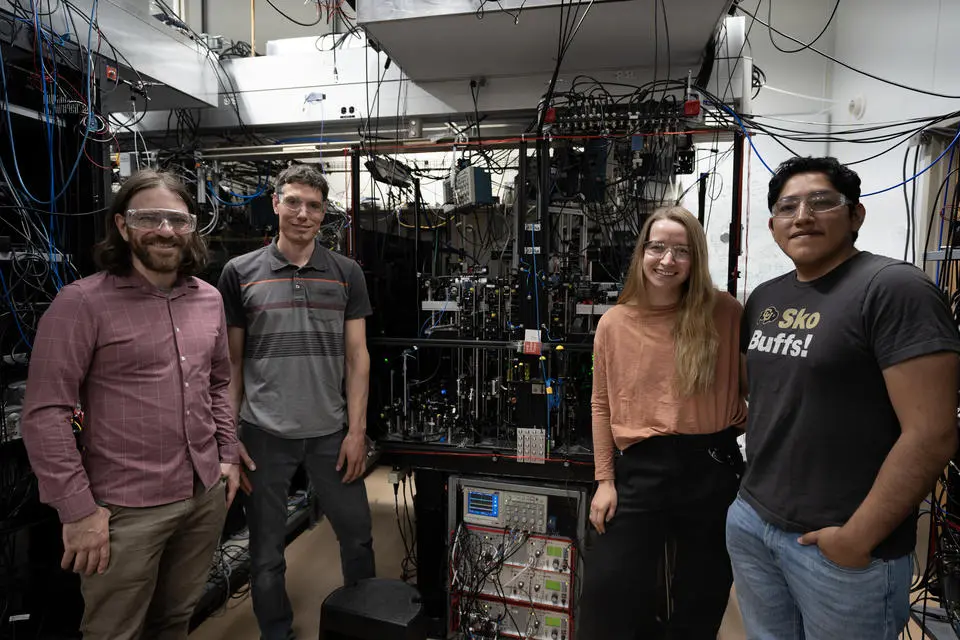
NIST researchers have demonstrably improved atomic clock accuracy by 41%, achieving time measurement to the 19th decimal place following two decades of development. The team overcame significant engineering challenges – including minimising ion disruption within the vacuum chamber and stabilising laser probing over 3.6 kilometres – to surpass previous records. Published on July 14, 2025, this advancement contributes to international efforts to redefine the second and unlocks potential for enhanced geodesy measurements and investigations into fundamental physics, representing a substantial step towards more precise quantum technology applications.
Quantum Clock Achieves Unprecedented Accuracy
The achievement of unprecedented accuracy in this latest iteration of the aluminum ion clock stems from meticulous refinement of multiple interdependent systems. Previous ion clocks have been limited by extraneous physical effects, notably excess micromotion within the ion trap and background gas contamination within the vacuum chamber. The team addressed the former by redesigning the trap structure, mounting it on a thicker diamond wafer and modifying electrode coatings to minimise electric field imbalances and associated ion movement. This intervention was critical in preserving the fidelity of the aluminum ion’s ticking rate.
Addressing the limitations imposed by background gas, the researchers constructed a vacuum chamber from titanium, a material exhibiting significantly lower outgassing rates than conventional steel. This resulted in a 150-fold reduction in residual hydrogen gas, extending continuous operational runtime from approximately 30 minutes to multiple days, and ensuring more consistent measurement conditions.
Further gains in quantum clock accuracy were achieved through collaboration with researchers at JILA, leveraging their ultrastable laser technology. Transmitting this laser beam via fibre optic links over 3.6 kilometres to a frequency comb at NIST allowed for precise comparison and transfer of stability to the aluminum clock laser. This substantially reduced the time required to achieve the stated precision – from three weeks to just one and a half days – by minimising the accumulation of quantum fluctuations during measurement.
The enhanced stability and reduced measurement time position this clock as a valuable tool for both redefining the standard second and for exploring fundamental physical questions. Potential applications extend beyond metrology to include precision geodesy and investigations into the potential variability of fundamental constants, areas where even incremental improvements in timing precision can yield significant insights. The team intends to scale the system by increasing the number of clock ions and exploring the benefits of quantum entanglement, with the aim of further enhancing measurement capabilities.
Advancing Timekeeping Standards
The underlying principle enabling this level of precision is quantum logic spectroscopy. By pairing the aluminum ion – chosen for its superior ticking frequency and environmental stability – with a magnesium ion, researchers circumvented the difficulties associated with directly probing and cooling aluminum. While magnesium lacks the desirable timing characteristics, its ease of laser control allows it to act as an intermediary, facilitating both the cooling of the aluminum ion and the readout of its quantum state via the magnesium ion’s motion.
A significant challenge lay in mitigating excess micromotion within the ion trap. Minute, unintended movements of the ions disrupt the accuracy of the clock by altering their ticking rate. The redesigned trap, mounted on a thicker diamond wafer and featuring modified gold electrode coatings, rectified electric field imbalances and reduced resistance, thereby minimising these disruptive ion movements.
The vacuum system also underwent substantial modification. Diffusion of hydrogen from the steel bodies of conventional vacuum chambers introduced collisions with the ions, limiting operational runtime. Rebuilding the chamber from titanium reduced background hydrogen gas by a factor of 150, extending continuous operation from approximately 30 minutes to multiple days and ensuring more consistent measurement conditions.
The reduction in measurement time to achieve the 19th decimal place – from three weeks to a day and a half – was facilitated by a collaborative effort with JILA researchers. Their ultrastable laser, transmitted via fibre links over 3.6 kilometres to a frequency comb at NIST, allowed for precise comparison with the clock’s laser and the transfer of its stability. This improvement is critical for enhancing quantum clock accuracy and reducing the influence of quantum fluctuations during measurement.
Overcoming Technical Hurdles in Ion Control
Beyond these core improvements to the ion trap and vacuum system, meticulous attention was paid to minimizing extraneous electrical noise. The redesigned trap’s thicker diamond wafer and modified gold electrode coatings not only rectified electric field imbalances but also reduced electrical resistance, further stabilizing the ions’ environment and preserving the fidelity of their quantum state. This attention to detail was crucial in achieving the reported level of quantum clock accuracy.
The collaborative effort with researchers at JILA extended beyond simply providing a stable laser source. The transmission of this ultrastable beam over a 3.6-kilometre fibre link to a frequency comb at NIST represents a significant engineering achievement in itself. This allowed for precise comparison between the JILA laser and the clock’s laser, effectively ‘transferring’ the stability of the former to the aluminum clock laser. This process is essential for reducing the accumulation of quantum fluctuations, which inherently limit the precision of any quantum measurement.
The reduction in measurement time – from three weeks to a day and a half – has implications extending beyond the immediate goal of redefining the second. It opens avenues for new measurements in areas such as geodesy, where even minute variations in time can reveal subtle changes in Earth’s gravitational field. Furthermore, it enhances the potential for investigating fundamental physics beyond the Standard Model, including searching for variations in fundamental constants – a pursuit demanding the highest levels of timing precision attainable with current technology. The team’s ongoing efforts to scale up the system by increasing the number of clock ions and exploring entanglement promise to further enhance these capabilities and push the boundaries of quantum clock accuracy.
Enhancing Stability Through System Refinement
Beyond these physical refinements, meticulous characterization of numerous subtle effects was paramount. The team identified and mitigated sources of noise and instability that, while individually minor, collectively limited precision. This involved detailed analysis of electromagnetic interference, thermal fluctuations, and even vibrations transmitted through the building’s infrastructure.
The collaborative effort with JILA was not merely a provision of a stable laser; it represented a sophisticated integration of disparate technologies. The 3.6-kilometre fibre link, while seemingly straightforward, required precise calibration and compensation for signal degradation and polarization drift. The frequency comb at NIST served as a critical intermediary, translating the JILA laser’s frequency to one compatible with the aluminum clock laser, and enabling a direct, quantifiable comparison of their respective stabilities. This process effectively ‘transferred’ the stability of the JILA laser, renowned for its exceptional performance, to the aluminum ion clock, significantly reducing the influence of quantum fluctuations.
The reduction in measurement time, from three weeks to a day and a half, is not simply a logistical improvement; it represents a fundamental advance in the feasibility of utilizing these clocks for real-world applications. The ability to rapidly assess and calibrate the clock’s performance opens new possibilities for portable, high-precision timekeeping, potentially impacting areas such as satellite navigation, secure communications, and fundamental physics experiments conducted in remote locations. The implications for enhancing quantum clock accuracy extend beyond metrology to enable a broader range of scientific and technological innovation.
Potential Applications and Future Research
Beyond these immediate advancements in precision, the enhanced stability and reduced measurement time inherent in this new generation of clocks facilitate novel scientific investigations. The ability to maintain consistent timing with such fidelity opens avenues for probing subtle variations in Earth’s geodesy – the precise measurement of the planet’s shape, orientation, and gravitational field – with unprecedented resolution. Minute shifts in timing can reveal subtle changes in mass distribution, potentially improving our understanding of plate tectonics, glacial movement, and even groundwater fluctuations.
Furthermore, the clock’s enhanced precision significantly strengthens the potential for investigating fundamental physics beyond the Standard Model. Specifically, the search for variations in fundamental constants – quantities such as the fine-structure constant and the gravitational constant – demands exceptionally precise measurements over extended periods. Even a minuscule drift in these constants could challenge our current understanding of the universe and necessitate revisions to established physical laws. The reduction in averaging time to achieve the 19th decimal place dramatically improves the feasibility of conducting such experiments, enabling longer observation periods and increased sensitivity to potential variations.
The research team’s stated intention to scale up the system by increasing the number of clock ions and exploring the benefits of quantum entanglement represents a logical next step in pushing the boundaries of quantum clock accuracy. Entangling multiple ions – linking their quantum states together – promises to further reduce quantum fluctuations and enhance measurement precision. This approach, while technically challenging, could potentially unlock even greater levels of timing accuracy, paving the way for transformative advancements in metrology, fundamental physics, and beyond. The ultimate limit of achievable quantum clock accuracy remains an open question, but this latest achievement demonstrates the continued potential of ion-based quantum clocks to redefine our understanding of time and its measurement.
More information
External Link: Click Here For More