

Niobium exhibits remarkable superconducting properties, making it a promising material for advanced electronic technologies, and researchers are continually seeking ways to enhance and protect its performance. Wenbin, alongside colleagues at their institutions, investigates the behaviour of niobium films when covered with a thin layer of gold, a common protective measure. Their work demonstrates that this gold capping layer not only shields the niobium from degradation but also surprisingly improves its superconducting capabilities by pinning magnetic vortices, tiny disturbances that can disrupt the flow of current. This discovery is significant because it reveals a pathway to create more robust and efficient superconducting devices, potentially paving the way for innovations in areas like medical imaging and high-speed computing.
Niobium, owing to its superconducting properties, represents an excellent candidate material for superconducting electronics and applications in quantum technology. Researchers perform scanning tunneling microscopy and spectroscopy experiments on niobium films covered by a thin gold film to investigate the characteristics of the interface between the two materials. The work provides evidence for a highly transparent interface between niobium and gold, a characteristic beneficial for device applications. Imaging of Abrikosov vortices in the presence of a perpendicular magnetic field further informs understanding of these hybrid superconducting structures.
Superconductivity, Josephson Junctions and Proximity Effects
A comprehensive body of research underpins the study of superconductivity, Josephson junctions, and related phenomena. Foundational work, such as that by Tinkham, establishes the theoretical framework for understanding superconductivity. Early investigations into proximity effects, like those conducted by Dynes and colleagues, are crucial for comprehending how superconductivity can be induced in neighboring materials. Studies of Andreev reflection, conducted by Bergeal and others, explore the behavior of electrons at the interface between a superconductor and a normal metal. Further research by Moussy and colleagues, and Gurevich and Kubo, delves into the intricacies of Josephson junctions and non-equilibrium superconductivity, while Il’in and coworkers contribute to the theoretical understanding of superconducting behavior.
Significant attention has been given to superconductivity in two-dimensional materials. Emtsev and colleagues pioneered early work on graphene and its potential for superconductivity, while Sabattini, Kumar, and Gupta have all contributed to understanding superconductivity within these materials. A particularly active area of research focuses on topological superconductivity and the search for Majorana zero modes, exotic states of matter with potential applications in quantum computing. Kim, Kiselov, Mel’nikov, and Chang have all contributed theoretical and experimental work in this field, alongside de Ory, Bal, and Stolyarov.
These investigations often involve combining superconductors with other materials to create hybrid structures, as explored by Nishio and Kim. Furthermore, research into non-equilibrium superconductivity, conducted by Eskildsen and Crétinon, examines superconducting behavior under conditions driven away from thermal equilibrium. Theoretical and computational work, such as that by Gubin and Kubo, provides essential models and calculations to support experimental observations. Overall, this body of research demonstrates a strong focus on Majorana zero modes and a combination of theoretical and experimental approaches. The recent publications reflect the rapid progress in this field and its interdisciplinary nature, drawing on concepts from condensed matter physics, materials science, and quantum information theory.
Gold Protects Niobium Superconductivity for Device Study
Niobium exhibits excellent superconducting properties and is a promising material for advanced electronic devices, particularly those involved in emerging quantum technologies. Recent research has focused on understanding how to maintain these properties when the niobium is exposed to real-world conditions and integrated into complex structures. Researchers have demonstrated a method for protecting niobium films with an ultra-thin layer of gold, preserving superconductivity while allowing for detailed study using advanced microscopy techniques. The team investigated the interface between niobium and gold, finding it to be remarkably transparent to superconducting electrons, a crucial factor for device performance.
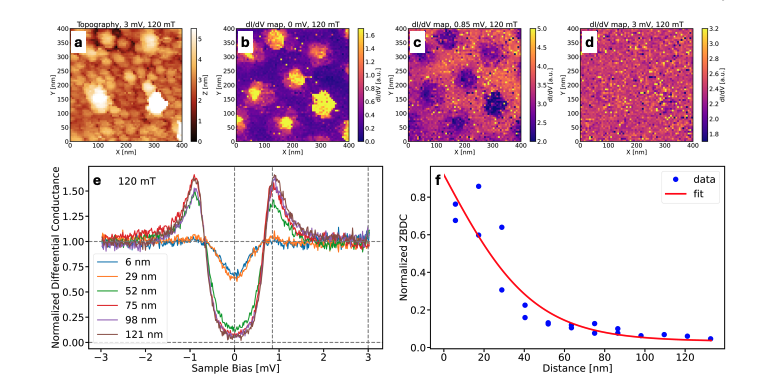
This transparency allows superconducting signals to extend through the gold layer, enabling the study of the underlying niobium. Measurements reveal robust and homogeneous superconducting behavior in the niobium films, even with the gold capping layer, confirming the protective effect of the gold and its minimal disruption to superconductivity. Furthermore, the study visualized the behavior of magnetic vortices within the niobium films when exposed to a magnetic field. These vortices were found to be effectively pinned by the granular structure of the polycrystalline gold layer, preventing them from moving freely and potentially disrupting superconductivity.
This pinning effect is significant because uncontrolled vortex motion can lead to energy loss and decoherence in sensitive quantum devices. The research builds on previous work that struggled with surface oxidation of niobium, a common problem that hinders detailed study. By using a thin gold layer, the team circumvented this issue, creating a stable surface suitable for scanning tunneling microscopy and spectroscopy. The resulting data confirms that this approach maintains the desirable properties of niobium, including a critical temperature around 8 Kelvin and a coherence length of approximately 10. 5 nanometers, values comparable to bulk niobium. This combination of protection and preserved superconducting characteristics positions niobium-gold films as a strong candidate for future quantum technologies and sensitive electronic devices.
Niobium Superconductivity and Vortex Pinning in Gold
This research demonstrates robust superconducting properties in thin niobium films protected by a gold capping layer. The experiments reveal a highly transparent interface between the two metals, which is beneficial for potential device applications, and confirm the preservation of superconductivity despite the presence of the gold layer. Importantly, the study provides direct observation of Abrikosov vortices within the niobium film when exposed to a magnetic field, and shows these vortices are effectively pinned by the granular structure of the polycrystalline gold film. Quantitative analysis of the data yields a coherence length of approximately 31.
II superconductor. The researchers note that the gold film broadens the vortices at the surface, and that the structure of the gold film influences the proximity effect. While the study provides detailed insights into the behaviour of these films, the authors acknowledge that further investigation is needed to fully understand the interplay between the gold layer, vortex pinning, and the proximity effect. They suggest that future work could explore the impact of varying the gold film’s structure and thickness on the superconducting properties of the niobium layer.
🗞 Vortex Pinning in Niobium covered by a thin polycrystalline Gold
🧠 ArXiv: https://arxiv.org/abs/2507.22515


