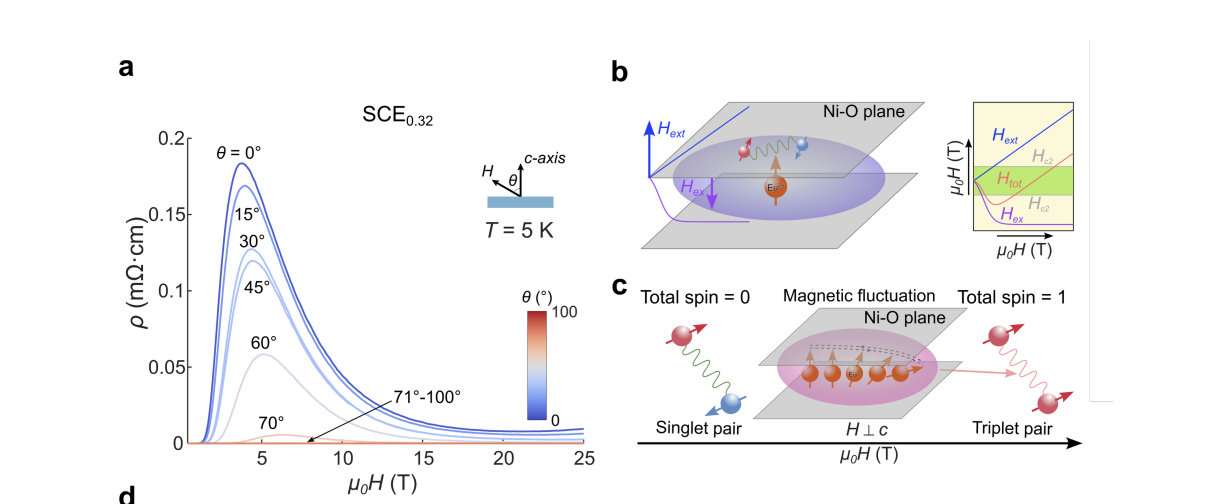
The pursuit of materials exhibiting both superconductivity and ferromagnetism presents a significant challenge in condensed matter physics, as these two states typically oppose one another. Now, Mingwei Zhang and colleagues at the University of Science and Technology of China, along with collaborators, report the surprising discovery of robust, field-induced superconductivity in a heavily europium-doped infinite-layer nickelate. This material demonstrates a remarkable ability to regain superconductivity under strong magnetic fields, over 6 Tesla, after the initial superconducting state has been suppressed, and this high-field phase persists to at least 45 Tesla. The coexistence of ferromagnetism and superconductivity within the same material, occurring on separate atomic layers, establishes infinite-layer nickelates as a promising new platform for exploring high-temperature superconductivity and potentially unlocking unconventional phases in strongly correlated materials.
Reinducing Superconductivity with Strong Magnetic Fields
Researchers have discovered a surprising way to restore superconductivity in a specific nickelate material, even after it has been suppressed by strong magnetic fields. This re-entrant superconductivity, observed in thin films doped with europium, challenges conventional understanding of how superconductivity behaves in the presence of magnetism and opens new avenues for exploring high-temperature superconductivity. The team meticulously grew these thin films, carefully controlling the amount of europium incorporated into the material’s structure to manipulate its electronic properties and induce this unusual behaviour. The key finding is that superconductivity reappears under high magnetic fields, exceeding 6 Tesla and persisting up to 45 Tesla, after being initially suppressed.
This suggests a complex interplay between magnetism and superconductivity, where the magnetic field somehow reinstates the superconducting state. Detailed measurements of electrical resistance, magnetic properties, and the Hall effect confirmed this re-entrant behaviour and provided insights into the material’s electronic structure. The researchers propose that the coexistence of ferromagnetic and superconducting regions within the material, stabilized by a delicate balance of internal and external magnetic fields, is crucial for this phenomenon. Introducing europium into the nickelate material creates a unique electronic environment.
While increasing europium initially suppresses superconductivity, a specific concentration allows superconductivity to re-emerge under strong magnetic fields. This doping process introduces ‘holes’ into the material, altering its electronic structure and influencing the superconducting transition temperature, which reached approximately 30 Kelvin in optimal conditions. The Hall effect measurements revealed an unexpected anomaly at higher doping levels, indicating a fundamental change in the material’s electronic structure and the way electrons move through it. This research establishes infinite-layer nickelates as a promising platform for exploring high-temperature superconductivity and unconventional quantum phases of matter. The discovery of robust, high-field induced re-entrant superconductivity challenges conventional understanding and expands the possibilities for manipulating and controlling these exotic superconducting states. Further investigation is needed to fully understand the underlying mechanisms driving this re-entrant behaviour, potentially revealing a hidden quantum critical point and the role of magnetic scattering in electron transport.
Europium-Doped Nickelate Crystals Grown for Superconductivity
Researchers have successfully grown crystals of a nickelate compound doped with europium, demonstrating a novel approach to manipulating the interplay between superconductivity and magnetism. By carefully controlling the amount of europium incorporated into the material, the team aimed to create a system where these two typically opposing phenomena could coexist. This strategy diverges from traditional high-temperature superconductor research, which often focuses on materials where magnetism and superconductivity are mutually exclusive. The team meticulously grew crystals with varying europium concentrations and characterised their electrical properties by measuring resistance over a range of temperatures.
They discovered that while increasing europium influences superconductivity, applying strong magnetic fields reveals a surprising phenomenon: superconductivity reappears after being initially suppressed. This ‘re-entrant’ superconductivity, observed at fields exceeding 6 Tesla and persisting up to 45 Tesla, suggests a complex interplay between magnetism and superconductivity, where the magnetic field somehow reinstates the superconducting state. Detailed measurements of the Hall effect further supported the idea that europium doping fundamentally alters the material’s electronic structure. By analysing how the material scatters electrons at different temperatures, the team identified a transition to a more complex ‘correlated Fermi-liquid’ state.
This analysis, combined with the observation of re-entrant superconductivity, suggests that the europium dopants are not merely introducing charge carriers, but are actively mediating interactions between electrons, potentially enhancing the superconducting state. This combination of precise materials growth, detailed electrical measurements under extreme conditions, and sophisticated data analysis provides a unique platform for exploring the frontiers of high-temperature superconductivity and unconventional quantum phases of matter. The research highlights the potential of europium-doped nickelates for understanding and potentially engineering new quantum materials with enhanced superconducting properties.
Re-entrant Superconductivity in Modified Nickelate Material
Researchers have discovered a robust form of superconductivity that reappears under strong magnetic fields in a heavily modified nickelate material, opening new avenues for exploring high-temperature superconductivity. The team focused on a material containing nickel, oxygen, calcium, europium, and strontium, systematically increasing the amount of europium to finely tune its electronic properties. They observed that while increasing europium initially suppresses superconductivity, a remarkable re-entrant superconducting state emerges under high magnetic fields, around 6 Tesla, persisting even in fields exceeding 45 Tesla. This is particularly noteworthy as it represents a superconducting state that reappears after being seemingly destroyed by a strong magnetic field.
The key to this unusual behaviour lies in the interplay between magnetism and superconductivity within the material. The researchers found that the europium ions exhibit ferromagnetism, while the nickel-oxygen layers remain superconducting, creating distinct magnetic and superconducting regions within the same material. This coexistence, previously rare in high-temperature superconductors, appears to be stabilized by a delicate balance between internal and external magnetic fields, alongside enhanced pairing due to magnetic fluctuations. Detailed analysis of the material’s electrical resistance and magnetic properties revealed a unique doping effect.
Increasing europium introduces ‘holes’ into the material, effectively changing its electronic structure and influencing the superconducting transition temperature, which reached approximately 30 Kelvin in optimal conditions. The team observed a non-monotonic relationship between europium concentration and superconductivity, with an optimal doping level maximizing the transition temperature. Hall effect measurements confirmed the hole-doping effect of europium and revealed an unexpected anomaly at higher doping levels, indicating a fundamental change in the material’s electronic structure. This combination of ferromagnetic and superconducting behaviour, coupled with the broadened superconducting range and unique doping effects, establishes this nickelate material as a promising platform for exploring unconventional superconductivity and potentially engineering new quantum phases of matter.
Re-entrant Superconductivity in Nickelate Thin Films
Researchers have demonstrated the emergence of robust, high-field induced re-entrant superconductivity in heavily europium-doped infinite-layer nickelate thin films, a phenomenon previously elusive in high-temperature superconductors. They observed that superconductivity reappears under strong magnetic fields, up to 45 Tesla, after being initially suppressed, indicating a unique state where superconductivity and ferromagnetism coexist on separate parts of the material. This coexistence arises from a balance between external and internal magnetic fields, combined with enhanced pairing due to magnetic fluctuations. The discovery establishes infinite-layer nickelates as a promising platform for exploring high-temperature ferromagnetic superconductivity and expands the understanding of unconventional superconductivity in strongly correlated electron systems. While the research reveals a wide range of europium doping levels and a distinct phase diagram, further investigation is needed to fully understand the underlying mechanisms driving this re-entrant behaviour.
🗞 Robust field re-entrant superconductivity in ferromagnetic infinite-layer rare-earth nickelates
🧠 ArXiv: https://arxiv.org/abs/2508.14666