

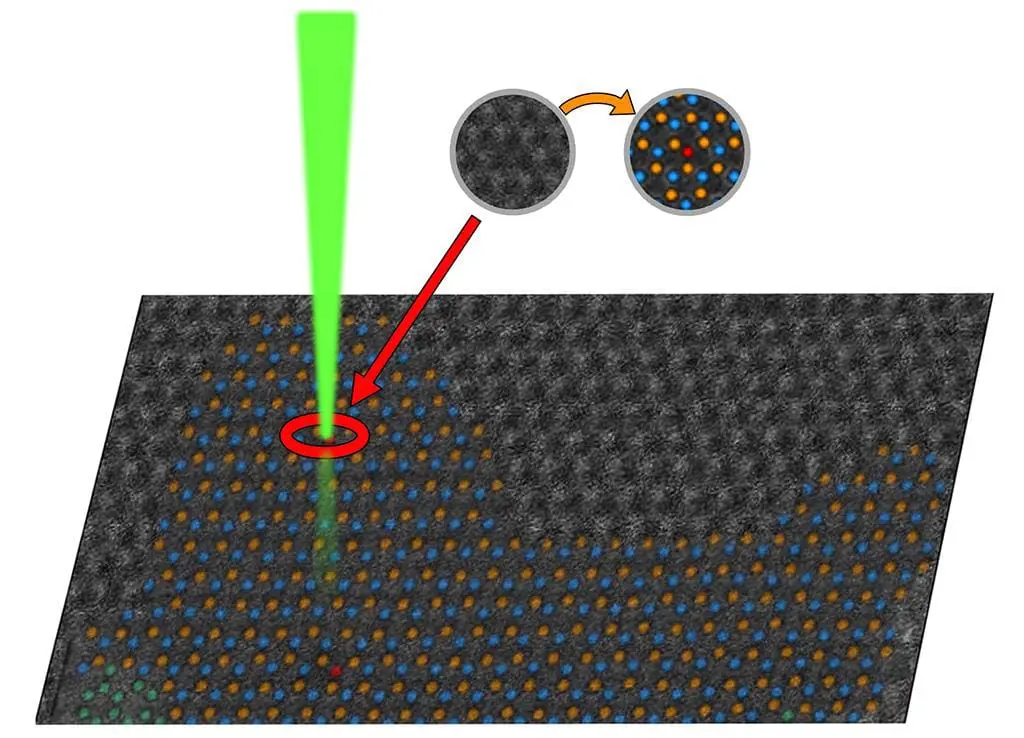
A breakthrough technique developed by researchers at the Department of Energy’s Oak Ridge National Laboratory is poised to unlock the potential of quantum materials. The Rapid Object Detection and Action System, or RODAS, combines imaging, spectroscopy, and microscopy methods to capture the properties of fleeting atomic structures as they form. This innovation enables scientists to study materials at the atomic level in real-time, without damaging the sample.
Led by Kevin Roccapriore, the research team demonstrated their technique on single-layer molybdenum disulfide, a promising semiconductor material for quantum computing and optics applications. By studying this material, scientists hope to answer vital questions about optical or electronic properties at the atomic scale. The RODAS technique represents a significant leap forward in materials characterization, empowering researchers to dynamically explore structure-property relationships during analysis.
This technology has the potential to push the boundaries in computing, electronics, and beyond, ultimately enabling the development of transformative technologies.
Unlocking the Potential of Quantum Materials with Advanced Electron Microscopy
The development of advanced materials for quantum computing and electronics has been hindered by the limitations of traditional electron microscopy techniques. However, a research team led by the Department of Energy’s Oak Ridge National Laboratory has devised a novel method to observe changes in materials at the atomic level, opening new avenues for understanding and developing these materials.
Overcoming Limitations of Traditional Techniques
Traditional approaches combining scanning transmission electron microscopy (STEM) with electron energy loss spectroscopy (EELS) have been limited by the fact that the electron beam can change or degrade the materials being analyzed. This dynamic often causes scientists to measure altered states rather than the intended material properties. The new technique, called the Rapid Object Detection and Action System (RODAS), overcomes this limitation by integrating imaging, spectroscopy, and microscopy methods to capture the properties of fleeting atomic structures as they form.
Real-Time Analysis with Machine Learning
RODAS focuses only on areas of interest, enabling rapid analysis in seconds or milliseconds compared to sometimes several minutes required by other STEM-EELS methods. Importantly, RODAS extracts crucial information without destroying the sample. The system integrates dynamic computer-vision-enabled imaging, which uses real-time machine learning to analyze the specimen.
Understanding Defect Configurations
All materials have defects, and these defects can directly influence virtually any of a material’s properties, whether electronic, mechanical, or quantum. Defects can arrange themselves in a variety of ways at the atomic level, both intrinsically and in response to external stimuli, such as electron beam irradiation. Understanding defect configurations is crucial for developing next-generation materials. By empowering researchers with knowledge of these configurations, they could intentionally create a specific configuration to produce a specific property.
Unleashing Quantum Materials’ Potential
The research team demonstrated their technique on single-layer molybdenum disulfide, a promising semiconductor material for quantum computing and optics applications. Molybdenum disulfide is particularly interesting because it can emit single photons from defects known as single sulfur vacancies. By studying molybdenum disulfide and similar single-layer materials, scientists hope to answer vital questions about optical or electronic properties at the atomic scale.
New Frontier in Materials Science
The RODAS technique represents a significant leap forward in materials characterization. It empowers researchers to dynamically explore structure-property relationships during analysis, target specific atoms or defects for measurement as they form, efficiently collect data on various defect types, adapt to identify new atomic or defect classes in real time, and minimize sample damage while maintaining detailed analysis. By applying this technology to a single layer of vanadium-doped molybdenum disulfide, the research team gained new understanding of defect formation and evolution under electron beam exposure. This approach allows for exploring and characterizing materials in dynamic states, offering a deeper knowledge of how materials behave under various stimuli.
The development of advanced materials for quantum computing and electronics has been hindered by the limitations of traditional electron microscopy techniques. However, with the advent of RODAS, researchers are now empowered to unlock the potential of these materials, pushing the boundaries in computing, electronics, and beyond, and ultimately enabling the development of transformative technologies.
External Link: Click Here For More


