

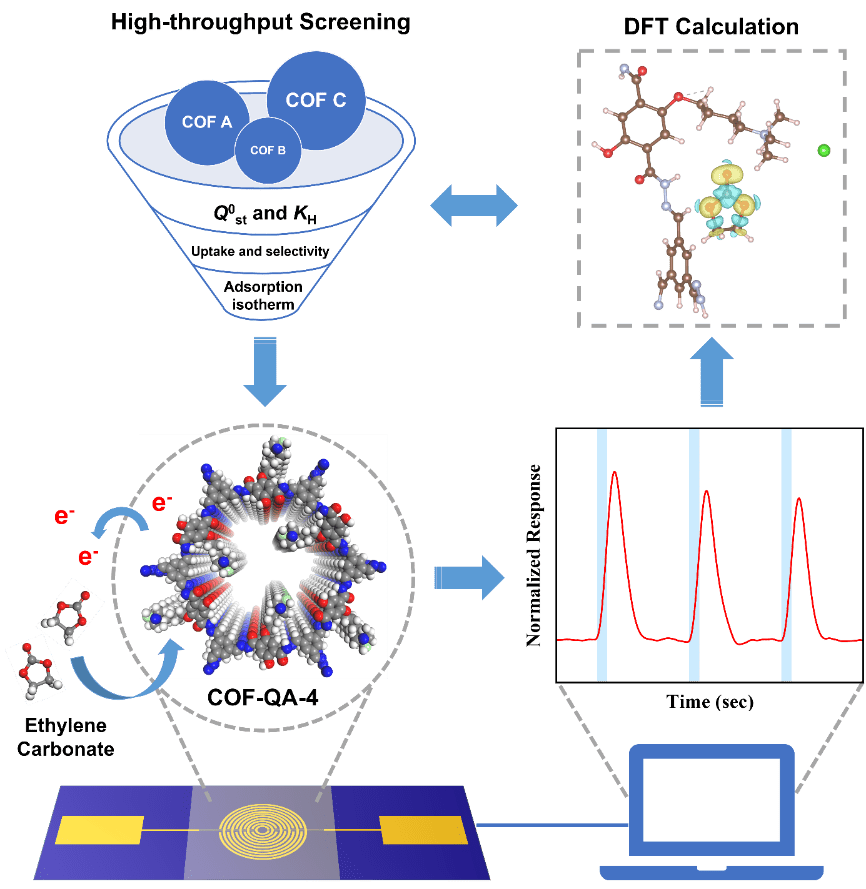
Researchers at Xi’an Jiaotong-Liverpool University (XJTLU) in China and the University of Liverpool in the UK have developed a new sensor designed to detect dangerous gas leaks in lithium-ion batteries. The sensor identifies trace amounts of ethylene carbonate (EC), a key electrolyte component, using covalent organic frameworks (COFs). This technology aims to enhance battery safety by enabling early detection of potential failures, which could prevent fires and explosions in devices ranging from smartphones to electric vehicles.
New sensor could help prevent lithium-ion battery fires and explosions
Lithium-ion batteries are integral to modern technology, powering devices from smartphones to electric vehicles. However, their widespread use is accompanied by significant safety risks. Failures in these batteries can lead to dangerous incidents such as fires or explosions, highlighting the urgent need for improved safety measures.
Researchers at Xi’an Jiaotong-Liverpool University have developed a novel gas sensor designed to detect early signs of battery failure. This innovation focuses on identifying ethylene carbonate (EC) vapors, a key component in battery electrolytes, which can indicate potential issues before they escalate into disasters. The sensor’s ability to detect EC at low concentrations ensures timely intervention.
The technology behind this advancement utilizes covalent organic frameworks (COFs), engineered for selective gas detection. Through computational screening, the researchers identified COF-QA-4 as the optimal material, offering high sensitivity and selectivity. This approach allows the sensor to detect EC vapors at concentrations as low as 1.15 parts per million, providing an early warning system crucial for preventing catastrophic failures.
The applications of this gas sensor extend beyond electric vehicles. It can be integrated into various systems, including smart home devices and industrial safety measures, enhancing overall safety across multiple sectors. By enabling proactive monitoring, the sensor contributes to a safer environment, potentially saving lives and protecting property from battery-related incidents.
Key developments in lithium-ion battery safety
The development of a gas sensor capable of detecting ethylene carbonate (EC) vapors at low concentrations represents a significant advancement in lithium-ion battery safety. EC, a critical component of battery electrolytes, can indicate potential failure modes such as thermal runaway or leakage. The ability to detect EC at 1.15 parts per million ensures timely intervention, reducing the risk of catastrophic failures.
The sensor’s design leverages covalent organic frameworks (COFs), materials engineered for selective gas detection. Computational screening identified COF-QA-4 as the optimal material, offering high sensitivity and selectivity to EC vapors. This capability is achieved through the use of covalent organic frameworks (COFs), materials engineered for selective gas detection.
The sensor’s reliability under varying conditions ensures consistent performance, making it a valuable tool for industries reliant on lithium-ion batteries. By enabling proactive monitoring of battery health, the sensor supports predictive maintenance and reduces the likelihood of accidents, enhancing safety across multiple sectors.
Applications of advanced gas sensing technology
Beyond electric vehicles, the gas sensor’s applications extend to smart home devices and industrial safety measures. This technology enhances overall safety by enabling proactive monitoring of lithium-ion batteries in various settings. By detecting ethylene carbonate (EC) vapors at concentrations as low as 1.15 parts per million, the sensor provides an early warning system crucial for preventing catastrophic failures.
The integration of this advanced gas sensing technology into diverse systems contributes to a safer environment, potentially saving lives and protecting property from battery-related incidents. Its ability to detect EC vapors ensures timely intervention, reducing risks associated with thermal runaway or leakage in lithium-ion batteries.
Research highlights: Electrolyte leakage detection using COFs
Researchers at Xi’an Jiaotong-Liverpool University have developed a gas sensor that detects ethylene carbonate (EC) vapors, a critical component of lithium-ion battery electrolytes. This innovation identifies early signs of battery failure, such as thermal runaway or leakage, which can lead to dangerous incidents like fires or explosions.
The sensor’s ability to detect EC at concentrations as low as 1.15 parts per million is achieved through the use of covalent organic frameworks (COFs). Computational screening identified COF-QA-4 as the optimal material for this application, offering high sensitivity and selectivity to EC vapors. This capability ensures timely intervention, reducing the risk of catastrophic failures in lithium-ion batteries.
The sensor’s reliability under varying conditions makes it a valuable tool for industries reliant on lithium-ion batteries. By enabling proactive monitoring of battery health, the sensor supports predictive maintenance and reduces the likelihood of accidents, enhancing safety across multiple sectors.
More information
External Link: Click Here For More


