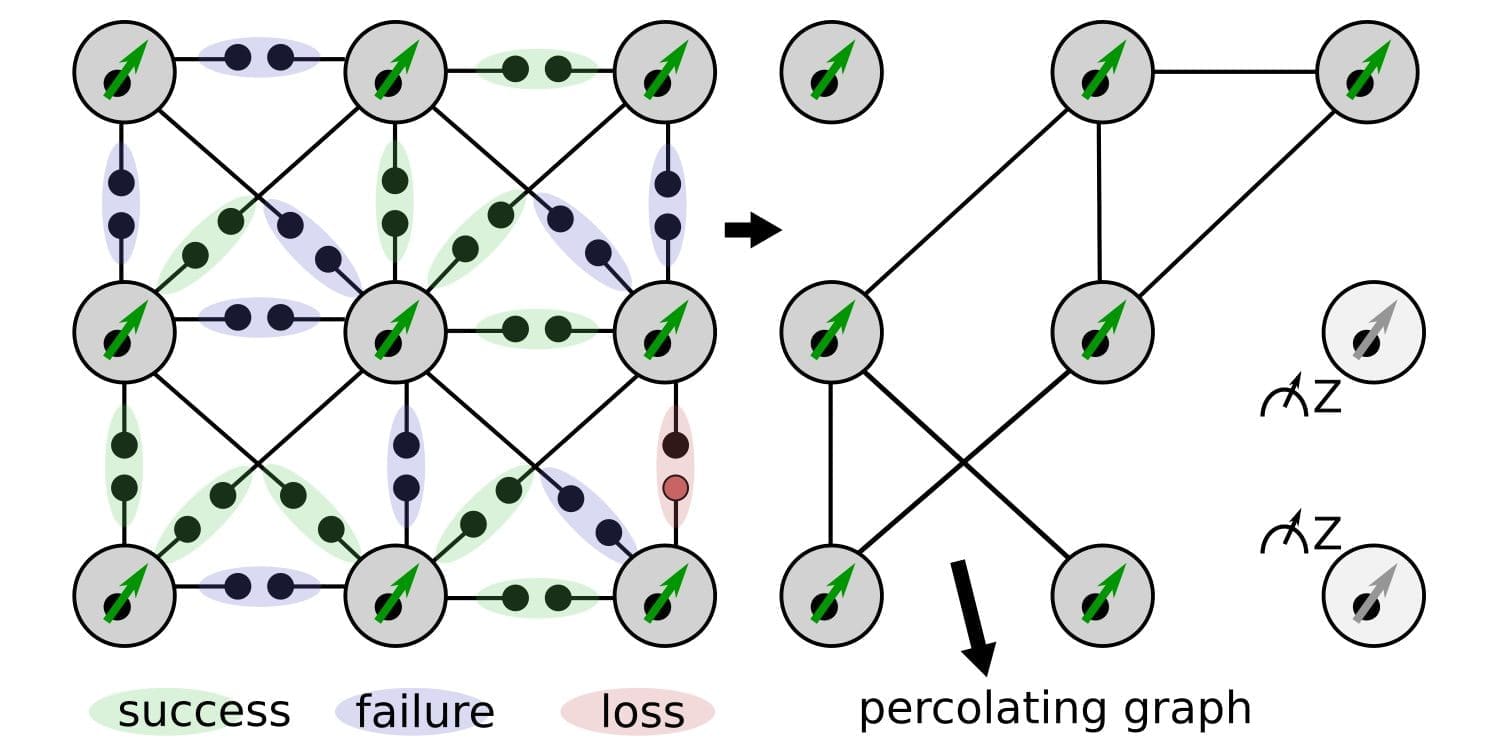
Researchers from the Center for Hybrid Quantum Networks HyQ and the NNF Quantum Computing Programme at the Niels Bohr Institute, University of Copenhagen, have developed a new architecture for measurement-based quantum computing. The architecture uses photonic quantum emitters and spin-photon entanglement to construct a large spin-qubit cluster state. This approach improves photon loss tolerance and is designed for emitters with limited memory capabilities. The architecture combines the advantages of spin-based and photon-based platforms, enabling full-scale quantum computing. It also removes the need for feedback on flying qubits and unheralded loss of the qubits in the final cluster state.
What is the New Architecture for Quantum Computing?
The article discusses a new architecture for measurement-based quantum computing using photonic quantum emitters. This architecture uses spin-photon entanglement as resource states and standard Bell measurements of photons for fusing them into a large spin-qubit cluster state. The scheme is designed for emitters with limited memory capabilities, as it only uses an initial non-adaptive ballistic fusion process to construct a fully percolated graph state of multiple emitters.
The architecture improves the photon loss tolerance significantly compared to similar all-photonic schemes. This is achieved by exploring various geometrical constructions for fusing entangled photons from deterministic emitters. The architecture is developed by Matthias C Löbl, Stefano Paesani, and Anders S Sørensen from the Center for Hybrid Quantum Networks HyQ at The Niels Bohr Institute, University of Copenhagen, and the NNF Quantum Computing Programme at the Niels Bohr Institute, University of Copenhagen, Denmark.
How Does Measurement-Based Quantum Computing Work?
Measurement-based quantum computing requires the generation of large graph states or cluster states, followed by measurements on them. This approach is particularly promising for photonic systems, as quantum operations can be implemented with linear optics and photon detectors only. The required photonic cluster states can be created from small resource states by connecting them through so-called fusion processes.
However, this approach has several challenges. First, fusions are probabilistic and consume photonic qubits. Furthermore, photons travel at immense speed, which necessitates long delay lines to implement conditional feedback operations. Most critically, however, photons are easily lost, which puts stringent bounds on the required photon efficiency.
What are the Challenges and Solutions in Quantum Computing?
The challenges in quantum computing include the probabilistic nature of fusions, the immense speed of photons, and the ease with which photons are lost. These challenges put stringent bounds on the required photon efficiency. Recent schemes require efficiencies of 97.5%, which is above the typical values of photonic platforms.
Fortunately, there are promising new methods to generate large resource states. In particular, quantum emitters such as quantum dots enable generating them in a deterministic and thus scalable way. These emitters have high photon efficiencies on-chip and end-to-end. The largest photonic resource states that have ever been generated are GHZ-states made with a quantum emitter.
How Does the New Architecture Improve Quantum Computing?
The new architecture for quantum computing uses star-shaped resource states locally equivalent to GHZ states with a central spin qubit. The spin is entangled with several photonic leaf-qubits, where the connections represent the entanglement properties. From these resource states, a large spin cluster state is generated via rotated type-II fusions or Bell measurements on the photons.
The proposed hybrid approach combines the advantages of spin-based and photon-based platforms. Spins in quantum dots are excellent photon emitters with coherence times much longer than qubit initialization, readout, and manipulation. The photons provide a fast link between the static spins, enabling full-scale quantum computing.
What are the Advantages of the New Architecture?
The new architecture for quantum computing has several advantages. It removes the need to implement feedback on flying qubits as well as unheralded loss of the qubits in the final cluster state. The latter poses a challenge to purely photonic approaches.
The architecture does not use a repeat-until-success strategy that creates an immense overhead in the number of qubits and requires long coherence times of the qubits. All fusions are performed in one shot ballistically, enabling a high overall clock speed. The architecture can operate loss-tolerantly without boosting the fusion success probability with ancillary photons. It only requires rotated type-II fusions, where success, failure, and photon loss are heralded on the detection pattern. All these features keep the experimental overhead low and make the approach particularly feasible.
Publication details: “Loss-tolerant architecture for quantum computing with quantum emitters”
Publication Date: 2024-03-28
Authors: Matthias C. Löbl, Stefano Paesani and Anders S. Sørensen
Source: Quantum (Vienna)
DOI: https://doi.org/10.22331/q-2024-03-28-1302