

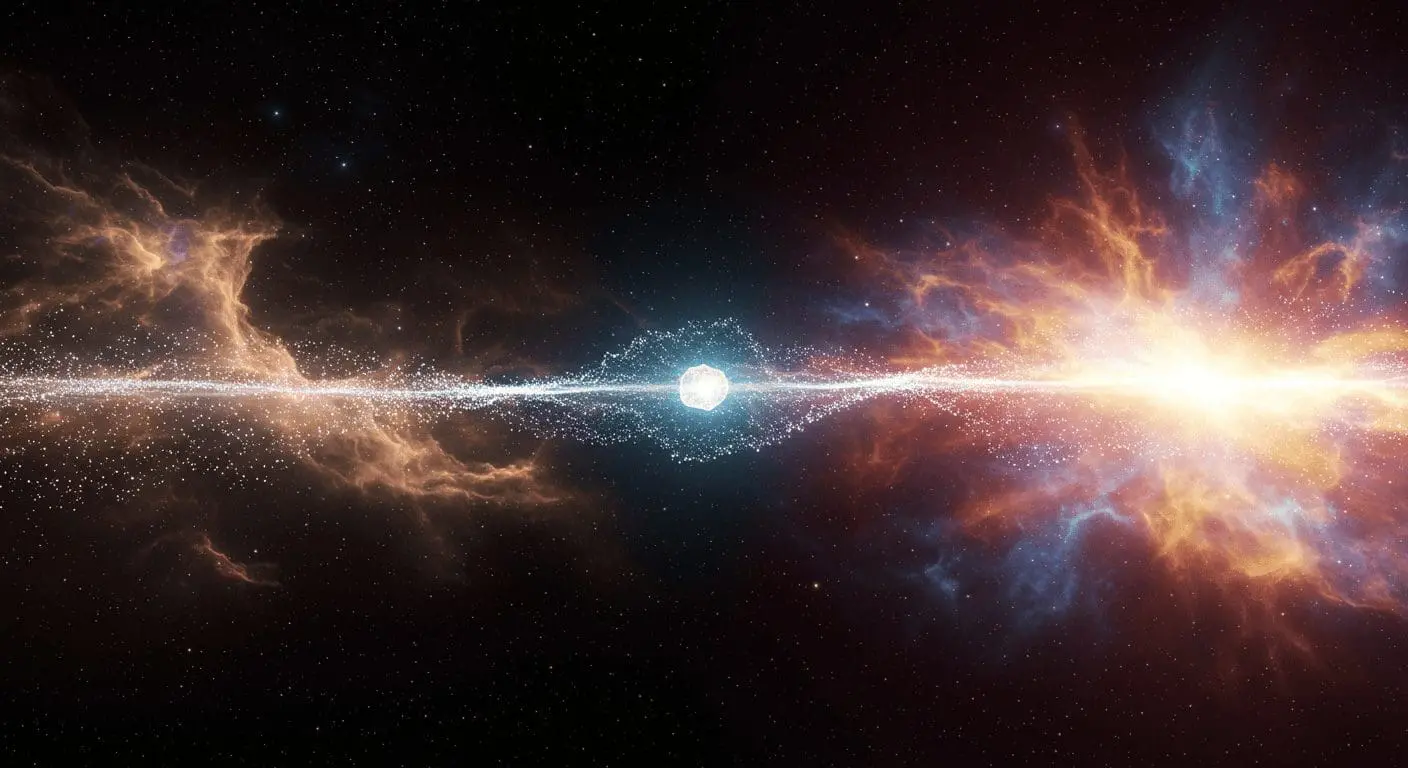
The discovery of new physical constants derived from hydrogen atoms suggests a multiverse theory where each universe corresponds to unique quantum states. Atomic particle transitions enable movement between universes, emitting energetic photons that could power advanced propulsion systems. Gravity’s role across dimensions may explain phenomena like dark matter and energy, potentially facilitating inter-universe communication via gravitational waves.
These findings could lead to technological space travel and breakthroughs in sustainable energy production. Additionally, they raise profound ethical and philosophical questions about the nature of reality, existence, causality, and identity, reshaping our understanding of the cosmos and humanity’s place within it.
What Defines the Universes of the Multiverse?
The concept of the multiverse has long fascinated scientists and philosophers alike. In recent research, Richard C. Cal Havens from Florida, USA, proposed a novel framework for understanding the universes within the multiverse. His work suggests that these universes differ fundamentally in their quantum states, particularly those of hydrogen atoms. By introducing new physical constants—specifically for mass, elementary charge, and the reduced Planck constant—Havens demonstrated that Schrödinger equations could be solved to yield entirely new wave functions for hydrogen atoms. These findings imply that each universe within the multiverse is defined by unique quantum states, creating a vast array of discrete universes.
The key insight from Havens’ research lies in the relationship between physical constants and quantum mechanics. By adjusting these constants, he showed that particles in different universes could exhibit vastly different properties. For instance, particles in other universes might have significantly less mass than those in our universe, yet they would still adhere to Einstein’s theory of special relativity. This adjustment allows particles in other universes to exceed the speed of light as we know it, but only within the context of their own universal constants. Thus, each universe has its own “speed limit,” determined by its unique set of physical constants.
This framework challenges traditional notions of space and time, suggesting that the multiverse is not merely a theoretical construct but a tangible reality with infinite possibilities. Havens’ work also raises profound questions about the compatibility of matter and energy across universes. If each universe operates under distinct physical laws, their interactions would likely be impossible or at least highly constrained. This idea aligns with the concept of parallel dimensions, where each dimension (or universe) exists independently, governed by its own set of rules.
How Do Particles Transition Between Universes?
One of the most intriguing aspects of Havens’ research is the mechanism by which particles transition between universes. He introduced a new principle called “atomic particle transitions,” which describes how quantum systems in one universe can shift to another. These transitions co-occur, effectively allowing atoms and particles to move from one quantum state to another across the multiverse. This process is not merely theoretical; it has practical implications for understanding the fundamental nature of matter and energy.
Atomic particle transitions involve hydrogen atoms emitting extremely energetic photons. These photons are not just a byproduct of the transition but play a critical role in facilitating the shift between universes. The energy emitted during these transitions creates an “energetic force,” which Havens hypothesizes could form the basis of a highly advanced propulsion system known as a “hydrogen photon reaction engine.” This engine would theoretically allow travel across different universes by harnessing the energy released during atomic particle transitions.
The implications of this research are vast. If atomic particle transitions and their associated energetic forces can be harnessed, our understanding of physics and engineering could be revolutionized. However, Havens’ work also highlights the challenges involved in studying these phenomena. The extreme energies required for such transitions make them difficult to observe or replicate in a laboratory setting. Despite these challenges, his research provides a compelling theoretical foundation for exploring the boundaries of quantum mechanics and inter-universal interactions.
What Role Does Gravity Play in the Multiverse?
In addition to redefining our understanding of particle physics and quantum mechanics, Havens’ research also sheds light on the role of gravity within the multiverse. He posits that gravity in each universe is an extension of Newton’s universal law of gravitation, adapted to the unique physical constants of that universe. This means that while the fundamental principles governing gravity remain consistent across universes, their manifestations can vary widely depending on the specific properties of each universe.
This adaptation of Newtonian gravity suggests that gravitational forces within a given universe are proportional to its physical constants. For example, gravitational interactions would be correspondingly weaker in a universe where particles have significantly less mass than our own. This idea challenges the notion of gravity as a universal constant and instead frames it as a variable force dependent on the specific characteristics of each universe.
Havens’ work also raises questions about the potential for gravitational interactions between universes. If each universe has its own distinct gravitational framework, it is unclear whether forces could act across the boundaries of different universes. This uncertainty underscores the need for further research into the nature of gravity within the multiverse and its implications for inter-universal dynamics.
Conclusion
Richard C. Cal Havens’ research offers a groundbreaking perspective on the nature of the multiverse, challenging long-held assumptions about physics, quantum mechanics, and gravitation. By introducing new physical constants and exploring the mechanisms by which particles transition between universes, his work provides a theoretical framework for understanding the infinite possibilities of the multiverse. While many questions remain unanswered, Havens’ research opens the door to new avenues of exploration in theoretical and applied physics. As scientists continue to delve into the mysteries of the multiverse, his findings remind us of the boundless potential for discovery in our quest to understand the universe—and those beyond it.
Publication details: “Universes of the Multiverse”
Publication Date: 2024-11-06
Authors: Richard C. Havens
Source: International Journal of Cosmology Astronomy and Astrophysics
DOI: https://doi.org/10.18689/ijcaa-1000149


