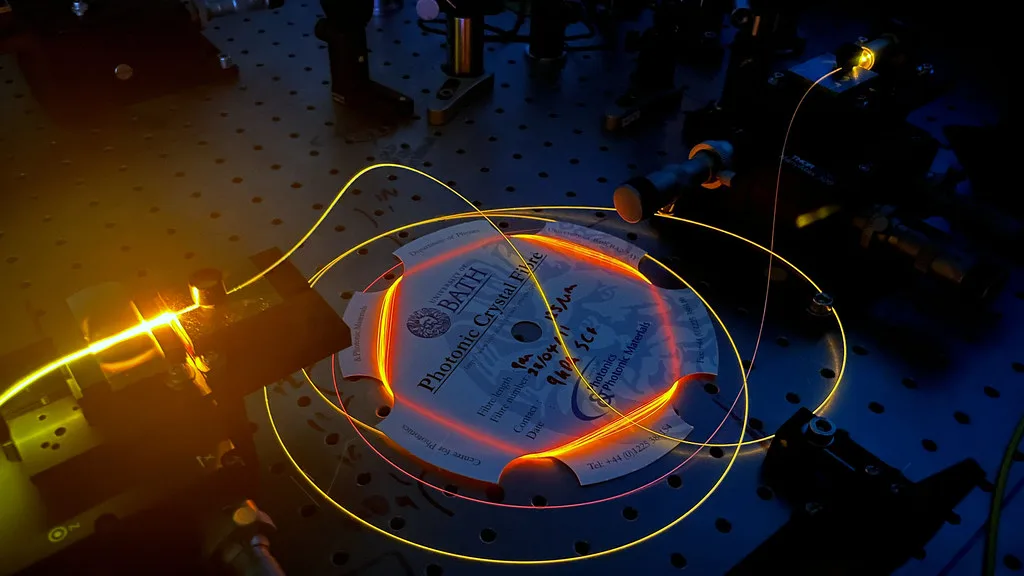
Physicists at the University of Bath have developed a new generation of specialty optical fibers designed to meet the data transfer challenges expected in the age of quantum computing. These fibers, with micro-structured cores consisting of complex patterns of air pockets, are unlike regular optical fibers and can manipulate light properties to create entangled photon pairs, change photon colors, or trap individual atoms inside the fibers.
Dr. Kristina Rusimova from the Department of Physics at Bath notes that conventional optical fibers are incompatible with the operational wavelengths required for quantum technologies. The researchers’ work, published in Applied Physics Letters Quantum, lays the foundation for data transmission needs in tomorrow’s quantum computers. Dr. Cameron McGarry, the paper’s first author, emphasizes the importance of a quantum internet, which will rely on these specialty optical fibers to deliver information from node to node.
Optical Fibers Fit for the Age of Quantum Computing
Physicists at the University of Bath are developing a new generation of specialty optical fibers that are poised to address the data transfer challenges anticipated in the era of quantum computing. These novel fibers, with their micro-structured cores consisting of complex patterns of air pockets running along their entire length, are designed to overcome the limitations of conventional optical fibers used in today’s telecommunications networks.
Conventional optical fibers, which form the backbone of modern telecommunications infrastructure, transmit light at wavelengths governed by the losses of silica glass. However, these wavelengths are incompatible with the operational wavelengths of single-photon sources, qubits, and active optical components required for light-based quantum technologies. The specialty fibers fabricated at Bath, on the other hand, offer a promising solution to this problem.
Quantum Entanglement and its Role in Quantum Computing
Light is an attractive medium for quantum computation due to its unique properties, which quantum technologies can harness. One such property is quantum entanglement, where two photons separated by a large distance hold information about each other and can instantly influence each other’s properties. Unlike classical bits, pairs of entangled photons can exist as both a one and a zero simultaneously, unlocking enormous computational power.
A quantum internet, which relies on optical fibers to deliver information from node to node, is essential in delivering emerging quantum technology’s promises. The development of specialty optical fibers that can support the requirements of quantum computing is crucial for the realization of this vision.
Challenges and Solutions for the Scalability of a Robust Quantum Network
The researchers at Bath discuss the challenges associated with the quantum internet from the viewpoint of optical fiber technology and present an array of potential solutions for scalability. This includes the development of fibers suitable for long-range communication, as well as specialty fibers that can enable quantum repeaters to extend the distance over which this technology can operate.
Beyond connecting nodes, these specialty optical fibers can also be used to implement quantum computation at the nodes themselves by acting as sources of entangled single photons, quantum wavelength converters, low-loss switches, or vessels for quantum memories. The micro-structured core of these fibers allows researchers to manipulate the properties of light inside the fiber and create entangled pairs of photons, change the color of photons, or even trap individual atoms inside the fibers.
The Future of Quantum Computing and its Dependence on Optical Fiber Technology
The development of specialty optical fibers is expected to lay the foundations for the quantum computers of tomorrow. Researchers around the world are making rapid advancements in the capabilities of microstructured optical fibers, which could be beneficial to future quantum technologies. The ability of these fibers to tightly confine light and transport it over long distances makes them useful not only for generating entangled photons but also for creating more exotic quantum states of light with applications in quantum computing, precision sensing, and impregnable message encryption.
The technological challenges identified in the perspective are likely to open new avenues of quantum research and bring us closer to achieving quantum advantage – the ability of a quantum device to perform a task more efficiently than a conventional computer.
External Link: Click Here For More