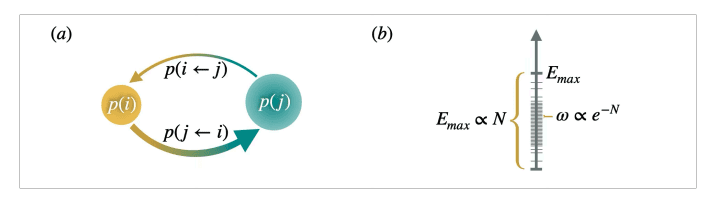
Researchers developed a master equation—a tool for modelling system evolution—without relying on the rotating wave approximation, crucial for systems with minimal energy spacing. This equation accurately predicts thermal equilibrium and exhibits improved computational efficiency, offering a robust model for both open quantum systems and algorithms.
The pursuit of understanding how isolated quantum systems evolve towards thermal equilibrium remains a central challenge in physics. Recent work addresses this by developing a master equation – a mathematical description of a system’s time evolution – that accurately models thermalisation in complex, interacting many-body systems. This approach circumvents limitations inherent in traditional methods, particularly when dealing with systems where energy levels are closely spaced. Matteo Scandi and Álvaro M. Alhambra, both from the Instituto de Física Téorica UAM/CSIC, detail this new formalism in their article, “Thermalization in open many-body systems and KMS detailed balance”, demonstrating its accuracy and computational efficiency for simulating the behaviour of open quantum systems and algorithms.
Researchers have developed a master equation offering improved accuracy in modelling open quantum systems – those interacting with their environment – without reliance on the rotating wave approximation (RWA). The RWA, a standard simplification technique in quantum mechanics, becomes invalid when energy level spacings within the system are small, limiting the fidelity of simulations for a range of physical systems including certain materials and nanoscale devices. This new equation, derived from first principles, circumvents this limitation. Crucially, it guarantees convergence to the correct many-body Gibbs state – the statistically predicted state of a system at thermal equilibrium – a property not universally assured by alternative approaches. This development facilitates more reliable simulations of complex quantum phenomena and expands the scope of accessible system modelling.
👉 More information
🗞 Thermalization in open many-body systems and KMS detailed balance
🧠 DOI: https://doi.org/10.48550/arXiv.2505.20064