

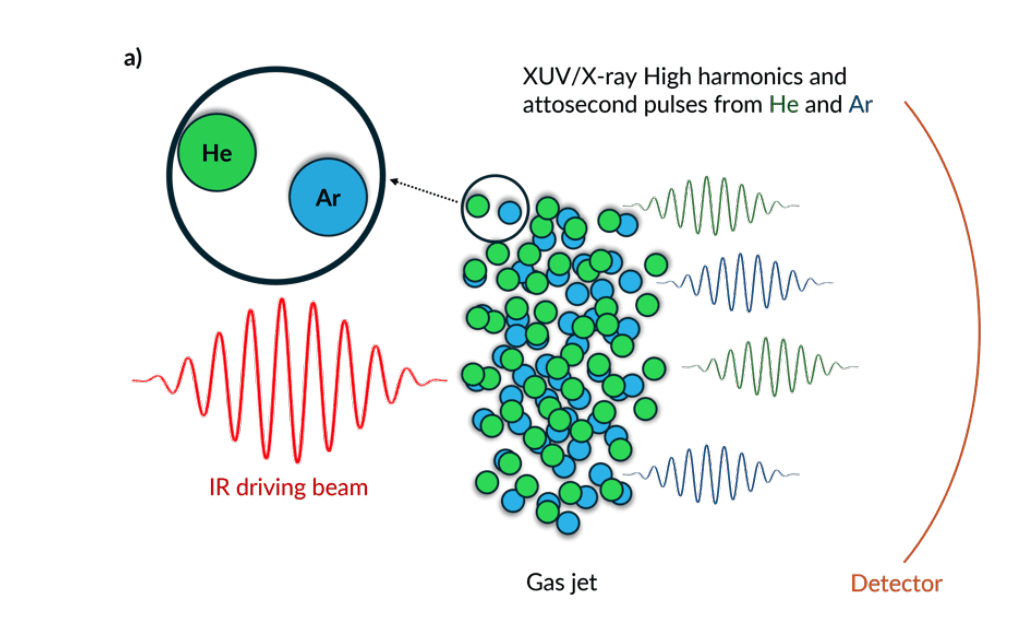
The generation of coherent extreme-ultraviolet (EUV) radiation and attosecond pulses, achieved through high harmonic generation (HHG) in gaseous media, presents significant opportunities for applications ranging from materials science to biomedical imaging. However, optimising the spectral and temporal characteristics of these pulses remains a considerable challenge. Researchers at the University of Salamanca, led by José Miguel Pablos-Marín and Javier Serrano, alongside Carlos Hernández-García and colleagues, now demonstrate enhanced control over HHG by utilising mixed-gas targets. Their work, detailed in the article ‘Enhanced Control of High Harmonic Generation in Mixed Argon-Helium Gaseous Media’, reveals how carefully adjusting the concentrations of argon and helium within the gas mixture, and employing a spatially separated dual-jet configuration, modulates the emitted EUV harmonics through coherent interference at the atomic level, offering a versatile pathway to tailor EUV light sources.
High harmonic generation (HHG) represents a prevalent technique for producing coherent extreme-ultraviolet (EUV) radiation and, crucially, attosecond pulses, prompting active investigation into methods for tailoring their spectral and temporal characteristics. Traditionally, control is achieved by manipulating the driving femtosecond laser pulse—pulses lasting on the order of 10-15 seconds—or the macroscopic laser-matter interaction, but recent work demonstrates control over the HHG process through the composition of the gaseous medium, specifically employing mixed-gas targets to enhance control over the emitted EUV harmonics.
Results indicate these modulations originate from coherent interference between harmonics generated by each species at the single-atom level, offering a mechanism for precise control over the harmonic output and enabling active tuning by adjusting the relative concentrations of the gases. Researchers spatially separate the gas species into two distinct, symmetrically arranged jets, introducing an additional degree of control over the overall harmonic bandwidth and effectively broadening or narrowing the range of frequencies emitted. This separation allows for manipulation of the phase matching conditions—a critical factor in achieving efficient harmonic generation where the generated harmonic wave and the driving laser wave propagate in phase—optimising the efficiency of harmonic generation across the desired spectral range and presenting a practical and versatile pathway to tailor EUV light and attosecond sources via HHG.
The ability to manipulate harmonic emission through gas composition and spatial configuration not only enhances control over the source characteristics but also facilitates the identification of species-specific contributions to the HHG process, building upon established principles and extending them through innovative control mechanisms. Theoretical work, such as that concerning vortex beams and quantum path signatures, provides a foundation for understanding the observed modulation effects. The application of machine learning techniques, utilising frameworks detailed by Chollet, enables the complex modelling required to predict and optimise the HHG process accurately. This research establishes a significant advancement in the field of attosecond science, offering a new paradigm for generating and controlling EUV radiation.
This ability to spatially control the gas composition, combined with compositional control, represents a practical and versatile approach to engineering EUV sources for attosecond science, shifting the focus from modifying the driving laser pulse or the overall experimental setup to the gas medium itself as a key control parameter. Artificial intelligence techniques play a crucial role in this research, assisting in the analysis of both microscopic and macroscopic aspects of the HHG process and facilitating a comprehensive understanding of how gas composition and spatial arrangement influence harmonic generation. The integration of AI enables a more nuanced interpretation of experimental results, providing insights into the underlying physical mechanisms. This allows for the identification of species-specific contributions to the HHG process, thereby enabling a clearer understanding of how each gas species contributes to the overall harmonic emission. By disentangling these contributions, researchers can optimise gas mixtures for specific applications, such as the generation of tailored attosecond pulses.
👉 More information
🗞 Enhanced Control of High Harmonic Generation in Mixed Argon-Helium Gaseous Media
🧠 DOI: https://doi.org/10.48550/arXiv.2507.01537


