

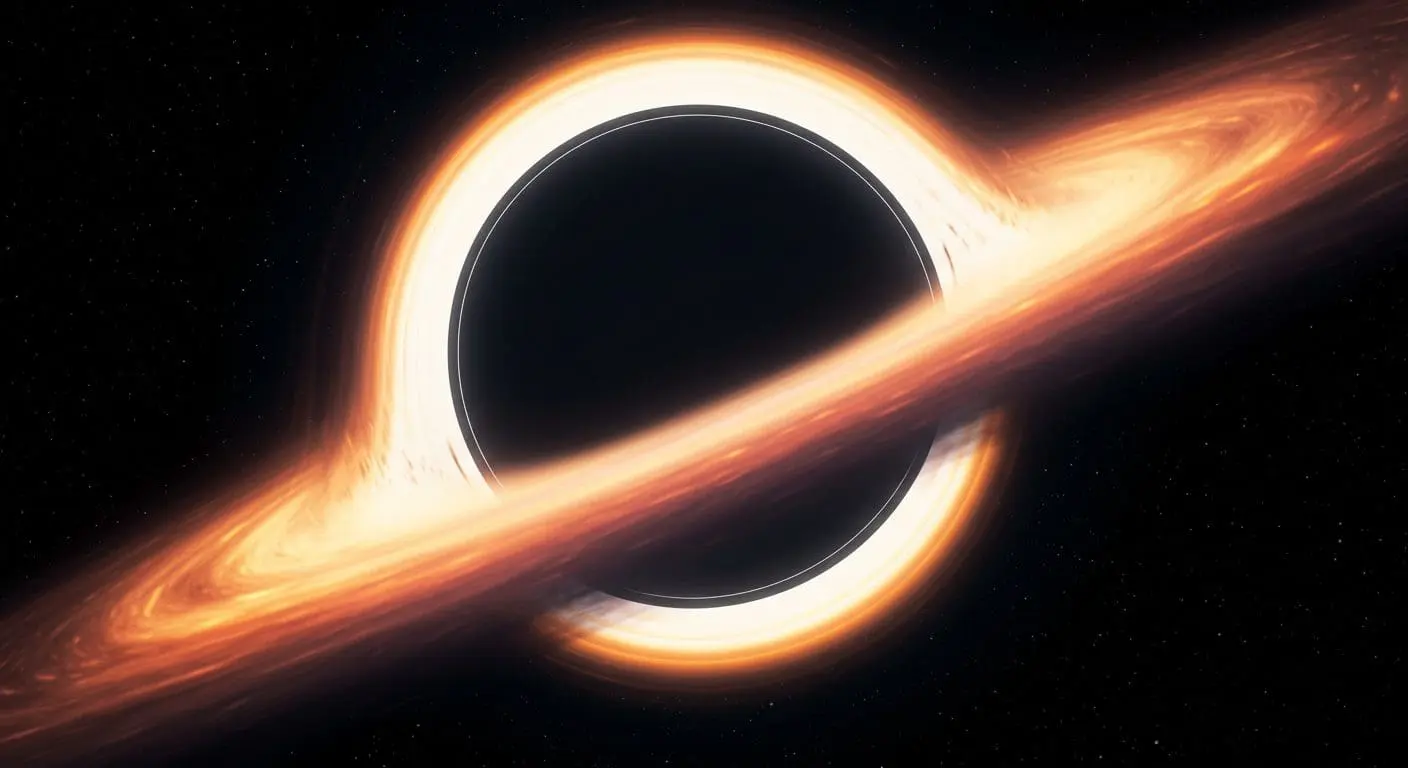
According to new observations using NASA’s James Webb Space Telescope (JWST), the supermassive black hole at the heart of our Milky Way galaxy is a ceaselessly active cosmic spectacle. Researchers from various institutions have discovered that Sagittarius A* (Sgr A*), the black hole at the center of our galaxy, exhibits continuous variability across two distinct wavelengths.
The team, led by astrophysicist Firouz Naderi, observed Sgr A* using JWST’s Near-Infrared Camera (NIRCam) and found that faint and bright variable emissions occur at different rates. These findings suggest the presence of two distinct populations of flares around the black hole.
The team posits that minor disturbances within the accretion disk generate the faint flickers, while magnetic reconnection events cause the larger, brighter flares. They also discovered a time delay in measurements at these wavelengths, with the shorter wavelength changing brightness slightly before the longer-wavelength events.
These observations provide valuable insights into the physical processes occurring around black holes and may help researchers better understand the behavior of these enigmatic celestial objects. The team plans to observe Sgr A* for an extended period using JWST to reduce noise and potentially detect periodicity or further nuances in its variability.
A recent study led by astrophysicist Yusef-Zadeh has provided new insights into the behavior of Sagittarius A*, the supermassive black hole at the center of our Milky Way galaxy. The research, published in The Astrophysical Journal Letters, suggests two separate processes are responsible for the short bursts and more extended flares observed from the black hole.
According to Yusef-Zadeh, minor disturbances within the accretion disk likely generate faint flickers, while magnetic reconnection events cause brighter flares. The former is likened to solar flares, with turbulent fluctuations in the disk compressing plasma to produce a temporary burst of radiation. On the other hand, magnetic reconnection occurs when two magnetic fields collide, releasing energy in the form of accelerated particles emitting bright bursts of radiation.
The study’s unique approach involved using the James Webb Space Telescope (JWST) to simultaneously observe Sagittarius A* at two separate wavelengths. This allowed researchers to compare how the flares’ brightness changed with each wavelength, providing a more complete and nuanced picture of the black hole’s behavior.
An unexpected finding was a time delay between events observed at shorter and longer wavelengths, with the longer wavelength lagging behind by a few seconds to 40 seconds. This time delay offers further clues about the physical processes occurring around the black hole, with one possible explanation being that particles lose energy over the course of the flare more quickly at shorter wavelengths than at longer ones.
To explore these questions further, Yusef-Zadeh plans to use the JWST for an uninterrupted 24-hour observation of Sagittarius A*. This extended observation period will help reduce noise and enable researchers to see finer details, potentially revealing periodicity or randomness in the flares.
The study was supported by NASA and the National Science Foundation.
External Link: Click Here For More


