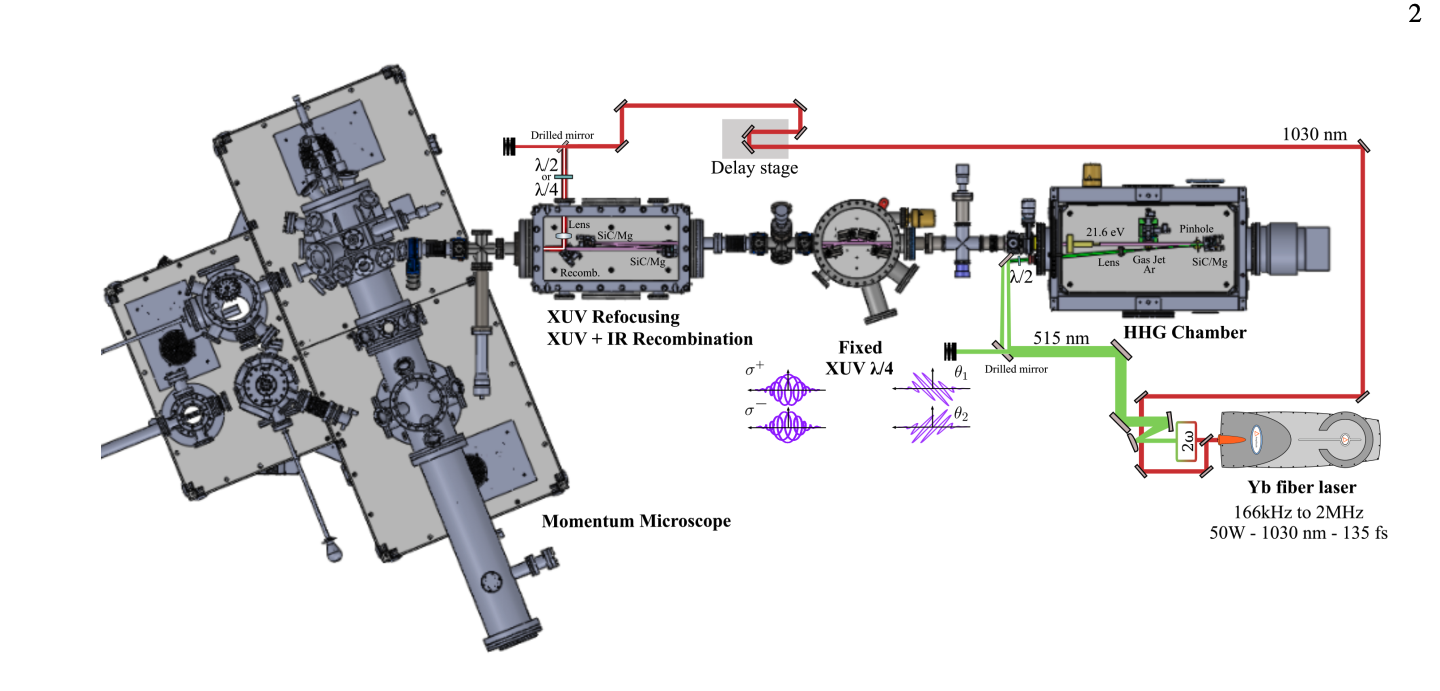
The investigation of materials’ electronic properties at the quantum level requires increasingly sophisticated instrumentation, capable of resolving both time and momentum with precision. Researchers are now detailing a novel apparatus designed to achieve precisely this, combining ultrafast laser technology with a next-generation momentum microscope. Sotirios Fragkos, Quentin Courtade, and colleagues, from Université de Bordeaux – CNRS – CEA and Johannes Gutenberg-Universität, present their development in a paper titled ‘Time- and Polarization-Resolved Extreme Ultraviolet Momentum Microscopy’. The instrument utilises extreme ultraviolet (XUV) light, with a wavelength of 21.6 electron volts, to probe the momentum of electrons emitted from a material, offering a detailed picture of its electronic structure and how it changes over time. This capability is particularly valuable for understanding materials driven away from equilibrium, potentially advancing fields such as materials science and quantum electronics.
The continual development of spectroscopic techniques expands the boundaries of materials science, allowing researchers to investigate the fundamental properties of matter with increasing precision. A newly developed instrument integrates an ultrafast, high-repetition-rate, polarization-tunable monochromatic extreme ultraviolet (XUV, photon energy of 21.6 electron volts) beamline with a next-generation momentum microscope, creating a powerful platform for advanced surface analysis. This innovative setup performs time- and angle-resolved photoemission spectroscopy, simultaneously offering multimodal photoemission dichroism capabilities, and opening new avenues for understanding complex electronic phenomena.
The momentum microscope simultaneously detects the full surface Brillouin zone, a representation of the allowed momenta of electrons in a solid, over an extended binding energy range, providing a comprehensive map of the material’s electronic structure. Equipped with advanced electron optics, including a novel front lens supporting multiple operational modes, the microscope enhances its versatility and adaptability. Enhanced spatial resolution is achieved by combining the small XUV beam footprint (33 μm by 45 μm) with precise selection of small regions of interest using apertures positioned in the Gaussian plane of the microscope, allowing detailed investigation of localized electronic states. The instrument achieves an energy resolution of 44 milli-electron volts and a temporal resolution of 144 femtoseconds, crucial for studying the ultrafast dynamics of electrons and tracking the evolution of electronic states in response to external stimuli.
Linear, Fourier, and circular dichroism measurements on photoelectron angular distributions from photoexcited two-dimensional materials demonstrate the instrument’s capabilities, revealing valuable insights into their electronic properties. Linear dichroism provides information about the alignment of atomic orbitals, Fourier dichroism probes the spatial symmetry of electronic states, and circular dichroism is sensitive to the spin polarization of electrons, offering a comprehensive characterization of the material’s electronic structure. This functionality paves the way for time-, energy-, and momentum-resolved investigations of orbital and geometrical properties underlying the electronic structures of materials driven out of equilibrium, enabling a deeper understanding of their behaviour.
This instrument serves as a valuable tool for researchers studying a wide range of materials, from two-dimensional materials and topological insulators to correlated electron systems and quantum materials. The ability to probe the electronic structure and dynamics of these materials with such precision will undoubtedly lead to new discoveries and advancements in materials science, fostering innovation and technological progress. We anticipate that this platform will facilitate the exploration of novel materials and phenomena, pushing the boundaries of our understanding of the electronic properties of matter.
The integration of an ultrafast laser system with a high-resolution momentum microscope allows capture of the transient behaviour of electrons in materials with exceptional temporal and spatial resolution. The experimental setup is carefully optimised to minimise distortions and aberrations, ensuring the accuracy and reliability of the measurements. The data acquisition system handles the high data rates generated by the experiment, enabling capture of the complete evolution of the electronic structure over time. Sophisticated data analysis algorithms extract meaningful information from the complex datasets, revealing the underlying physics of the materials.
This instrument investigates the interplay between electronic structure, orbital symmetry, and spin polarization in materials driven out of equilibrium, providing insights into the fundamental mechanisms governing their behaviour. The dynamics of charge carriers, excitons—bound electron-hole pairs—and other quasiparticles are explored, revealing how they contribute to the material’s optical and electronic properties. Control of the polarization of the incident light selectively excites specific electronic states, providing a powerful tool for manipulating the material’s properties. The instrument also studies the effects of external stimuli, such as electric fields, magnetic fields, and temperature, on the material’s electronic structure.
We are confident that this instrument will enable new discoveries and advancements in materials science, condensed matter physics, and nanotechnology. The ability to probe the electronic structure and dynamics of materials with such detail will undoubtedly lead to the development of new technologies and materials with tailored properties, addressing critical challenges in energy, electronics, and other areas. We envision that this instrument will become an essential tool for researchers worldwide, fostering collaboration and accelerating the pace of scientific discovery.
👉 More information
🗞 Time- and Polarization-Resolved Extreme Ultraviolet Momentum Microscopy
🧠 DOI: https://doi.org/10.48550/arXiv.2507.02371