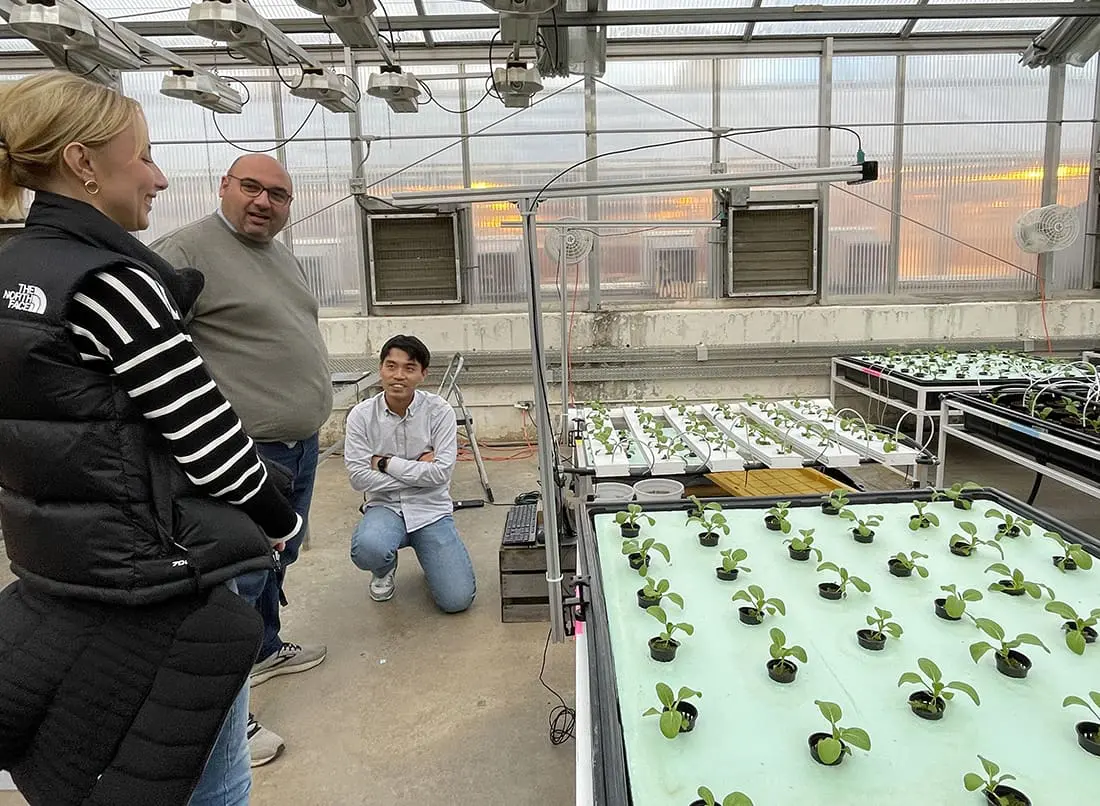
Researchers at Penn State University have developed an innovative computer vision system that integrates Internet of Things (IoT) technology and artificial intelligence (AI) to monitor specialty crops in controlled environment agriculture. This interdisciplinary project, involving agricultural engineers and plant scientists, was spearheaded by Long He, with contributions from Chenchen Kang, Francesco Di Gioia, Aline Novaski Seffrin, and Xinyang Mu.
The system employs a recursive image segmentation model to track plant growth continuously, initially tested on baby bok choy but applicable to various crops. Funded by the Pennsylvania Department of Agriculture and the U.S. Department of Agriculture’s National Institute of Food and Agriculture, this advancement is part of a broader federal initiative to enhance indoor agricultural systems’ sustainability and efficiency.
Introduction to Controlled Environment Agriculture
Controlled-environment agriculture (CEA) refers to farming methods that utilize soilless growing systems within enclosed structures such as greenhouses. These systems enable year-round production of high-quality specialty crops by maintaining optimal conditions for plant growth regardless of external environmental factors. The approach is particularly suited for producing leafy greens, herbs, and other high-value crops in a controlled setting.
Integrating precision agriculture techniques with CEA is essential for enhancing crop productivity while minimizing waste and resource consumption. Automation and optimization of growing conditions play a crucial role in achieving these goals.
Traditional Crop Monitoring Methods
Traditional methods of monitoring plant growth rely on manual checks, which are time-consuming and labor-intensive. These periodic assessments fail to provide comprehensive insights into plant growth dynamics throughout the entire crop cycle, hindering timely interventions and leading to inefficiencies in crop management.
Core Innovation in Recursive Image Segmentation
The core innovation of this research project lies in recursive image segmentation, a technique that breaks down complex visual data into manageable components for precise tracking of plant growth over time. By repeatedly applying segmentation algorithms, subtle changes in plant morphology can be detected early, enabling timely stress or anomaly detection. Machine learning further enhances this process by adapting segmentation parameters to variations in lighting, humidity, and plant development stages.
Future Applications of Precision Agriculture Technologies
The future applications of precision agriculture technologies in controlled environment agriculture (CEA) are vast and transformative. These technologies enable precise control over environmental factors such as radiation, temperature, and humidity, allowing for the cultivation of crops with tailored nutritional profiles to meet diverse consumer demands.
Additionally, these technologies improve resource efficiency by optimizing water, nutrient, and energy use, thereby reducing waste and operational costs while aligning with global sustainability goals. They also support a broader range of specialty crops in CEA settings, enhancing food security through stable supplies of diverse produce.
Scalability is another critical aspect of future applications. As precision agriculture technologies become more accessible, their integration into existing agricultural systems can facilitate broader adoption across various regions and crop types. This scalability ensures that the benefits of CEA are not limited to specific areas but can be extended to contribute to global food production efforts.
Finally, the sustainability benefits of these technologies cannot be overstated. By reducing resource consumption and waste, precision agriculture supports more sustainable agricultural practices, significantly enhancing food security while mitigating environmental impacts.
More information
External Link: Click Here For More