

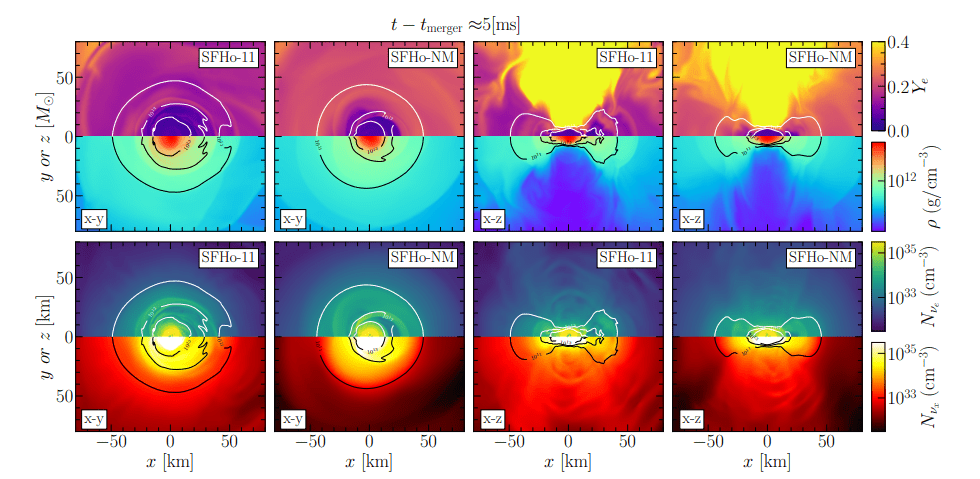
Neutron star mergers represent some of the most energetic events in the universe, and scientists are now discovering how neutrino behaviour within these cataclysmic collisions profoundly impacts the resulting aftermath. Yi Qiu, David Radice, and Sherwood Richers, along with colleagues, investigate how changes in neutrino flavour, driven by instabilities and potentially new physics, alter the dynamics of merging neutron stars. Their simulations reveal that these flavour conversions create more neutron-rich material ejected from the merger, significantly boosting the production of heavy elements through a process called the r-process. This work demonstrates a clear link between neutrino transport and the overall evolution of neutron star mergers, potentially explaining stronger gravitational wave and neutrino signals and offering new avenues for understanding the origin of heavy elements in the cosmos.
Neutrino Emission Alters Post-Merger Gravitational Waves
Scientists have performed detailed computer simulations of merging neutron stars, incorporating the complex behavior of neutrinos, fundamental particles with almost no mass. These simulations investigate how changes in neutrino properties, driven by instabilities within the incredibly dense environment of the merger, affect the gravitational waves emitted after the collision and the electromagnetic radiation released, including the faint glow of a kilonova. The results demonstrate that neutrino transformations can significantly alter the dynamics of the post-merger remnant and observable signals, establishing a crucial link between fundamental neutrino physics and observations of these cataclysmic events. The research explores how sensitive these effects are to various parameters, offering a pathway to constrain new physics with multi-messenger astronomy, which combines gravitational wave and electromagnetic observations.
Neutron Star Mergers, Simulations and Dense Matter
A substantial body of research focuses on neutron star mergers and the physics of extreme density. Scientists employ numerical relativity, using powerful computers to simulate these collisions, and refine these simulations to improve their accuracy and efficiency. A key goal is to understand the equation of state of matter at densities far exceeding those found on Earth, by comparing simulation results with observations from gravitational waves and electromagnetic radiation. Researchers also investigate the post-merger dynamics, including the formation of a hypermassive neutron star or a black hole, and the ejection of material that creates kilonovae. This ejected material is thought to be the site of the r-process, where heavy elements like gold and platinum are created. Understanding the properties of matter at extreme densities also involves investigating nuclear physics, potential phase transitions to exotic states like quark matter, and the role of neutrinos.
Neutrino Transformations Boost Heavy Element Production
Scientists have achieved a breakthrough in modeling binary neutron star mergers by incorporating the complex physics of neutrino flavor transformations and their impact on the material ejected during the collision. The work utilizes numerical relativity simulations to investigate how these transformations, driven by instabilities within the dense neutrino gas, alter the composition and yield of the r-process, the astrophysical mechanism responsible for creating heavy elements. Results demonstrate that neutrino flavor conversions consistently drive the ejected material towards more neutron-rich conditions, significantly boosting the production of heavy elements, particularly in low-density outflows. The team identified regions within the merger environment unstable to fast flavor instabilities, and remarkably, these instabilities persist even as flavor conversions occur.
Further analysis revealed that slower flavor conversions interact with thermodynamic equilibration, leading to an even greater increase in the neutron richness of the ejected material. These simulations show that enabling neutrino flavor conversions alters the types of neutrinos present, directly impacting the composition of the ejecta and potentially leaving detectable signatures in post-merger gravitational wave signals. The research demonstrates that the simulations accurately capture the complex interplay between neutrino physics and the formation of heavy elements, providing crucial insights into the astrophysical origins of these elements and paving the way for interpreting future multi-messenger observations.
Neutrino Mixing Boosts Neutron-Rich Ejecta Yields
Numerical relativity simulations of binary neutron star mergers demonstrate that neutrino flavor transformations significantly alter the conditions within the merging system and subsequent ejecta. These simulations, incorporating effects such as fast flavor instabilities and many-body interactions, reveal that flavor conversions drive the matter towards more neutron-rich compositions. The team observed increases in neutron-rich ejecta, with some simulations showing increases of up to 300%, and a corresponding boost in r-process nucleosynthesis yields, potentially by a factor of ten. These changes stem from alterations in neutrino species luminosities and energies, with heavier neutrinos amplified and lighter neutrinos diminished in the simulations with mixing scenarios.
The simulations indicate that flavor conversions effectively shift the location where neutrinos decouple, influencing the composition of the material ejected during the merger. Importantly, the researchers identified regions prone to fast flavor instabilities, finding that these instabilities persist even with flavor conversions occurring. These findings highlight the interconnectedness of neutrino transport and merger dynamics, suggesting a potential correlation between neutrino emissions and gravitational wave signals.
👉 More information
🗞 Impact of Neutrino Flavor Conversions on Neutron Star Merger Dynamics, Ejecta, Nucleosynthesis, and Multi-Messenger Signals
🧠 ArXiv: https://arxiv.org/abs/2510.15028

