The efficient solution of partial differential equations (PDEs) remains a significant computational challenge, particularly as simulations demand increasing accuracy and scale. Current approaches, including Monte Carlo methods which rely on random sampling, are constrained by the limitations of conventional computer architectures in generating true randomness. Siqing Fu, Lizhou Wu, and colleagues from the College of Computer Science and Technology at the National University of Defence Technology, address this issue in their paper, ‘NeuroPDE: A Neuromorphic PDE Solver Based on Spintronic and Ferroelectric Devices’. They present a novel hardware design, NeuroPDE, which exploits the probabilistic behaviour of emerging spintronic and ferroelectric materials to emulate random walks and accelerate PDE solving, achieving substantial improvements in both speed and energy efficiency compared to conventional CMOS-based systems.
Partial differential equations (PDEs) underpin modelling across numerous scientific and engineering disciplines, describing how quantities change across space and time. Solving these equations efficiently presents a persistent computational challenge, particularly as complexity increases with dimensionality and non-linearity. Traditional approaches, encompassing analytical techniques and numerical methods like finite differences and finite elements, often struggle with these demanding problems, necessitating the exploration of alternative computational paradigms.
Recent research explores data-driven approaches using neural networks and probabilistic techniques such as Monte Carlo methods, offering potential solutions by framing PDE solving as a simulation of random particle movement. This is constrained by the limitations of conventional computing architectures, which lack inherent randomness and rely on pseudo-random number generators that can introduce biases and limit scalability. This motivates the development of novel devices and architectures that can harness intrinsic physical randomness, offering a pathway towards more efficient and accurate simulations.
Researchers are increasingly turning to neuromorphic computing, inspired by the human brain, to overcome limitations in traditional computer architectures when tackling complex problems such as solving PDEs. NeuroPDE directly addresses this challenge by harnessing the inherent randomness found in emerging spintronic and ferroelectric devices, offering both speed and energy efficiency gains through a novel hardware implementation of probabilistic computation.
NeuroPDE employs ‘spin neurons’ built from spin-transfer torque
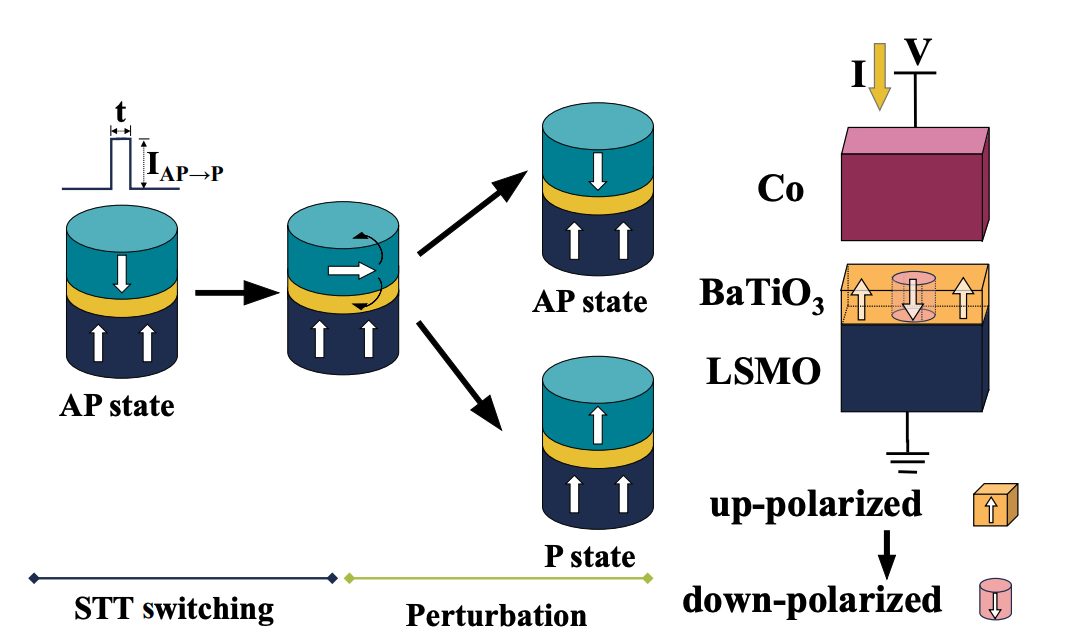
NeuroPDE employs ‘spin neurons’ built from spin-transfer torque magnetic tunnel junctions (STT-MTJs) to generate truly random numbers, exploiting the quantum mechanical properties of electron spin to produce probabilistic transmission. STT-MTJs are nanoscale devices where the resistance changes depending on the spin of electrons passing through, creating inherent randomness. Complementing these spin neurons are ‘ferroelectric synapses’ constructed from ferroelectric tunnel junctions (FTJs), acting as memristive elements that change resistance based on applied voltage, enabling continuous weight storage and adaptation. The integration of these devices with complementary metal-oxide-semiconductor (CMOS) circuitry forms a complete neuromorphic system capable of efficiently solving PDEs by mimicking the parallel and stochastic processing of the brain.
Rigorous testing demonstrates NeuroPDE achieves a variance of less than 0.01 compared to analytical solutions when solving diffusion equations, indicating a high degree of accuracy. Furthermore, the neuromorphic solver exhibits a speedup ranging from 3.48 to 315 times faster than its CMOS counterparts, alongside an energy consumption reduction of 2.7 to 29.8 times. This substantial improvement stems from the inherent parallelism of the neuromorphic architecture, where numerous random walkers explore the solution space simultaneously, and the energy efficiency of spintronic and ferroelectric devices. The development of NeuroPDE represents a significant step towards probabilistic computing systems, where uncertainty and randomness are not treated as errors but as fundamental aspects of computation.
The research presents NeuroPDE, a novel hardware architecture designed to accelerate solutions to PDEs by integrating emerging spintronic and ferroelectric devices. It addresses limitations inherent in conventional von Neumann architectures by exploiting the probabilistic behaviour of these materials, offering a departure from traditional deterministic computation. NeuroPDE employs ‘spin neurons’, which emulate random walks through probabilistic transmission, and ferroelectric synapses, offering non-volatile, continuous weight storage, enabling a hardware-intrinsic approach to randomness crucial for efficient PDE solving.
The core innovation lies in leveraging the physical stochasticity of these materials to directly implement Monte Carlo methods in hardware, mapping the random walk process onto the physical characteristics of the devices. Spin-transfer torque magnetic tunnel junctions (MTJs) function as the spin neurons, exhibiting inherent randomness in their switching behaviour, while ferroelectric field-effect transistors (FETs) serve as the synapses, enabling analogue weight storage and reducing energy consumption compared to digital implementations. This combination allows for a highly efficient and scalable solution to the problem of solving complex PDEs.
Evaluations demonstrate NeuroPDE achieves a variance of less
Evaluations demonstrate NeuroPDE achieves a variance of less than 10-2 when solving diffusion equations, aligning closely with analytical solutions, and translates to a significant performance improvement. The system exhibits a speedup ranging from 3.48x to 315x compared to conventional CMOS-based chips, and demonstrates substantial energy efficiency gains, consuming 2.7x to 29.8x less energy than comparable CMOS implementations. These results highlight the potential of utilising emerging materials to overcome the computational bottlenecks associated with traditional PDE solvers, paving the way for more efficient and scalable simulations.
While challenges remain in scaling the system to solve larger and more complex PDEs, and in mitigating the effects of device variability, the demonstrated performance gains and energy efficiency suggest a promising future for neuromorphic approaches to solving computationally intensive problems across a range of scientific and engineering disciplines.
Future work focuses on scaling the NeuroPDE architecture to tackle more complex PDEs and larger problem sizes, and optimisation of device characteristics, specifically tuning the stochasticity and switching characteristics of the spin neurons and ferroelectric synapses. Exploration of alternative materials and device structures could further enhance performance and reduce energy consumption, paving the way for even more efficient and scalable simulations.
Beyond PDE solving, the principles underpinning NeuroPDE hold potential for broader applications in probabilistic computing and machine learning, unlocking new algorithms and accelerating existing ones, particularly those reliant on Monte Carlo methods or Bayesian inference. This research therefore contributes to the growing field of neuromorphic computing, paving the way for more efficient and biologically inspired computational systems.
🗞 NeuroPDE: A Neuromorphic PDE Solver Based on Spintronic and Ferroelectric Devices
🧠 DOI: https://doi.org/10.48550/arXiv.2507.04677