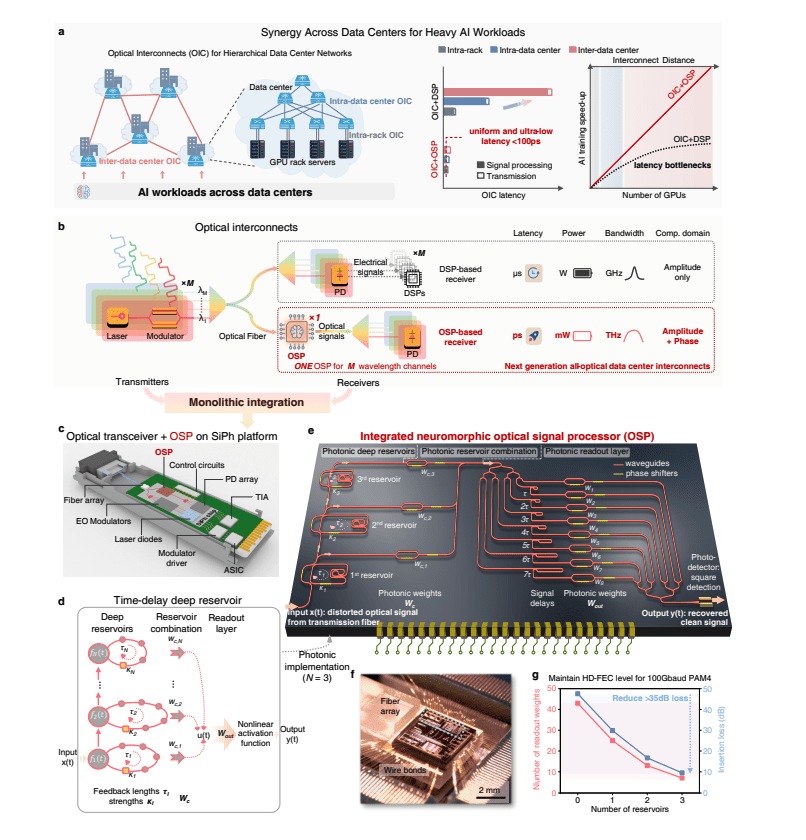
Published on April 21, 2025, Beyond Terabit/s Integrated Neuromorphic Photonic Processor for DSP-Free Optical Interconnects introduces an innovative optical signal processor achieving terabit-per-second speeds with ultra-low latency and energy efficiency, addressing the challenges of scaling AI infrastructure.
The rapid expansion of generative AI demands high-performance computing, requiring vast GPU clusters across data centers. Traditional interconnects struggle with latency and energy efficiency for multi-scale AI tasks. Researchers developed an integrated optical signal processor (OSP) using deep reservoir computing to achieve DSP-free, all-optical processing. The OSP demonstrated 100 Gbaud PAM4 per lane and 1.6 Tbit/s over 5 km fiber, surpassing state-of-the-art DSP solutions constrained by chromatic dispersion. It reduces latency by four orders of magnitude and energy consumption by three orders of magnitude, maintaining ultra-low latency at high data rates. The OSP adapts to various modulation formats and can be monolithically integrated with silicon photonic transceivers, offering a scalable solution for next-generation AI infrastructure.
Neuromorphic computing represents a promising shift towards more efficient and powerful information processing systems inspired by the human brain. Here’s an organized summary of the key points:
- Concept and Technology:
- Neuromorphic computing uses photonic chips, which leverage light (photons) instead of electricity for computations. This approach offers faster processing speeds and lower energy consumption compared to traditional electronic circuits.
- Silicon-based ring resonators are integral components in these chips, enabling precise manipulation and transmission of light signals.
- Functionality:
- These systems excel at parallel processing, allowing multiple operations to be handled simultaneously, akin to the brain’s neural networks. This capability enhances speed and efficiency, particularly beneficial for complex tasks like machine learning.
- Applications:
- Artificial Intelligence: Enhances data processing in fields such as healthcare, improving diagnostics through rapid analysis of medical imaging and genomic data.
- Telecommunications: Promises faster and more reliable global communication networks by revolutionizing data transmission.
- Autonomous Vehicles: Facilitates quicker decision-making, crucial for safety and efficiency.
- Challenges:
- Manufacturing photonic chips at scale is complex and costly due to the need for advanced fabrication techniques and precise optical component control.
- Developing software and algorithms optimized for neuromorphic architectures presents another hurdle, as traditional programming methods may not be suitable.
- Future Outlook:
- Researchers are actively addressing these challenges through advancements in manufacturing processes and the creation of new software frameworks tailored to neuromorphic systems.
- Despite being in early stages, neuromorphic computing holds significant potential for revolutionizing various industries with its innovative approach to information processing.
In conclusion, while neuromorphic computing faces current technical and developmental hurdles, its promise of transformative advancements across multiple sectors makes it a compelling area of ongoing research and innovation.
👉 More information
🗞 Beyond Terabit/s Integrated Neuromorphic Photonic Processor for DSP-Free Optical Interconnects
🧠 DOI: https://doi.org/10.48550/arXiv.2504.15044