The development of brain-inspired computing requires synaptic devices capable of storing and updating information with precision and reliability, and a team led by Shubham Jadhav, Kaustav Roy, and Luis Amaro are pioneering a new approach using ferroelectric microelectromechanical systems. Their research demonstrates a novel synapse based on Hafnium Zirconium Oxide, where analog weights are stored not in electrical charge, but in the material’s mechanical properties, specifically its piezoelectric coefficient. This innovative design allows for weight readout using a gentle mechanical drive, avoiding destructive electrical measurements and significantly improving device endurance, while achieving over seven distinct programming levels. The team’s findings reveal a fundamental relationship between the mechanical weight storage and the underlying electrical switching behaviour, following predictable physical laws, and paving the way for robust, energy-efficient hardware capable of supporting complex neural networks.
Mechanical Probing of Ferroelectric Domain Switching
This research details a comprehensive analysis of domain switching dynamics in thin hafnium oxide (HZO) films. Scientists investigated how these films respond mechanically to electrical stimuli, aiming to understand the underlying mechanisms governing polarization switching. The study reveals that material disorder significantly impacts domain switching, evidenced by a Cauchy distribution that accurately models the distribution of switching thresholds, highlighting the role of material imperfections. The observed behaviour aligns with Merz-type kinetics, suggesting that the duration of the applied electric field influences the switching process.
Furthermore, the mechanical response of the film, when appropriately rescaled, follows universal Lorentzian statistics, independent of the applied pulse width, underscoring the dominance of underlying material properties. A crucial aspect of the analysis involved a strict monotonic filter, which successfully extracted discrete switching levels from continuous displacement-voltage data, providing a clear picture of the switching events. This research provides valuable insights into the fundamental physics of ferroelectric materials and has implications for the design and optimization of ferroelectric devices, such as non-volatile memories and sensors.
Mechanical Synapse via Piezoelectric Domain Control
Scientists have pioneered a novel mechanically read synapse, addressing limitations of conventional ferroelectric synapses. This innovative device stores analog synaptic weights in the piezoelectric coefficient of a released hafnium zirconium oxide (HfZrO) microelectromechanical system (MEMS) unimorph beam. Researchers engineered this device to modulate its piezoelectric coefficient through partial switching of ferroelectric domains, effectively storing synaptic weight information. A key innovation lies in the non-destructive readout of these weights using a low-amplitude mechanical drive, avoiding depolarization and charge-injection effects.
Detailed characterization revealed that the distribution of switching thresholds follows a Lorentzian distribution when plotted as a logarithmic function of the applied poling voltage, supporting a nucleation-limited switching (NLS) model. Furthermore, the median switching threshold was found to obey a Merz-type field-time law, establishing a quantitative link between mechanical weights and electrical switching kinetics. Researchers developed a unique method for extracting discrete levels from the partially poled HfZrO by applying a strict monotonic subsequence scheme to beam displacement data, identifying approximately 200 distinct levels, demonstrating over 7-bit programming resolution. This transparently reveals the underlying monotonic structure of the data, crucial for advanced neuromorphic computing. The device’s ability to store bipolar weights, directly reveal partial domain populations, and offer robust, energy-efficient operation positions it as a promising candidate for high-bit hardware implementations in neuromorphic systems.
Ferroelectric Synapse Achieves Multi-Level Analog Weight Storage
Scientists have developed a novel ferroelectric microelectromechanical system (FeMEMS) synapse that stores analog weights within the piezoelectric coefficient of a released hafnium zirconium oxide (HZO) beam, achieving non-destructive readout and over 7-bit programming levels. Experiments revealed that the mechanical switching distribution follows a Lorentzian distribution as a logarithmic function of the partial poling voltage, consistent with nucleation-limited switching. Measurements confirm that the median threshold extracted from electromechanical data obeys a Merz-type field-time law, establishing a quantitative link between mechanical weights and electrical switching kinetics. The neuromorphic weight element consists of a clamped-clamped unimorph beam engineered to reflect the effective piezoelectric coefficient through out-of-plane motion.
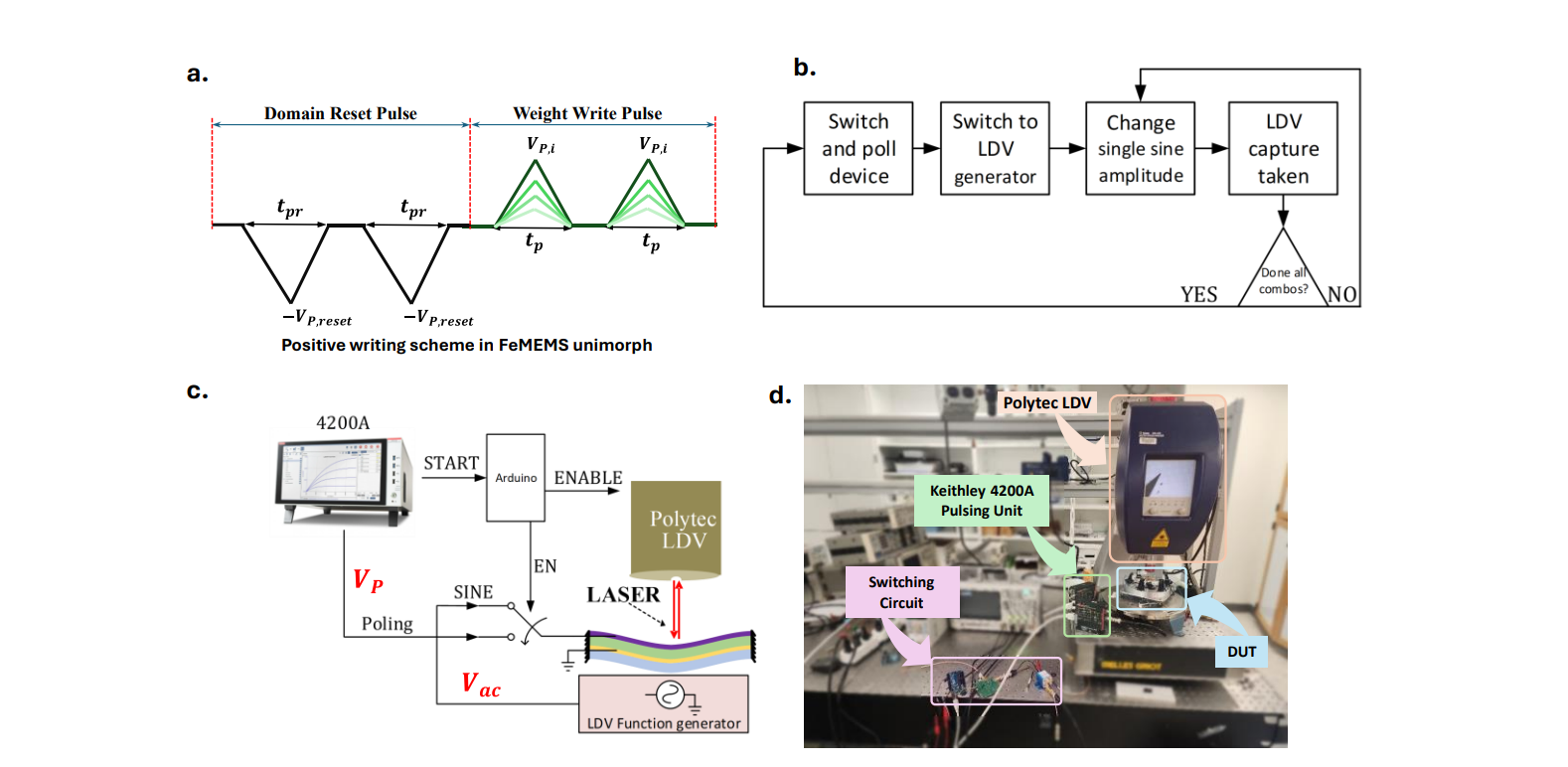
The device fabrication involves depositing a silicon dioxide layer on a silicon wafer, followed by sputtering and patterning a titanium/platinum bottom electrode. Subsequently, the ferroelectric HZO and aluminum oxide films are deposited using atomic layer deposition and annealed to crystallize the HZO. A titanium/platinum top electrode is then sputtered and patterned, followed by etching to define the beam and release windows. Finally, xenon difluoride isotropic dry etching fully releases the clamped-clamped bridge. Tests demonstrate that the device can be programmed using a sequence of triangular voltage pulses, controlling the fraction of switched domains, achieving approximately 200 distinct programming levels, showcasing the potential for high-bit mechanical synapses.
Mechanical Synapse Stores and Reads Analog Weights
This research demonstrates a novel ferroelectric mems (FeMEMS) synapse that stores and reads analog weights mechanically, offering a potential pathway towards more robust and energy-efficient hardware. The team successfully stored synaptic weights not in electrical polarization, but in the piezoelectric coefficient of a released hafnium zirconium oxide (HZO) mems unimorph. By modulating partial switching of ferroelectric domains, the device achieves over seven distinct programming levels, and crucially, reads these weights with a low-amplitude mechanical drive that avoids destructive read-out processes. This mechanical readout circumvents issues related to depolarization and charge injection, enabling bipolar weights suitable for modelling both excitatory and inhibitory synapses.
The researchers established a quantitative link between the mechanical weights and the kinetics of electrical switching, finding that the mechanical switching distribution follows a predictable Lorentzian distribution. Furthermore, the median threshold extracted from electromechanical data aligns with a Merz-type field-time law, confirming a consistent relationship between mechanical behaviour and electrical switching dynamics. While the current demonstration achieves over seven programming levels, further refinement is needed to fully explore the limits of this approach, potentially optimising the material properties and device geometry to maximise the number of resolvable levels and improve overall performance. This innovative approach to synaptic weight storage and readout represents a significant step towards building more reliable and energy-efficient neuromorphic computing systems.
🗞 Lorentzian Switching Dynamics in HZO-based FeMEMS Synapses for Neuromorphic Weight Storage
🧠 ArXiv: https://arxiv.org/abs/2510.27095