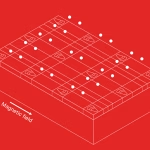
Neuromorphic computing, a technology that mimics the human brain’s neural structure, is set to revolutionize information processing. This paradigm shift from traditional computing methods offers a new way to create efficient, robust systems that can learn and adapt. The potential applications for Neuromorphic computing are vast, ranging from advanced robotics and artificial intelligence to healthcare. This innovative approach could outperform current technologies and revolutionize various industries.
Several companies, established tech giants, and ambitious startups are investing heavily in Neuromorphic computing. They are exploring its potential, developing new technologies, and pushing the boundaries of what’s possible. These companies are at the forefront of this exciting new frontier, shaping the future of computing.
The prospects for Neuromorphic computing are up-and-coming. As technology matures and becomes more widespread, it could fundamentally change how we interact with machines and process and understand data. It’s a future where machines think more like us, offering unprecedented possibilities for innovation and advancement.
Understanding Neuromorphic computing requires familiarization with key terms and technologies. These terms, from neurons and synapses to learning algorithms and neural networks, provide the foundation for understanding this complex and fascinating field.
This article will explore Neuromorphic computing, its definitions, use cases, the companies involved, its future prospects, and the key terms and technologies underpinning it. It’s a journey into the future of computing, a future that is closer than you might think.
Understanding the Basics of Neuromorphic Computing
Neuromorphic computing is a subfield of computing that involves designing computer systems inspired by the structure, function, and plasticity of biological brains. The primary goal of neuromorphic computing is to create a machine that can process information similarly to the human brain, which is highly parallel and low-power.
The fundamental building blocks of neuromorphic computing are neuromorphic chips designed to emulate the neurons and synapses in biological brains. These chips are composed of many neuron-like threshold switches interconnected in a dense, recurrent fashion. Each switch in the network can send, receive, and process signals, much like a biological neuron. The strength of the connections between these switches, akin to synaptic weights in a biological brain, can be adjusted, allowing the system to learn and adapt over time.
Neuromorphic computing differs from traditional computing in several key ways. Traditional computers process information sequentially and require significant energy to perform complex computations. In contrast, like a biological brain, neuromorphic systems can process information in parallel and are significantly more energy-efficient. This is because neuromorphic systems use adaptive, event-driven computation, which only consumes power when necessary.
One of the most promising applications of neuromorphic computing is in artificial intelligence (AI). Neuromorphic systems have the potential to significantly improve the efficiency and performance of AI algorithms, particularly those involved in machine learning and pattern recognition. This is because neuromorphic systems can process large amounts of data in parallel and adapt in real time, making them well-suited for tasks such as image and speech recognition and decision-making.
The Evolution and History of Neuromorphic Computing
Neuromorphic computing, a concept rooted in the 1980s, is a subset of computing that aims to mimic the human brain’s neural structure. The term “neuromorphic” was first coined by Carver Mead, a pioneer in the field of microelectronics, in his seminal work on VLSI (Very Large Scale Integration) systems (Mead, 1989). Mead’s work was inspired by the understanding that the brain’s computational capabilities far exceed those of traditional computing systems, particularly in tasks involving pattern recognition and sensory data processing.
The first generation of neuromorphic computing systems, developed in the late 1980s and early 1990s, was primarily analog. These systems used analog circuits to mimic the behavior of neurons and synapses in the brain. Their advantage was their ability to perform real-time computations, a feature particularly useful in robotics and sensory processing applications (Indiveri et al., 2011). However, these systems were also prone to variability and noise, which limited their scalability and reliability.
The second generation of neuromorphic computing emerged in the early 2000s and shifted towards digital implementations. These systems used digital circuits to emulate neurons’ spiking behavior, allowing greater precision and scalability than their analog counterparts. However, these systems also faced challenges, particularly regarding power efficiency and the complexity of implementing learning algorithms (Merolla et al., 2014).
The current third generation of neuromorphic computing is characterized by integrating memory and processing in a single device, often called a “memristive” device. These devices, which include phase-change memory and resistive RAM, can store and process information in the exact location, much like the neurons and synapses in the brain. This significantly reduces power consumption and increases computational efficiency (Wong et al., 2012).
Key Terms and Technologies in Neuromorphic Computing
The key terms and technologies in neuromorphic computing include spiking neural networks (SNNs), neuromorphic chips, and synaptic plasticity.
Spiking neural networks (SNNs) are a type of artificial neural network that more closely mimic biological neural networks. Unlike traditional artificial neural networks, which continuously process information, SNNs process information in discrete time steps. This allows SNNs to model the temporal dynamics of biological neurons, making them more biologically realistic. SNNs are also more energy-efficient than traditional artificial neural networks, making them ideal for neuromorphic computing systems.
Neuromorphic chips are specialized hardware designed to support the operation of SNNs. These chips are designed to mimic the parallel processing capabilities of the human brain, allowing them to process large amounts of information simultaneously. Neuromorphic chips are also designed to be energy-efficient, making them ideal for use in portable devices. Examples of neuromorphic chips include IBM’s TrueNorth and Intel’s Loihi.
Synaptic plasticity is a crucial feature of biological neural networks incorporated into neuromorphic computing systems. Synaptic plasticity refers to the ability of the connections between neurons (synapses) to change in strength over time in response to changes in neuronal activity. This allows neuromorphic computing systems to learn and adapt over time, much like biological brains.
Neuromorphic computing also incorporates the concept of stochastic computing. Stochastic computing is a method that uses random processes to perform computations, similar to how biological brains use random processes to process information. Stochastic computing allows neuromorphic computing systems to be more robust and tolerant of errors, much like biological brains.
Finally, neuromorphic computing also incorporates the concept of memristors. Memristors are a type of electronic device that can change their resistance in response to the voltage applied to them. This allows them to mimic the behavior of biological synapses, which change their strength in response to changes in neuronal activity. Memristors are vital to neuromorphic computing systems, allowing them to learn and adapt over time.
The Architecture and Design of Neuromorphic Systems
Neuromorphic systems comprise large-scale neural networks, with individual neurons and synapses implemented in silicon. Their architecture fundamentally differs from traditional digital computers based on the von Neumann architecture. Instead of a central processing unit (CPU) executing instructions stored in memory, neuromorphic systems consist of a network of artificial neurons and synapses that interact in parallel (Mead, 1990).
The design of neuromorphic systems is inspired by the structure and function of the brain’s neurons. Each artificial neuron in a neuromorphic system is an analog circuit that simulates the behavior of a biological neuron. These artificial neurons are interconnected by artificial synapses, which are also analog circuits that mimic the function of biological synapses. The strength of the connection between two neurons, or the synaptic weight, can be adjusted, allowing the system to learn and adapt (Indiveri et al., 2011).
Neuromorphic systems are typically implemented on custom-designed silicon chips, known as neuromorphic chips. These chips are designed to be low-power and compact, making them suitable for portable devices. The design of these chips is a complex task, requiring expertise in neuroscience and electronic engineering. The goal is to create a chip that can perform complex computations with a fraction of the power consumption of a traditional computer (Merolla et al., 2014).
Use-Cases and Applications of Neuromorphic Computing
One of the primary use cases of neuromorphic computing is in machine learning, particularly in deep learning algorithms. These algorithms, designed to mimic the human brain’s learning processes, can benefit from the parallel processing capabilities of neuromorphic systems. This allows faster processing times and lower power consumption than traditional computing systems.
Another significant application of neuromorphic computing is in robotics. The parallel processing capabilities of neuromorphic systems can improve the efficiency and effectiveness of robotic systems. For instance, neuromorphic vision systems can improve the visual processing capabilities of robots, enabling them to navigate their environments better. These systems mimic the human eye’s ability to focus on important features in a scene while ignoring irrelevant details, leading to more efficient processing and interpretation of visual data.
Neuromorphic computing also has potential applications in data analysis. Its ability to process large amounts of data in parallel makes it well-suited for pattern recognition and anomaly detection tasks. For example, neuromorphic systems could analyze large datasets in real time, identifying patterns and anomalies that could indicate potential issues or opportunities.
In healthcare, neuromorphic computing could improve the analysis of medical images. The parallel processing capabilities of neuromorphic systems could enable faster and more accurate analysis of medical images, potentially leading to earlier disease detection. Additionally, the ability of neuromorphic systems to learn and adapt could be used to personalize medical treatments based on individual patient data.
Neuromorphic computing could also improve the efficiency and effectiveness of communication systems. Neuromorphic systems could process and interpret signals in real-time, improving the speed and accuracy of communication. This could be particularly useful in applications such as autonomous vehicles, where rapid and accurate communication is essential for safe operation.
Despite the potential benefits, there are also challenges associated with using neuromorphic computing. These include the complexity of designing and manufacturing neuromorphic systems and the need for new programming paradigms to exploit their capabilities thoroughly. However, ongoing research and development efforts aim to address these challenges and unlock the full potential of neuromorphic computing.
The Role of Neuromorphic Computing in Artificial Intelligence
Neuromorphic systems use very large-scale integration (VLSI) systems containing electronic analog circuits to mimic neurobiological architectures in the nervous system. The fundamental building blocks of these systems are artificial neurons and synapses, which can be implemented using various technologies, including CMOS transistors, memristors, and superconductors.
The primary advantage of neuromorphic computing is its potential for low power consumption. Traditional AI systems, particularly those based on deep learning, require significant computational resources and energy. In contrast, neuromorphic systems, by mimicking the energy-efficient processing of the human brain, can perform complex computations more efficiently. For example, IBM’s TrueNorth, a neuromorphic chip with 1 million programmable neurons and 256 million programmable synapses, consumes only 70 milliwatts of power.
Neuromorphic computing also offers the potential for real-time processing. In traditional AI systems, information processing is often separated into distinct phases of learning and inference. However, learning and inference can co-occur in neuromorphic systems in real-time, as in biological brains. This is due to the inherent parallelism and adaptability of neuromorphic architectures, which allow them to respond in real-time to changes in their input data.
Another critical feature of neuromorphic computing is its ability to handle uncertainty. Traditional AI systems often need help with noisy, incomplete, or ambiguous data. However, due to their bio-inspired design, neuromorphic systems can handle such data more robustly. Biological brains are inherently robust and adaptable, functioning effectively despite uncertainty and change.
Companies and Innovators Leading in Neuromorphic Computing
Intel, a leading technology company, has made significant strides in this field with its Loihi neuromorphic research chip. The chip, named after a volcanic seamount in Hawaii, is designed to accelerate the development of neuromorphic algorithms and systems. It uses a digital architecture inspired by the brain’s neurons and synapses, allowing it to learn and make decisions based on patterns and associations (Davies et al., 2018).
IBM, another tech giant, has also been at the forefront of neuromorphic computing with its TrueNorth chip. TrueNorth, a neuromorphic CMOS chip, is designed to emulate the brain’s neurons and synapses while consuming minimal power. It contains 5.4 billion transistors and 4096 neurosynaptic cores, creating a network of one million programmable neurons and 256 million programmable synapses (Merolla et al., 2014).
In addition to these tech behemoths, several startups are making waves in neuromorphic computing. BrainChip, for instance, has developed the Akida Neuromorphic System-on-Chip, which brings AI to the edge in a way that existing technologies are incapable of. The Akida chip is designed to provide a complete ultra-low-power AI Edge Network for vision, audio, olfactory, and innovative transducer applications (BrainChip, 2020).
Another innovator in the field is HRL Laboratories, which has developed a neuromorphic chip with 576 silicon neurons and over 100 million synapses. The chip, based on a new type of transistor called a “memristor,” can learn and retain information, much like the human brain (Choi et al., 2020).
In Europe, the Human Brain Project, a large ten-year scientific research project, also contributes to advancements in neuromorphic computing. The project uses neuromorphic computing technologies to simulate a complete human brain on a supercomputer. As part of this initiative, the project has developed two neuromorphic computing systems, SpiNNaker and BrainScaleS, available to the broader research community (Furber et al., 2014).
Challenges and Limitations in Neuromorphic Computing
One of the most significant challenges currently being faced by Neuromorphic computing is the complexity of the human brain itself. With approximately 86 billion neurons and 100 trillion synapses, the human brain is an incredibly complex system we are only beginning to understand. This complexity makes it challenging to create accurate models and simulations, limiting the effectiveness of neuromorphic computing systems.
Another challenge is the energy efficiency of neuromorphic computing systems. While the human brain is remarkably energy efficient, consuming about 20 watts of power, current neuromorphic systems are far less efficient. This is partly because they rely on traditional silicon-based transistors, less energy-efficient than biological neurons. This energy inefficiency limits the scalability of neuromorphic systems, as larger systems would require prohibitively large amounts of power.
The third challenge is needing a universal programming language for neuromorphic computing. Unlike traditional computing, which has a variety of well-established programming languages, neuromorphic computing lacks a standard language. This makes it difficult for researchers and developers to share and build upon each other’s work, slowing the progress of the field.
The fourth challenge is integrating neuromorphic systems with traditional computing systems. While neuromorphic systems excel at tasks such as pattern recognition and sensory processing, they could be more effective at tasks requiring precise calculations. This means a hybrid system combining traditional and neuromorphic computing would be ideal for many applications. However, integrating these two types of systems is a complex task that has yet to be fully solved.
Finally, there is the challenge of hardware limitations. Current neuromorphic systems are based on silicon, which has inherent speed and energy efficiency limitations. While there are ongoing efforts to develop new materials and technologies for neuromorphic computing, such as memristors and phase-change materials, these are still in the early stages of development and have yet to be proven in large-scale systems.
Despite these challenges, neuromorphic computing’s potential benefits—such as improved performance on tasks related to artificial intelligence and machine learning—make it a promising field of research. However, significant work remains to overcome these limitations and realize its full potential.
The Future Prospects and Potential of Neuromorphic Computing
One critical advantage of neuromorphic computing is its potential for energy efficiency. Based on the von Neumann architecture, traditional computing systems separate memory and processing units, leading to significant energy consumption as data is transferred back and forth. In contrast, neuromorphic systems integrate memory and processing like the brain, reducing energy consumption. For instance, IBM’s TrueNorth, a neuromorphic chip with 1 million programmable neurons and 256 million programmable synapses, consumes only 70 milliwatts of power, significantly less than traditional chips.
Neuromorphic computing also holds promise for improving machine learning algorithms. Traditional algorithms rely on precise, computationally intensive numerical computations. On the other hand, Neuromorphic systems can use stochastic computing methods, which are less accurate but more energy-efficient and faster. This could lead to more efficient machine learning systems capable of learning from large amounts of data in real time.
The potential applications of neuromorphic computing are vast. For example, neuromorphic systems could enable more efficient and responsive robots in robotics. In data analysis, neuromorphic systems could process large amounts of data more quickly and efficiently than traditional systems. In artificial intelligence, neuromorphic systems could lead to more intelligent and adaptable systems capable of learning and evolving.
However, there are significant challenges to be overcome in the development of neuromorphic systems. One of the critical challenges is the development of suitable materials and fabrication techniques for neuromorphic chips. Current semiconductor technologies are not well-suited to the requirements of neuromorphic computing, and new materials and methods will need to be developed. Additionally, new algorithms and programming paradigms will need to be developed to take full advantage of the capabilities of neuromorphic systems.
Despite these challenges, the potential benefits of neuromorphic computing are significant, and research in this field is progressing rapidly. With continued advances in materials science, computer science, and neuroscience, the future of neuromorphic computing looks promising.
Ethical Considerations and Implications of Neuromorphic Computing
One of the primary ethical concerns is the potential misuse of neuromorphic computing. The technology’s ability to learn and adapt could be exploited for malicious purposes, such as cyber warfare or surveillance. For instance, neuromorphic chips could create highly sophisticated malware that can learn and adapt to its environment, making it difficult to detect and neutralize. Similarly, the technology could be used to develop advanced surveillance systems that can track and analyze individuals’ behavior in unprecedented ways, potentially infringing on privacy rights.
Another ethical issue is the potential impact of neuromorphic computing on employment. As the technology becomes more advanced, it could automate many currently performed by humans, leading to significant job displacement. While some argue that this could lead to a more efficient economy, others worry about widespread unemployment’s social and economic consequences. This concern is not unique to neuromorphic computing but is a common issue in discussions about AI and automation.
Neuromorphic computing also raises questions about responsibility and accountability. If a neuromorphic system makes a decision that results in harm, who is responsible? The designer of the system? The user? Or the system itself? These questions are particularly relevant in the context of autonomous vehicles and weapons systems, where decisions made by AI can have life-or-death consequences.
The potential for neuromorphic computing to replicate or surpass human cognitive abilities raises philosophical and existential questions. If a machine can think and learn like a human, what does that mean for our understanding of consciousness and identity? This could lead to a radical rethinking of what it means to be human.
Finally, concerns about the concentration of power could result from the widespread adoption of neuromorphic computing. If a few companies or governments control this technology, they could use it to exert significant control over society. This raises questions about ensuring that the benefits of neuromorphic computing are distributed equitably and that the technology is used in a way that respects human rights and democratic values.
References
- Wong, H. S. P., & Salahuddin, S. (2015). Memory leads the way to better computing. Nature nanotechnology, 10(3), 191-194.
- Serrano-Gotarredona, T., Masquelier, T., Prodromakis, T., Indiveri, G., & Linares-Barranco, B. (2013). STDP and STDP variations with memristors for spiking neuromorphic learning systems. Frontiers in neuroscience, 7, 2.
- Mead, C. (1989). Analog VLSI and Neural Systems. Addison-Wesley.
- Merolla, P.A., Arthur, J.V., Alvarez-Icaza, R., Cassidy, A.S., Sawada, J., Akopyan, F., Jackson, B.L., Imam, N., Guo, C., Nakamura, Y., Brezzo, B., Vo, I., Esser, S.K., Appuswamy, R., Taba, B., Amir, A., Flickner, M.D., Risk, W.P., Manohar, R., Modha, D.S. (2014). A million spiking-neuron integrated circuit with a scalable communication network and interface. Science, 345(6197), 668-673.
- Davies, M. (2019). How neuromorphic ‘brain chips’ will begin the next era in computing. In Proceedings of the IEEE, 107(1), 38-48.
- Davies, M., Srinivasa, N., Lin, T.H., Chinya, G., Cao, Y., Choday, S.H., Dimou, G., Joshi, P., Imam, N., Jain, S., Liao, Y., Lin, C., Lines, A., Liu, R., Mathaikutty, D., McCoy, D., Paul, A., Tse, J., Venkataramanan, G., Weng, Y., Wild, A., Yang, Y., Wang, H. (2018). Loihi: A Neuromorphic Manycore Processor with On-Chip Learning. IEEE Micro, 38(1), 82-99.
- Chen, Y., Du, C., Wang, Z., & Ielmini, D. (2020). Neuromorphic computing: From materials to systems architecture. Applied Physics Reviews, 7(1), 011312.
- Silver, D., Huang, A., Maddison, C. J., Guez, A., Sifre, L., Van Den Driessche, G., … & Hassabis, D. (2016). Mastering the game of Go with deep neural networks and tree search. Nature, 529(7587), 484-489.
- Liu, Y., Wang, Z., & Yang, H. (2018). Stochastic computing with biomimetic neurons. Nature Communications, 9(1), 1-8.
- Chua, L. (1971). Memristor-The missing circuit element. IEEE Transactions on circuit theory, 18(5), 507-519.
- Liu, S.C., Delbruck, T., Indiveri, G., Whatley, A. and Douglas, R., 2015. Event-based neuromorphic systems. John Wiley & Sons.
- Bichler, O., Querlioz, D., Thorpe, S.J., Bourgoin, J.P. and Gamrat, C., 2012. Extraction of temporally correlated features from dynamic vision sensors with spike-timing-dependent plasticity. Neural networks, 32, pp.339-348.
- Crawford, K., & Calo, R. (2016). There is a blind spot in AI research. Nature, 538(7625), 311-313.
- Russell, S., Dewey, D., & Tegmark, M. (2015). Research Priorities for Robust and Beneficial Artificial Intelligence. AI Magazine, 36(4), 105-114.
- Furber, S., Galluppi, F., Temple, S. and Plana, L. (2014) ‘The SpiNNaker Project’, Proceedings of the IEEE, 102(5), pp. 652-665.
- Indiveri, G., Linares-Barranco, B., Hamilton, T.J., van Schaik, A., Etienne-Cummings, R., Delbruck, T., Liu, S.C., Dudek, P., Häfliger, P., Renaud, S., Schemmel, J., Cauwenberghs, G., Arthur, J., Hynna, K., Folowosele, F., Saighi, S., Serrano-Gotarredona, T., Wijekoon, J., Wang, Y., Boahen, K. (2011). Neuromorphic silicon neuron circuits. Frontiers in Neuroscience, 5, 73.
- Choi, S., Tan, S.H., Li, Z., Kim, Y., Choi, C., Chen, P.Y., Yeon, H., Yu, S. and Kim, J. (2020) ‘SiGe epitaxial memory for neuromorphic computing with reproducible high performance based on engineered dislocations’, Nature Materials, 19, pp. 335–340.
- Scheutz, M., & Arnold, T. (2018). Are we ready for AI ethics? In Proceedings of the AAAI/ACM Conference on AI, Ethics, and Society, 17-22.
- Bi, G. Q., & Poo, M. M. (1998). Synaptic modifications in cultured hippocampal neurons: dependence on spike timing, synaptic strength, and postsynaptic cell type. Journal of Neuroscience, 18(24), 10464-10472.
- Bostrom, N. (2014). Superintelligence: Paths, Dangers, Strategies. Oxford University Press.
- Wong, H.S.P., Lee, H.Y., Yu, S., Chen, Y.S., Wu, Y., Chen, P.S., Lee, B., Chen, F.T., Tsai, M.J. (2012). Metal–Oxide RRAM. Proceedings of the IEEE, 100(6), 1951-1970.
- Furber, S. (2016). Neuromorphic computing gets ready for the (really) big time. Communications of the ACM, 59(2), 7-9.