Controlling the structure of materials with light represents a significant challenge in modern physics, yet recent work by Sraddha Agrawal, Stephen Whitelam, and Pierre Darancet, along with their colleagues, demonstrates a powerful new approach to achieving this goal. The team successfully uses a technique called neuroevolution to design precisely timed electric fields that steer structural changes in materials, even in complex systems far removed from simple harmonic behaviour. This method enables the stabilisation of non-equilibrium structures, including hidden and metastable phases, by leveraging experimentally measurable data and physically-interpretable models of light-matter interactions. Importantly, the technique requires no prior knowledge of material gradients, offering a practical route to controlling structural dynamics with light and opening exciting possibilities for materials design and discovery.
Optimizing Laser Pulses with Machine Learning
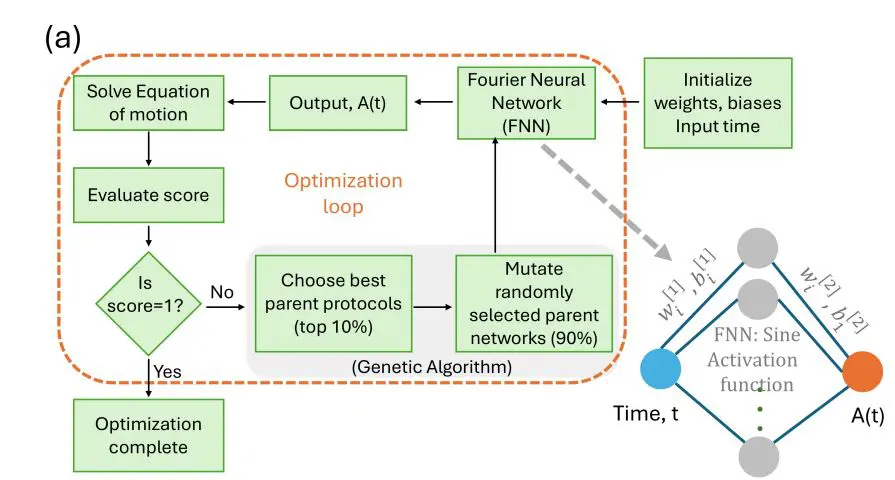
Scientists have developed a powerful new method for optimizing the efficiency of material responses to laser pulses. The research focuses on tailoring the precise shape of laser pulses to maximize energy conversion and minimize unwanted timing spread within a material, achieved through a combination of experimental data and a Fourier Neural Network. The network learns the complex relationship between pulse shape and material behaviour, designing new pulses predicted to deliver optimal performance through a closed-loop optimization process. Results demonstrate a clear improvement in both efficiency and timing spread as the optimization process progresses, with later generations of pulse shapes consistently exhibiting higher efficiency and lower dissipation. The neural network’s learning progress is evident in steadily increasing efficiency scores, eventually stabilizing as it approaches the theoretical limit. This seamless integration of experimental data with the neural network creates a powerful tool for materials optimization.
Light Stabilizes Solids Beyond Harmonic Limits
Scientists have demonstrated precise control over structural dynamics in solids using light, achieving the stabilization of non-thermal structures beyond conventional limitations. The research centers on employing reinforcement learning to derive time-dependent electric fields that manipulate materials at the atomic level, utilizing Fourier Neural Networks to predict the necessary electric field configurations. Experiments demonstrate the stabilization of a symmetric structure in bismuth through impulsive Raman scattering, achieved using both continuous and pulsed light sources even in the presence of energy dissipation. The method is notably gradient-free, meaning it optimizes control signals based solely on experimental data, such as measurements of the half-periods of oscillations observed in transient spectroscopy.
Analysis of the optimized continuous wave protocol revealed ten learned frequencies, spanning from approximately 0. 06THz to 4. 38THz, which act as both slow envelopes and rapid shaping components for the phase-space trajectory. Remarkably, a five-frequency subset matched the performance of the full ten-frequency model, suggesting substantial reduction in experimental complexity is possible. For pulsed driving, the network defines the arguments of a Gaussian pulse train in frequency space, constructing a time-domain pulse sequence.
The team quantified stabilization by dividing the total simulation time into multiple periods defined by velocity crossings, analogous to Poincaré sections, and calculating a score based on the average position relative to a saddle point. A score of 1 indicates perfect stabilization, achieved when the average position consistently aligns with the saddle point. Hyperparameter testing, including mutation strength and population size, was crucial in refining the protocol search and optimizing the learning process.
Light Stabilizes Solids Via Reinforcement Learning
This research demonstrates a new approach to controlling structural changes in solids using light. Scientists successfully applied reinforcement learning to design time-dependent electric fields that stabilize specific, non-equilibrium structures within materials, extending control beyond traditional harmonic limitations. The method relies on measurable characteristics of the material’s behaviour and utilizes Fourier Neural Networks to learn and generate optimized illumination protocols, even in complex, non-linear systems. The team demonstrated this capability by stabilizing a specific structure in bismuth through the precise manipulation of light, achieving control via impulsive Raman scattering.
Importantly, the technique is gradient-free, meaning it can operate solely on experimental data, bypassing the need for complex theoretical models. This offers a practical route to controlling materials’ behaviour with light, potentially enabling the stabilization of previously inaccessible or transient states. Future research will likely focus on refining the experimental setup to eliminate the need for theoretical inputs altogether, enabling entirely experiment-driven optimization of non-equilibrium phase transitions, paving the way for a more versatile and robust method for controlling materials’ behaviour with light.
🗞 Learning to shine: Neuroevolution enables optical control of phase transitions
🧠 ArXiv: https://arxiv.org/abs/2511.03895