

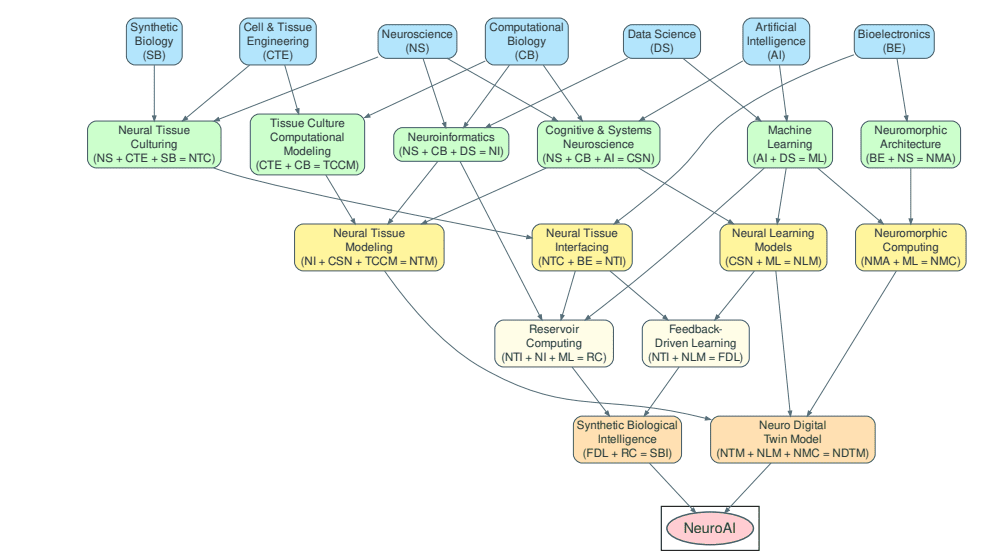
The convergence of neuroscience and artificial intelligence is driving innovation in the emerging field of NeuroAI, and a particularly exciting area within this is synthetic biological intelligence. Dhruvik Patel and Md Sayed Tanveer, from Rensselaer Polytechnic Institute and Albany Medical College, alongside Jesus Gonzalez-Ferrer and Mohammed A. Mostajo-Radji from the University of California Santa Cruz, and Alon Loeffler and Brett J. Kagan from Cortical Labs and The University of Melbourne, present a comprehensive overview of this rapidly evolving landscape. Their work organizes the field into three interconnected domains, hardware, software, and wetware, and highlights how combining biological and artificial systems unlocks new possibilities for modelling neural function and creating advanced, embodied intelligence. This research demonstrates the potential for a new generation of systems that integrate living neural tissue with digital algorithms, promising breakthroughs in biohybrid architectures and neuro-symbolic learning.
Brain-Inspired Computing, Neuroscience and Artificial Intelligence
The convergence of neuroscience, artificial intelligence, and bioengineering is driving innovation in our understanding of the brain and the development of new technologies. Researchers are focused on bridging these fields to create brain-inspired computing systems and novel treatments for neurological disorders, utilizing advanced models of brain function, including brain organoids, and leveraging the power of artificial intelligence to analyze complex neural data. A central theme is the creation of in vitro models of the brain, such as brain organoids grown from human induced pluripotent stem cells, allowing scientists to study brain development, model neurological diseases like Alzheimer’s, Parkinson’s, and schizophrenia, and test potential therapies. Complementing this work is the development of neuromorphic computing, which aims to build hardware and software systems that mimic the brain’s structure and function, utilizing components like spiking neural networks and memristors to create artificial synapses.
Advanced techniques in neural data analysis are also crucial, employing machine learning and deep learning algorithms to identify patterns and build predictive models from complex neural recordings. Self-supervised learning is used to train AI models on unlabeled data, while foundation models are being developed for a variety of neural data analysis tasks. Computational models are also being used to simulate synaptic plasticity and the interactions of neural circuits, providing insights into how the brain computes information.
Dendritic Filter Bank Mimics Neural Computation
Synthetic biological intelligence seeks to design systems that accurately mimic the structure and function of brains, beginning with a detailed understanding of biological neural networks. Unlike simplified artificial neural networks, biological neurons exhibit significantly more complex computations, functioning not as simple summing points, but as distributed filter banks approximating electrical properties with distinct membrane resistance, axial resistance, and capacitance. Synaptic inputs undergo location and time-dependent attenuation, with signals arriving more weakly and slowly from distant synapses. Superimposed on this electrical scaffold are voltage-gated channels, which drive the membrane potential when local depolarization exceeds a threshold, producing regenerative signals, and somatic action potentials can back-propagate into the dendrites, triggering calcium influx that enables synapse-specific plasticity. Notably, NMDA receptors amplify time-sensitive signals, increasing conductance only when glutamate release coincides with sufficient depolarization, amplifying synchronous inputs while filtering asynchronous spikes. Functioning like temporal filters and logical AND gates, NMDA-rich dendrites distinguish input sequences and timing without requiring additional network layers, demonstrating that simplified models of neurons are inadequate and understanding the intricacies of biological neural networks is essential for designing more sophisticated and biologically-inspired artificial intelligence systems.
NeuroAI Advances, Wetware, Software, Hardware Integration
Researchers are actively advancing the field of NeuroAI, a convergence of neuroscience and artificial intelligence, with a focus on synthetic biological intelligence. This work integrates biological and engineered systems, creating platforms for modeling neural function and developing biohybrid architectures, organizing the field into three interacting domains: hardware, software, and wetware. A crucial aspect of this research involves refining methods for analyzing neural signals, beginning with preprocessing steps like whitening, denoising, and band pass filtering, detecting spikes using thresholding techniques, and extracting features matched to templates. Units are then aggregated across channels to improve signal clarity, while interactive tools assist in manually validating and refining these results, and platforms enable cross-sorter consensus and benchmarking.
To ensure reproducibility and collaboration, scientists are adopting standardized data formats, notably Neurodata Without Borders and the Brain Imaging Data Structure, supporting rich metadata, modular extensibility, and compatibility with high-throughput pipelines. Both frameworks are being extended to accommodate additional data types and experimental paradigms, supporting the implementation of FAIR principles, data that is Findable, Accessible, Interoperable, and Reusable, with data repositories providing cloud-based access and analysis, facilitating collaborative research. Furthermore, researchers are addressing the ethical implications of SBI and organoid intelligence, with investigations revealing spontaneous neural activity resembling early human brain development, prompting consideration of potential moral relevance. Researchers are exploring whether these constructs could support conscious experience, utilizing frameworks to assess complexity and integration, emphasizing donor consent and privacy, and ensuring that the use of stem cell lines derived from donors is ethically sound and respects individual rights. Proponents of SBI and OI are actively developing actionable ethical frameworks, including an embedded ethics approach to allow for ongoing research and responsible innovation.
NeuroAI, Synthetic Biology, and Intelligent Systems
NeuroAI represents a convergence of neuroscience, artificial intelligence, and biomedical engineering, offering a new framework for understanding and building intelligent systems. This emerging field organizes research into three interacting domains: wetware, encompassing living neural substrates like organoids and cultured networks; hardware, including neuromorphic systems and brain-computer interfaces; and software, spanning learning models from deep neural networks to neuro-symbolic AI. The most significant advances are expected from integrating these domains, particularly through synthetic biological intelligence, which aims to create adaptive, energy-efficient, and interpretable intelligence. Researchers acknowledge that realising the full potential of NeuroAI requires further development in several key areas, including improving real-time feedback control, scaling up organoid interfacing, and establishing standardized multimodal datasets.
Crucially, software systems must evolve to not simply analyse biological data, but to actively interact with and co-adapt to living neural circuits. Future work will also necessitate the development of ethical and regulatory frameworks to address the complex questions surrounding sentience, consent, and biological data security as these bio-computational systems become more sophisticated. With coordinated, multidisciplinary effort, NeuroAI promises to redefine our understanding of intelligence and unlock new possibilities for both basic research and modern medicine.
👉 More information
🗞 A Computational Perspective on NeuroAI and Synthetic Biological Intelligence
🧠 ArXiv: https://arxiv.org/abs/2509.23896


