Light interacting with matter confined within nanoscale waveguides presents a powerful means of investigating collective behaviours in quantum systems, and researchers are increasingly turning to these platforms to explore fundamental physics. Tatiana Vovk from the Institute for Theoretical Physics, University of Innsbruck, Anka Van de Walle from Ludwig Maximilian University Munich, and Hannes Pichler, also from Innsbruck, alongside their colleagues, have developed a new computational technique to model the complex interactions between multiple light-emitting atoms within these waveguides. Their method extends an existing framework called time-dependent neural quantum states to account for the loss of energy to the surrounding environment, a crucial factor in these open quantum systems. This advancement allows scientists to accurately simulate scenarios where atoms are positioned arbitrarily, overcoming limitations of previous approaches and opening new avenues for understanding superradiance and other out-of-equilibrium phenomena in waveguide quantum electrodynamics.
Time-Dependent IC-POVM Neural Network Simulations
This document provides supplementary information for research simulating the dynamics of many-body quantum systems, focusing on light-matter interactions in arrays of emitters like quantum dots or atoms. The work introduces a novel approach called time-dependent IC-POVM Neural Network (t-NQS) and compares it to traditional tensor network (TN) methods. The supplementary material details computational costs, derivations, and technical aspects, demonstrating the efficiency and scalability of t-NQS for simulating complex quantum systems. Tensor networks represent high-dimensional quantum states, reducing computational cost by exploiting entanglement.
This work utilizes a tensor network approach based on vectorized density matrices. IC-POVM represents quantum states using probabilities derived from measurements, while neural networks approximate the quantum state and its time evolution. Entanglement describes the correlation between quantum particles, even when separated. Computational cost measures the resources needed for a calculation, focusing on how it scales with system size. The Savitzky-Golay filter smooths data and reduces noise.
This section analyzes the computational costs of both TN and t-NQS methods, focusing on scaling with qubits, bond dimension, and neural network hidden dimension. The document derives scaling laws for different operations, suggesting t-NQS can be more efficient for large systems with limited entanglement. This section explains the quadratic scaling observed in the main paper, focusing on how peak emission intensity changes with slight perturbations in emitter spacing. Using a perturbative approach, a Taylor expansion derives a formula for peak emission intensity as a function of emitter spacing. The derivation confirms theoretical predictions and provides insights into the system’s behavior, relying on the assumption of approximate permutational symmetry.
This work offers a promising approach to simulating large quantum systems beyond the reach of traditional methods, potentially more efficient than tensor networks for systems with limited entanglement. The combination of neural networks and IC-POVM representations is a novel approach with potential applications in quantum optics, materials, and information processing. This supplementary material provides a comprehensive account of the methods and results, demonstrating the technical rigor and innovation of the research.
Neural Quantum States for Many-Body Systems
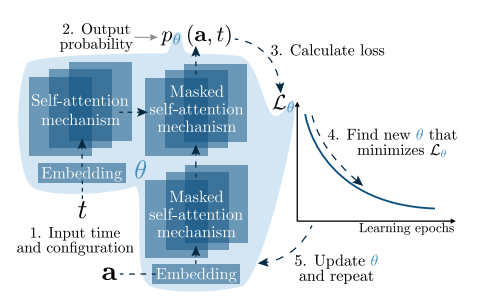
Researchers investigating multiple quantum particles coupled to an environment face significant computational challenges, particularly when systems lack simplifying symmetry. Traditional methods struggle to accurately simulate these complex interactions, especially considering environmental noise and time evolution. To address this, the team developed a numerical technique based on neural quantum states (NQSs), representing quantum states using artificial neural networks. This approach leverages the expressibility of neural networks to capture intricate relationships between quantum particles, specifically simulating the dynamic behaviour of open quantum systems where particles interact with their surroundings.
The researchers extended a time-dependent NQS framework to account for the characteristics of open systems, enabling them to model energy and information flow over time. A key innovation lies in simulating systems where the arrangement of quantum particles breaks symmetry, like in the Dicke model. This asymmetry, common in realistic setups, makes calculations difficult. The team demonstrated that their NQS-based method exhibits improved convergence and accuracy compared to tensor network methods when simulating these symmetry-broken systems, allowing for a more realistic understanding of quantum particle behaviour in complex environments and opening avenues for exploring phenomena like superradiance and quantum information processing. The method’s versatility extends to modeling scenarios found in waveguide quantum electrodynamics.
Simulating Open Quantum Systems with Neural Networks
Researchers have developed a new computational method for simulating multiple quantum emitters interacting with light within a waveguide. This work addresses the challenge of accurately modeling systems where symmetry, present in simpler models like the Dicke model, is broken due to emitter arrangement. The team’s approach extends neural quantum states, employing neural networks to represent quantum states, to handle the complex dynamics of open quantum systems where energy and information can flow into the environment. Realistic arrangements of quantum emitters within a waveguide lack the perfect symmetry assumed in the Dicke model, complicating calculations.
Traditional methods struggle to accurately capture the system’s evolution, requiring substantial computational resources. The newly developed method overcomes this limitation by efficiently simulating dynamics even without symmetry, offering a substantial improvement over existing techniques and demonstrating improved convergence. The researchers benchmarked their method against established techniques across scenarios relevant to waveguide quantum electrodynamics, demonstrating the ability to simulate a variety of physical regimes. They found that breaking the symmetry of the emitter arrangement leads to a predictable decrease in emitted light intensity, specifically a quadratic decrease as the distance between emitters increases, providing valuable insight into the system’s behaviour.
🗞 Neural quantum states for emitter dynamics in waveguide QED
🧠 ArXiv: https://arxiv.org/abs/2508.08964