

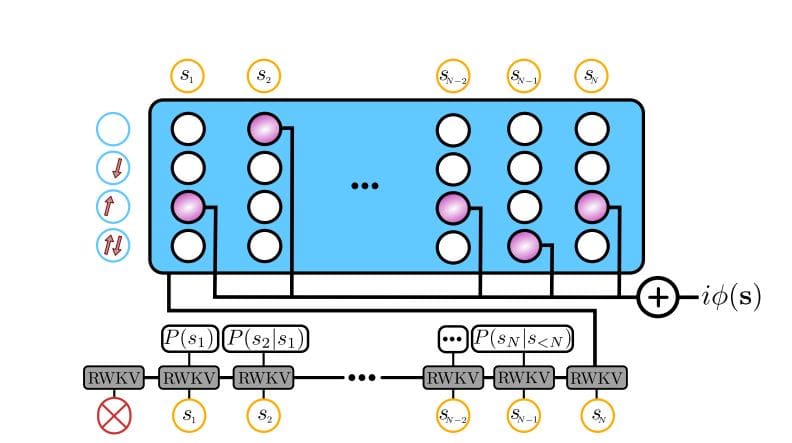
Understanding the complex interactions between electrons in strongly correlated materials requires accurate modelling of multi-orbital systems, and researchers continually seek improved methods to achieve this. Jonas B. Rigo and Markus Schmitt, from Forschungszentrum J ̈ulich GmbH and University of Regensburg, present a new approach to solving these challenging problems, developing a real-frequency impurity solver based on neural quantum states combined with an operator-Lanczos construction. This method leverages the power of neural networks to capture long-range correlations, offering a systematically improvable way to tackle multi-orbital impurity problems and achieve excellent precision in determining ground-state properties. The team demonstrates the accuracy of their technique by successfully resolving zero temperature spectral functions and self-energies, paving the way for applying dynamical mean-field theory to even more complex materials and phenomena.
Neural Networks for Quantum Many-Body Systems
This compilation details research into neural network quantum states (NNQS) and related computational methods for solving quantum many-body problems. Researchers employ Variational Monte Carlo (VMC) to optimize the parameters of the neural network wavefunction, increasingly within the frameworks of Dynamical Mean-Field Theory (DMFT) and Cluster DMFT for more accurate treatment of strong correlations. Exploration extends to Numerical Renormalization Group (NRG) to improve calculations of spectral functions and properties. Autoregressive models, like Transformers and Recurrent Neural Networks, demonstrate promise for efficient wavefunction representation, alongside methods for incorporating symmetry, such as particle number and spin.
Optimization techniques, including backflow transformations, Kaczmarz updates, and automated differentiation, accelerate convergence and avoid local minima. This research also focuses on quantum impurity solvers using NNQS to solve the effective single-impurity Anderson model within DMFT, and accurately calculating spectral functions to understand excitation spectra. Applications span various physical systems, including the Hubbard model and Kondo problem.,.
Neural Networks Solve Correlated Quantum Problems
Scientists have developed a new method for solving complex quantum problems using neural networks combined with the Segmented Commutator Operator-Lanczos (SCOL) technique. This work addresses a critical need for more powerful impurity solvers within Dynamical Mean-Field Theory, a key approach for understanding strongly correlated quantum materials. The team constructed a real-frequency impurity solver based on neural quantum states (NQS), leveraging the ability of neural networks to accurately represent complex quantum systems with many interacting particles. Experiments demonstrate excellent ground-state precision and the capacity to accurately resolve zero temperature spectral functions and self-energies, crucial for characterizing the behavior of quantum materials. The researchers tested their method on the single-orbital Anderson model, a fundamental model in condensed matter physics, and extended it to multi-orbital Hubbard-Kanamori Hamiltonians, which represent more complex systems with multiple interacting electron bands. Results show the new approach accurately calculates key properties of these models, paving the way for studying more challenging materials.,.
Neural States Solve Correlated Material Problems
This research presents a new method for solving complex problems in strongly correlated materials, focusing on accurately modelling the interactions between electrons in multiple atomic orbitals. Scientists have developed a real-frequency impurity solver that combines neural states, a type of machine learning approach, with a sophisticated mathematical construction called operator-Lanczos. This innovative combination allows for a systematically improvable and accurate determination of the ground state properties of these materials, which is crucial for understanding their behaviour. The team demonstrated the effectiveness of their method by benchmarking it against established techniques, achieving high precision in calculating key quantities like spectral functions and self-energies.
Importantly, the method proves scalable and adaptable to various complex systems, including those with multiple correlated sites or orbitals, making it particularly well-suited for use within Dynamical Mean-Field Theory, a powerful approach for studying materials. The accuracy of the results depends on computational parameters and the number of samples used, and future work will likely focus on optimising these aspects. This advancement promises to extend the reach of Dynamical Mean-Field Theory to a wider range of quantum materials and accelerate the discovery of new quantum phenomena.
👉 More information
🗞 Operator Lanczos Approach enabling Neural Quantum States as Real-Frequency Impurity Solvers
🧠 ArXiv: https://arxiv.org/abs/2512.08624


