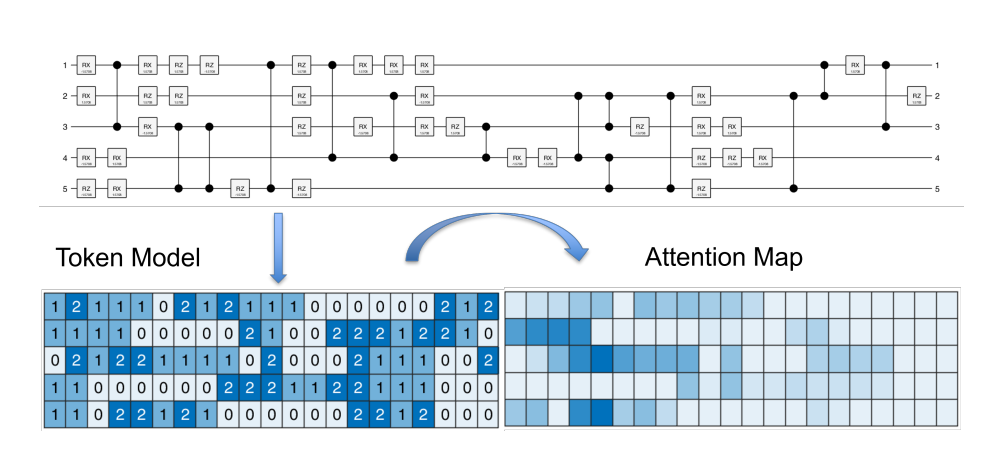
Optimising quantum circuits, a crucial step in preparing them for execution on real hardware, often results in significantly longer and more complex circuits than originally intended, threatening the stability of quantum computations. Bodo Rosenhahn, Tobias J. Osborne, and Christoph Hirche, from Leibniz Universität Hannover, address this challenge with a novel approach to circuit optimisation, termed neural guided sampling. Their method tackles the inefficiency of random sampling techniques by employing a neural network to predict which parts of a quantum circuit are most amenable to reduction, effectively creating a more informed and efficient search strategy. This prioritised sampling dramatically reduces the computational effort required to simplify circuits, demonstrably outperforming existing optimisation methods and paving the way for more complex and reliable quantum algorithms.
Scientists have tackled a key challenge in quantum computing: optimizing the efficiency of quantum circuits. They have developed a new method, neural guided sampling, which significantly reduces the time and computational resources needed to prepare quantum algorithms for execution on real hardware. This approach leverages a neural network to identify and simplify sections of a quantum circuit represented in a two-dimensional format, leading to substantial improvements in circuit efficiency.
Quantum Circuit Optimisation and Transpilation Techniques
Quantum computers require careful preparation before running algorithms. Quantum circuits, the blueprints for these computations, often need to be transformed, a process called transpilation, to suit the limitations of specific quantum hardware. Optimizing these circuits aims to reduce their complexity, measured by the number of operations and the circuit’s overall length, while preserving the algorithm’s functionality. Researchers have explored a wide range of techniques to achieve this optimization. Many approaches draw on established optimization methods.
Stochastic search techniques, including simulated annealing, Monte Carlo methods, and genetic algorithms, use random sampling to explore potential circuit improvements. Gradient-based optimization refines circuits by adjusting parameters to minimize a defined cost function. More complex methods, such as mixed integer linear programming, formulate the optimization problem as a mathematical equation to find exact solutions. Alongside these, various transpilation techniques are employed, including gate decomposition and qubit mapping. Specific frameworks and approaches further refine these techniques.
The Berkeley Quantum Synthesis Toolkit (Bqskit) provides a platform for circuit optimization, while parameterised circuit instantiation allows for flexible circuit design. Hierarchical synthesis builds circuits from reusable modules, and stochastic neural architecture search applies machine learning to discover optimal circuit structures. Robust estimation techniques improve the reliability of circuit optimization in the presence of noise. Increasingly, researchers are integrating machine learning, including large language models, to assist in the transpilation process. Several challenges remain in quantum circuit optimization.
As circuits grow in size, many optimization methods become computationally expensive. The specific characteristics of the target quantum hardware significantly impact the optimization process. Balancing competing optimization goals, such as minimizing circuit depth and maximizing gate fidelity, requires careful consideration. Dealing with noise and imperfections in quantum hardware also presents a significant hurdle. The vast complexity of the search space for possible circuit transformations further complicates the optimization process.
Neural Networks Guide Faster Quantum Circuit Optimization
Scientists have achieved a significant breakthrough in quantum circuit optimization with a novel method that dramatically improves both circuit efficiency and optimization speed. This new technique, neural guided sampling, utilizes a neural network to predict which sections of a quantum circuit, represented in a two-dimensional format, can be simplified. By focusing on these reducible blocks, the method significantly reduces the computational time required to prepare quantum computations for execution. The team’s method employs a neural network to generate an attention map, effectively highlighting circuit blocks most likely to be simplified through a term replacement scheme.
Experiments demonstrate that this guided sampling process outperforms other iterative optimization schemes and existing tools, such as qiskit and Bqskit, in generating more efficient quantum circuits. These optimized circuits require fewer gates to represent the same quantum operation, leading to faster and more reliable computations. Researchers validated the method using two distinct gate sets, one common for ion-trap architectures and another for NISQ architectures. The results consistently demonstrate the superiority of the new method in generating optimized circuits across both gate sets. This breakthrough establishes a new benchmark for quantum circuit optimization, paving the way for more complex and reliable quantum computations and unlocking the full potential of quantum computing.
Neural Sampling Optimizes Quantum Circuit Reduction
This work presents a new approach to quantum circuit reduction, addressing a critical challenge in realizing practical quantum computation. Researchers developed a method using 2D neural guided sampling to efficiently reduce the length of quantum circuits during the transpilation process. The team demonstrated that their method consistently outperforms existing optimization techniques, including those implemented in Qiskit and Bqskit, across various quantum architectures and gate sets. Experiments involving the reduction of circuits with up to eight qubits show a significant improvement in gate count and optimization speed when using the neural guided sampling approach.
Notably, the method’s performance remains robust regardless of the available gate set, a key advantage over other techniques. While other methods may prioritize minimizing the number of two-qubit gates, this approach offers a more balanced strategy for overall circuit optimization. Although the presented results demonstrate substantial progress, the authors acknowledge that further research is needed to explore the scalability of the method to larger and more complex quantum circuits. Additionally, they suggest that investigating the potential of this approach for optimizing circuits designed for specific applications could yield further improvements in quantum computation efficiency.
🗞 Neural Guided Sampling for Quantum Circuit Optimization
🧠 ArXiv: https://arxiv.org/abs/2510.12430