

Atmospheric turbulence presents a major obstacle to reliable, high-capacity free-space communication, and conventional methods struggle to overcome this challenge. Christopher R. Rawlings and Mitchell A. Cox, from the University of the Witwatersrand, Johannesburg, along with their colleagues, now demonstrate a novel approach using task-dependent optical neural networks. Their research introduces a physically configured multimode fibre reservoir that effectively classifies signals distorted by turbulence, achieving a significant performance improvement, averaging between 20. 32% and 3. 00%, over ideal modal decomposition in challenging conditions. This achievement reframes the receiver as a physical likelihood processor, promising to reduce the need for complex digital signal processing and paving the way for simpler, more robust machine learning systems designed for real-world applications.
Fiber Optics Enable Trainable Neural Networks
This research details a novel approach to building physical neural networks using light scattering within a multi-mode fiber. The core idea leverages the complex light scattering within the fiber as a naturally occurring, trainable reservoir computing system. Traditional deep learning relies on energy-intensive electronic computation, but physical neural networks offer a potential solution by utilizing physical phenomena to perform computations. The system achieved high accuracy, exceeding 90%, in classifying handwritten digits and successfully recognized distorted orbital angular momentum modes, demonstrating its ability to handle noisy data and complex patterns.
This work demonstrates a promising new approach to building physical neural networks that is both efficient and trainable, opening up possibilities for developing all-optical machine learning systems. The system is potentially scalable due to the relatively simple and cost-effective nature of multi-mode fibers and offers the potential for lower energy consumption compared to electronic systems. In essence, this paper presents a compelling case for using the inherent physics of light scattering as a foundation for a new generation of optical neural networks, offering a simpler and more efficient alternative to many existing approaches.
Turbulence Mitigation via Task-Dependent Fibre Reservoir
Scientists developed a novel methodology for mitigating atmospheric turbulence in free-space optical communication by employing a task-dependent hardware design. Researchers established a set of physical design principles, demonstrating that recurrent dynamics perform optimally for structural data, while high mode-mixing proves superior for textural data. This understanding informed the configuration of the fibre reservoir, which treats turbulence as a complex textural feature, enabling robust classification of orbital angular momentum modes. The system employs a physical random projection, harnessing the intrinsic computational power of a complex optical system.
Scientists trained the system using the Extreme Learning Machine framework, allowing for a computationally trivial, one-shot analytical training process. Experiments demonstrate that the system outperforms an ideal modal decomposition by an average of 20. 32 ±3. 00% in moderate to high-turbulence regimes. The team utilized a simple, low-power continuous-wave laser, relying on square-law detection to provide sufficient nonlinearity. This work reframes the optical receiver as a physical likelihood processor, significantly reducing the burden on digital signal processing by offloading computation to the physical front-end.
Reservoir Design Optimizes Optical Signal Classification
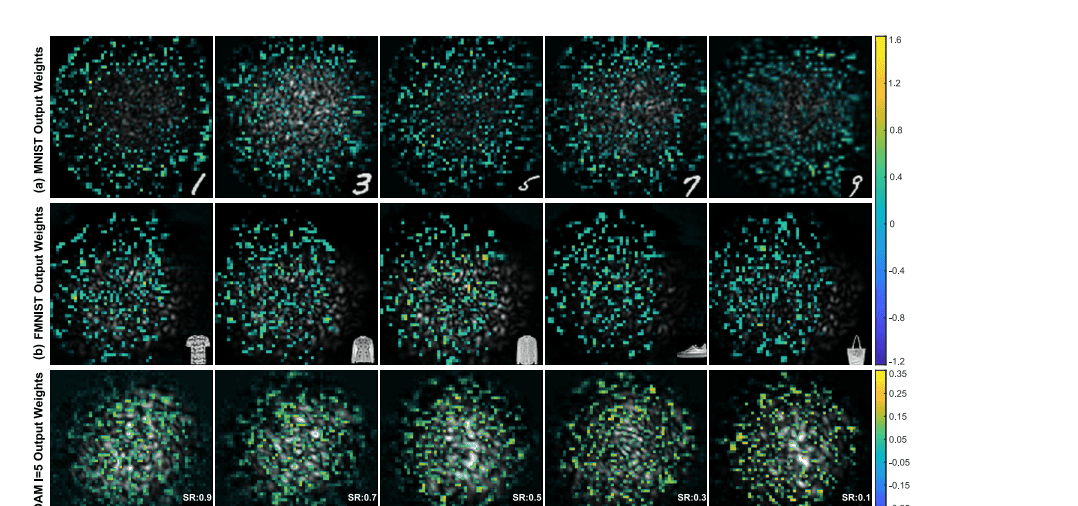
Scientists have achieved a breakthrough in optical communication by developing a physically optimized reservoir for classifying optical signals, demonstrating a system that outperforms conventional methods in challenging conditions. The team established a set of design principles, revealing that recurrent dynamics are optimal for structural data, while high mode-mixing is superior for textural data, allowing them to tailor the system’s performance to specific data types. Experiments revealed a clear relationship between the reservoir’s physical parameters and classification accuracy. Increasing spatial complexity through externally induced mode mixing boosted performance on the FMNIST dataset, while providing no benefit for the MNIST dataset.
Utilizing a larger fibre core, which supports the greatest number of modes, yielded the highest performance for both datasets, and an optimal interaction length of 1m was identified. Implementing a feedback loop within the reservoir significantly enhanced performance, elevating MNIST accuracy to 96. 5% with 6dB of attenuation. This research delivers a practical solution for turbulence mitigation, outperforming an ideal modal decomposition by an average of 20. 32% to 3. 00% in moderate to high-turbulence regimes. The breakthrough reframes the optical receiver as a physical processor, offering a path towards significantly reduced digital signal processing burdens.
Turbulence Mitigation via Fibre Reservoir Design
This research demonstrates a new approach to mitigating the effects of atmospheric turbulence on free-space optical communication, achieving improved performance compared to conventional methods. Scientists successfully designed and experimentally validated a multimode fibre reservoir, physically configured to classify optical signals even under turbulent conditions. By treating turbulence as a textural feature, the team optimised the fibre’s internal dynamics to enhance signal recognition, resulting in an average performance increase of over 20% in moderate to high turbulence. This work represents a shift in the design of optical machine learning systems, moving away from complex algorithmic training and towards intelligently configuring the physical hardware itself. The team highlights that by carefully adjusting the fibre’s properties, such as mode mixing, they can create a system tailored for specific tasks with reduced complexity and power requirements. This research establishes a framework for co-designing physical hardware with machine learning algorithms, paving the way for simpler, more robust systems suited to real-world challenges.
👉 More information
🗞 Intelligent Mode Sorting in Turbulence with Task-Dependent Optical Neural Networks
🧠 ArXiv: https://arxiv.org/abs/2509.20818


